In December 2024, the fall of Syria’s regime unlocked the gates of Sednaya and other notorious detention centers, exposing the machinery of disappearance that defined five decades of authoritarian rule. This investigation reconstructs how the former government operated a nationwide archipelago of prisons and intelligence branches where torture, starvation, and executions were not isolated abuses but state policy.
The investigation shows that Syria now faces a historic choice: to preserve and protect the evidence of detention crimes as the foundation of justice and reconciliation, or to let silence erase history and sow the seeds of renewed violence.
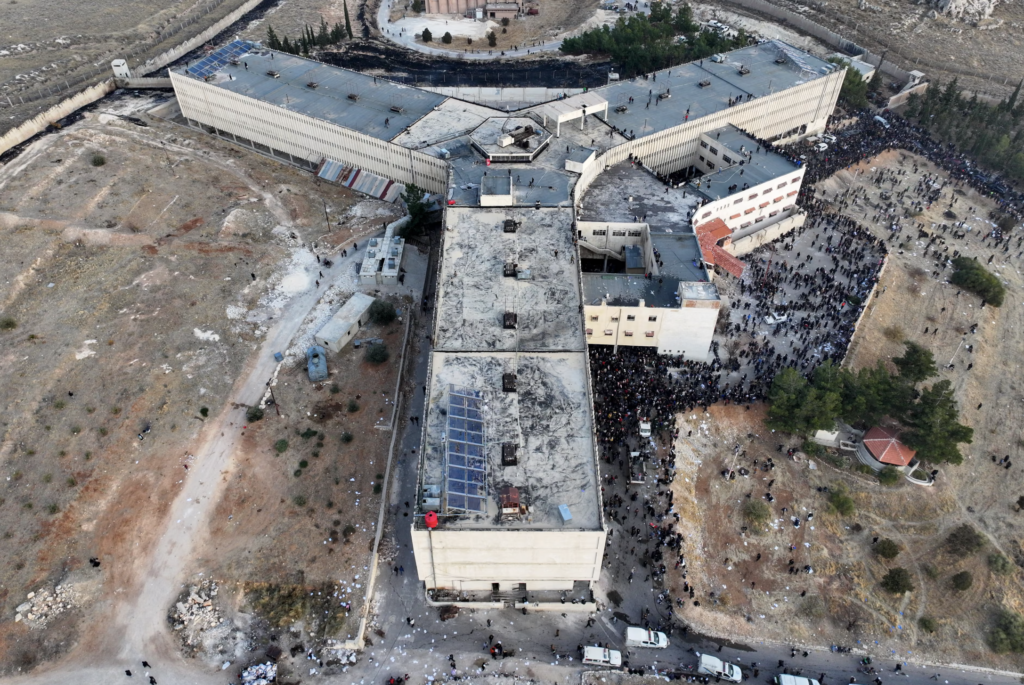
People gather outside the prison on 9 December.
By Ali Al Ibrahim
On a freezing morning in December, Mariam Al Rami (49 years) clutched a faded photograph of her son at the gates of Sednaya prison. Her hands trembled as she held the picture close to her chest of a boy of nineteen in his graduation suit, smiling awkwardly into the camera. It was the last image she had of him before security men came to their house in Homs one night in 2013 and took him away.
For more than a decade she searched: bribes to officers, endless queues outside military courts, whispered promises from intermediaries who claimed they could deliver news in exchange for cash. Each time the answer was the same: “He is not here.”
When the regime fell and Sednaya’s iron doors swung open, she believed the waiting was finally over. She traveled to Damascus with her husband, clutching bags of food and blankets, preparing to welcome her son back into life. But when the prisoners stumbled out skeletal men with hollow eyes, some carried by their cellmates he was not among them.
“I thought I would see him walk through those doors,” she told me, her voice breaking. “Instead, I saw other people’s sons. Not mine. Now I know he is in the ground somewhere. But I don’t know where.”
Around her, hundreds of families combed through piles of discarded documents strewn across the prison floor. Mothers and fathers bent over pages, searching for names scribbled in ink or stamped with numbers. Some cried out when they recognized handwriting or initials. Others fell silent, clutching fragments of paper as if they were relics.
For Mariam, the photograph in her hand remained all she had.
At dawn on December 8, 2024, the iron gates of Sednaya prison creaked open. From the hilltop fortress once synonymous with secrecy and fear, gaunt figures stumbled into the cold air, blinking against a freedom they had long believed impossible. Families crowded outside detention centers across Syria, clutching photos and lists of names, praying for a glimpse of loved ones lost to the labyrinth of the security state. Some were reunited after years of silence. For tens of thousands of others, the wait ended only in despair: the doors opened, but no familiar face emerged.
In the weeks that followed, the ruins of Syria’s detention empire began to surface. Burnt documents in intelligence offices, bodies unearthed in mass graves outside Damascus, and the testimonies of survivors finally willing to speak without fear of reprisal offered fragments of a system deliberately engineered to crush dissent and erase human beings without trace.
This investigation draws on those fragments thousands of pages of newly accessed records, the UN Commission of Inquiry’s most extensive findings, satellite evidence, and exclusive survivor interviews to reconstruct how the detention archipelago functioned as both a tool of repression and a driver of war.
But this story is not just about the past. With archives, graves, and survivor memories now precariously exposed, Syria faces a stark choice: allow evidence to decay and history to be rewritten by those who profit from silence, or protect, document, and confront the truth as the foundation of any durable peace.
In December 2024, over 200 survivor and family testimonies were gathered through structured, trauma-informed interviews. Each account was systematically cross-referenced with the UN Commission of Inquiry’s database of more than 2,000 witness statements, as well as with records recovered from abandoned intelligence branches.
To verify the existence and scale of mass graves, high-resolution satellite imagery from commercial providers was analyzed and compared against survivor timelines. Excavation patterns at Najha and Qutayfa matched witness accounts of clandestine burials, findings that were further confirmed by independent geospatial experts.
On December 9, 2024, I conducted direct field visits to Sednaya Prison and several deserted intelligence compounds around Damascus. Inside these sites, I documented burned files, graffiti etched by detainees, and rooms still marked by instruments of torture. These physical traces provided rare material evidence that was matched against survivor testimonies and archival records.
Leaked administrative documents including intake logs, transfer lists, and falsified death certificates were subjected to metadata authentication and compared with survivor narratives to reconstruct chains of detention and disappearance. In parallel, open-source photographs and videos from newly accessible detention centers were analyzed using forensic visual verification techniques to confirm authenticity and provenance.
Saydnaya was for decades administered by the Syrian military police and military intelligence, with construction beginning in the early 1980s. The first detainees arrived at the 1.4 sq km facility in 1987 – 16 years into the rule of President Hafeez al-Assad, Bashar’s father.
Once fully operational the prison contained two main detention facilities. The White Building was, according to rights groups, mainly built to hold military officers and troops suspected of being disloyal to the regime. It was an L-shaped complex in the south-east of the sprawling complex.
The Red Building – the main prison – was for opponents of the regime, initially comprising those suspected of membership of Islamist groups. This wing was noted for its distinctive Y-shape, with three straight corridors spreading out from a central hub.
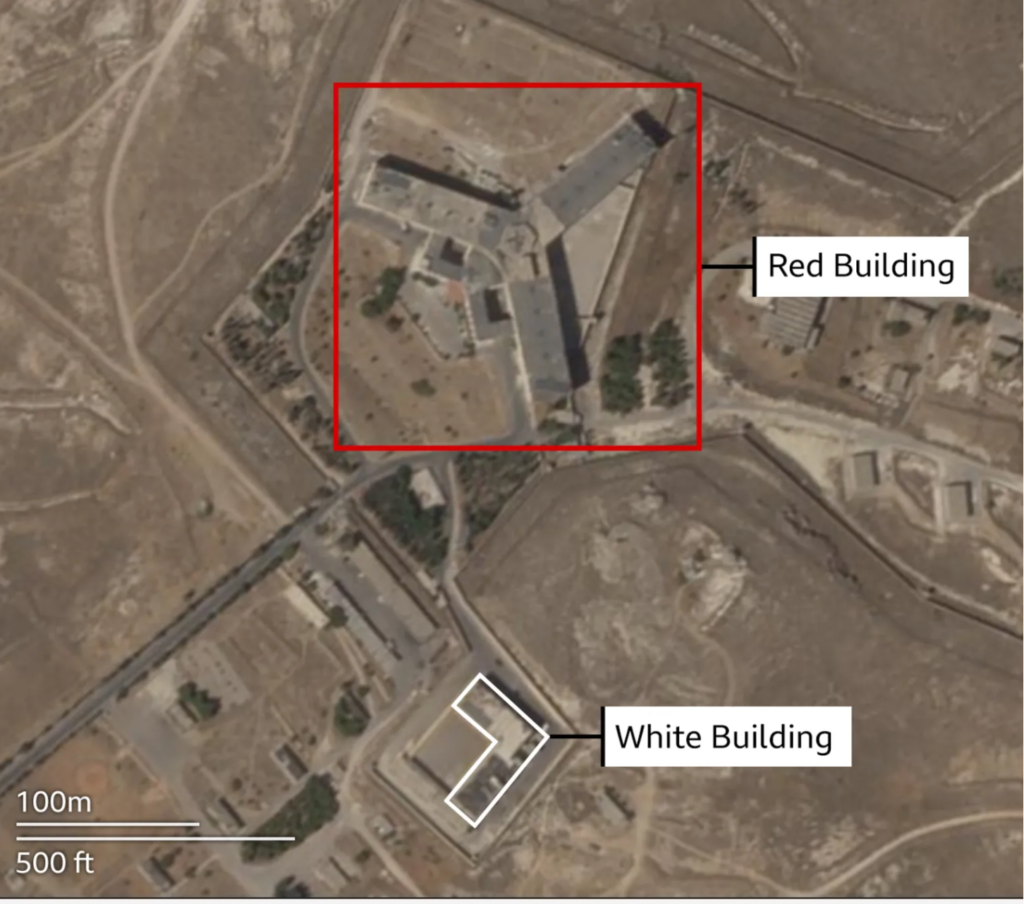
Around 10,000-20,000 people could be housed between the two buildings, according to rights groups.
Families search
Throughout Syria’s war, which began in 2011, security forces held hundreds of thousands of people in detention camps where international human rights organisations said abuses were rampant. Families were often told nothing of the fate of their loved ones.
As rebels seized one city after another in a blistering eight-day campaign, prisons were often among their first objectives. The most notorious prisons in and around Damascus itself were finally opened on the uprising’s final night and the early hours of Sunday.
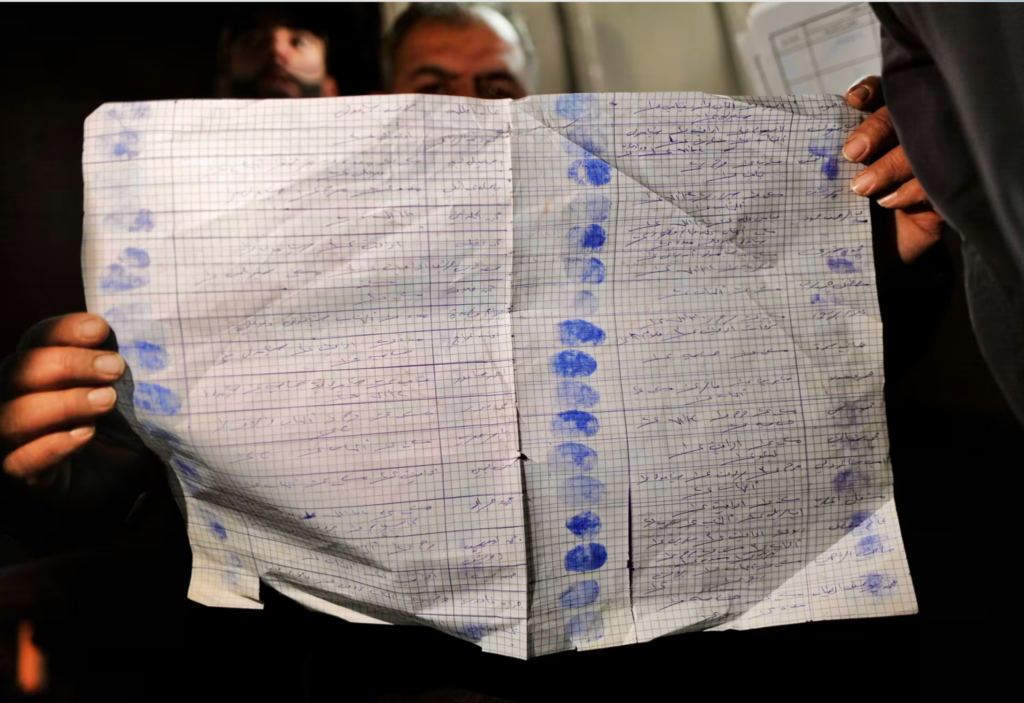
Outside the building itself a hulking, brutalist cube in dilapidated off-white crowds of mostly men gathered, some of them shouting to ask whether anyone had seen their sons, brothers or uncles believed detained by the regime. One of these men, a self-appointed organizer, called out names from a filthy document apparently recovered from one of the administrative rooms.
These documents littered the floor, a concern for international legal scholars who have stressed the importance of maintaining these records for use as evidence of these crimes.
Throughout the decades of the Assads’ rule, resistance of any kind was brutally quashed, and offenders were detained and tortured in a network of dozens of facilities across the country. Sednaya was the most infamous. Built in the late eighties, on a barren limestone hilltop forty minutes from downtown Damascus, it acquired such a fearsome reputation that many Syrians refused to utter its name aloud. In the first days of the war, I visited the hills nearby and spotted the complex.
Since then, as the war intensified, the prison became, by all accounts, even more terrible. When Sednaya was liberated, last weekend, some of those freed had been there for decades. One inmate had reportedly been imprisoned since 1981; he had entered as a young man of twenty-seven and emerged, a ghastly Rip Van Winkle, at seventy.
The Human Rights Data Analysis Group, an independent scientific human rights organization based in San Francisco, has counted at least 17,723 people killed in Syrian custody from 2011 to 2015 around 300 every week almost certainly a vast undercount, it says.
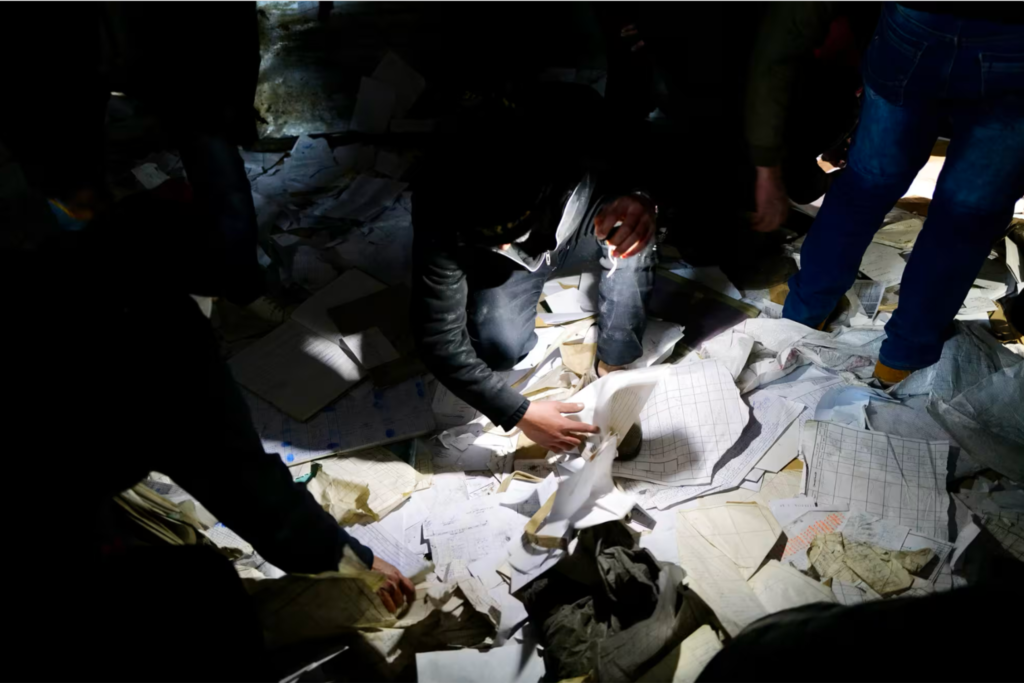
People scour through documents strewn across the floor of Sednaya Prison on 9 Dec 2024.
For the family members who have come to Sednaya after enduring years with no news about their fathers, brothers, sons, and nephews any bit of evidence stirs a despairing hope, which shows plainly in their body language and on their faces. The crowd that gathered around the Turks shovelling at the floor resembled relatives of people buried in earthquakes; they watched avidly, helplessly, for any indication of life. Other visitors wandered through cellblocks, some stooping to examine the documents on prison stationery that lay everywhere.
All across Syria, families wept as they were reunited with children, siblings, spouses and parents who vanished years ago into the impregnable gulag of the al-Assad dynasty’s five-decade rule.
Al-Assad fled Syria as rebels swept into the capital, bringing to an end five decades of brutal rule by him and his father over a country ravaged by one of the deadliest wars of the century.
According to the Syrian Network for Human Rights database, at least 181,312 individuals, including 5,332 children and 9,201 women (adult females), remain forcibly disappeared in Syria between March 2011 and April 2025. Of these, 160,123 individuals, including 3,736 children and 8,014 women (adult females), are in detention centers run by the former Bashar al-Assad regime.
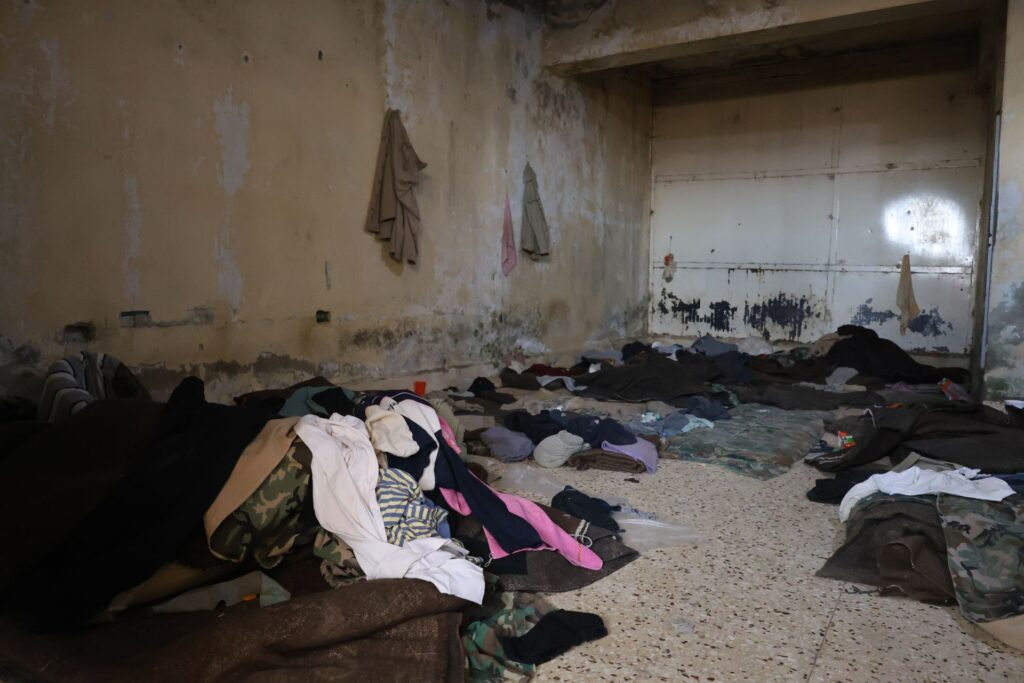
Inside a cell at Sednaya Prison, a pile of clothes and bedding have been left behind by liberated detainees.
Inside the Archipelago
When Syrians spoke of al-far‘ “the branch” they didn’t need to specify which. Everyone knew it meant one of the sprawling network of intelligence directorates and their secret prisons that became the black spine of the state. Each arrest was an entry ticket into a labyrinth without exits: men and women shuffled between basements, courtyards, and corridors where the law never applied.
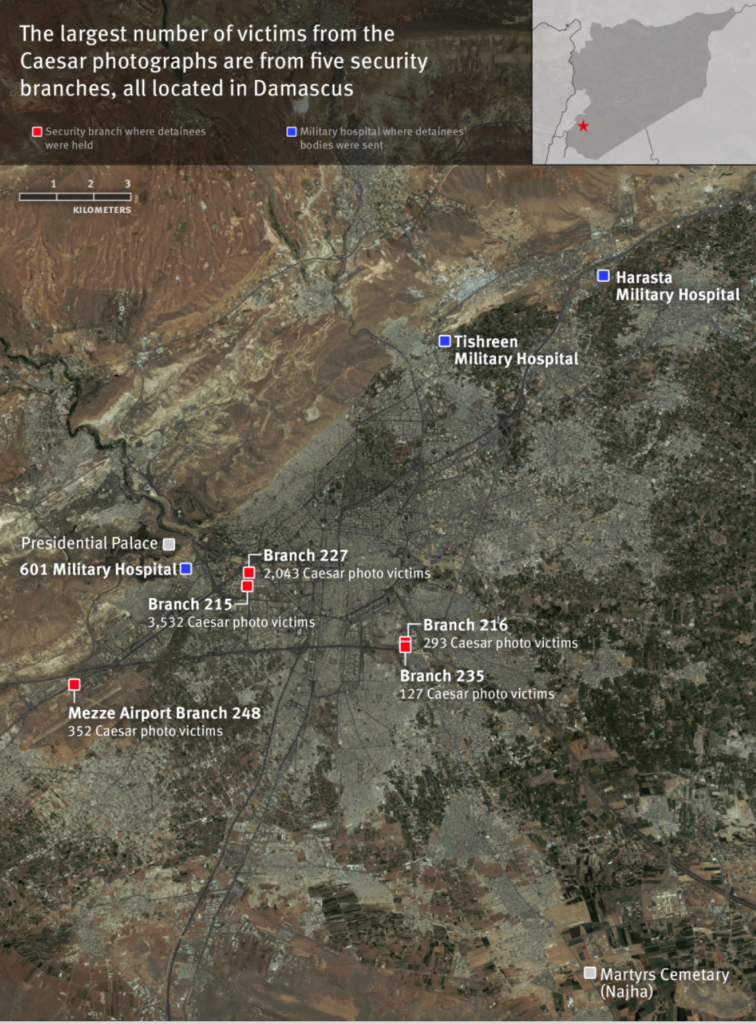
At the top of this machinery stood the four intelligence services: Military Intelligence, Air Force Intelligence, General Intelligence, and Political Security. Around them orbited dozens of detention facilities, field courts, and military hospitals. This overlapping structure was intentional. A detainee could vanish in Branch 235 (“Palestine”), resurface months later in Sednaya, and disappear again after a mock trial that lasted less than five minutes.
“They wanted you lost on the web,” said Khaled, a 29-year-old teacher from Dar‘a who was released in December. “Every time my family asked about me, they got a different answer. Sometimes I was in Branch 215, sometimes I had already died. The truth was, I was being moved back and forth like a file in a drawer.”
The Branches of Fear
- Branch 215 (Raids Branch): Known for mass intake after neighborhood sweeps in Damascus. Survivors describe rooms so crowded that “people slept in shifts, standing with their backs against each other.”
- Branch 227: Oversaw arrests in the capital’s suburbs. Torture survivors say the walls were blackened with soot from burned bodies and papers destroyed before investigators arrived in January 2025.
- Branch 235 (“Palestine” Branch): Among the deadliest. Witnesses told investigators that corpses would be piled in hallways until trucks from nearby military hospitals hauled them away at night.
- Sednaya Military Prison: The final station for many. Survivors recall executions by hanging, carried out weekly, often after detainees were marched through sham “field courts” without defense or evidence.
At the center of Syria’s detention machine stood the National Security Office (Maktab al-Amn al-Qawmi), a shadowy body that linked the sprawling network of intelligence branches directly to the presidency. Testimonies and UN Commission findings show that the Office was not merely coordinating but actively directing arrests, interrogations, and transfers. Orders flowed downward from the President’s inner circle through the National Security Office into the Military Intelligence, Air Force Intelligence, General Intelligence, and Political Security branches. This vertical chain of command ensured that what happened in the basements of Branch 215 or inside the execution chambers of Sednaya was never the work of “rogue officers,” but part of a state policy sanctioned at the highest level. By embedding the machinery of repression within a centralized office tied to the presidency, the regime institutionalized disappearance and torture as tools of governance, binding every arm of the security apparatus into a single web of impunity.
Paulo Sérgio Pinheiro, Chair of the UN Commission of Inquiry on Syria, told InDepthReports:
“These crimes were not the work of a few officers. They were state policy, coordinated across agencies. If Syria ignores this legacy, impunity will simply plant the seeds of future violence.”
In the Commission’s dataset, 26% of interviewees reported experiencing enforced disappearance; 30% were tortured; and nearly one in three lost a relative to in-custody death. These were not isolated abuses but systematic policies.
“Every four days a prisoner would die,” said one survivor from Branch 235. “We learned to stop asking the guards for medicine. Their answer was always the same: ‘Tell us when he is dead.’”
The Machinery of Death
The machinery of death did not end inside the cells. Once prisoners succumbed to torture, starvation, or disease, their bodies were transferred to military hospitals such as Mezzeh 601 and Tishreen. These institutions, ostensibly places of healing, became cogs in the state’s apparatus of disappearance. Doctors and clerks issued falsified death certificates, citing causes like “heart failure” or “respiratory arrest,” while the real injuries—shattered bones, burns, mutilation—were erased from the record.
One former hospital employee who fled Syria recalled:
“The orders were clear: we did not see individuals, only numbers. Bodies arrived by the truckload, tagged with digits, stamped with paperwork, and moved on to mass graves. We were told never to write the truth.”
By channeling corpses through hospitals, the regime gave its killing machinery a bureaucratic façade. Families who pressed for answers often received official papers confirming a “natural death,” a cruel deception designed to deny both justice and mourning. This systematic use of hospitals to launder the evidence of mass killings underscores how deep the architecture of disappearance reached—bridging prisons, courts, and medical institutions under one state policy of erasure.
Detainee transfers often ended at military hospitals like Mezzeh 601 or Tishreen, where death was formalized with falsified certificates. From there, refrigerated trucks carried bodies to mass graves in Najha and Qutayfa. Satellite images later confirmed soil disturbances consistent with large-scale burials during peak killing years, especially between 2012 and 2018.
One former intelligence officer, now in hiding, testified in a European court that he helped supervise burials in Najha: “Hundreds of bodies arrived at once. We dug trenches at night. No names, no records just numbers.”
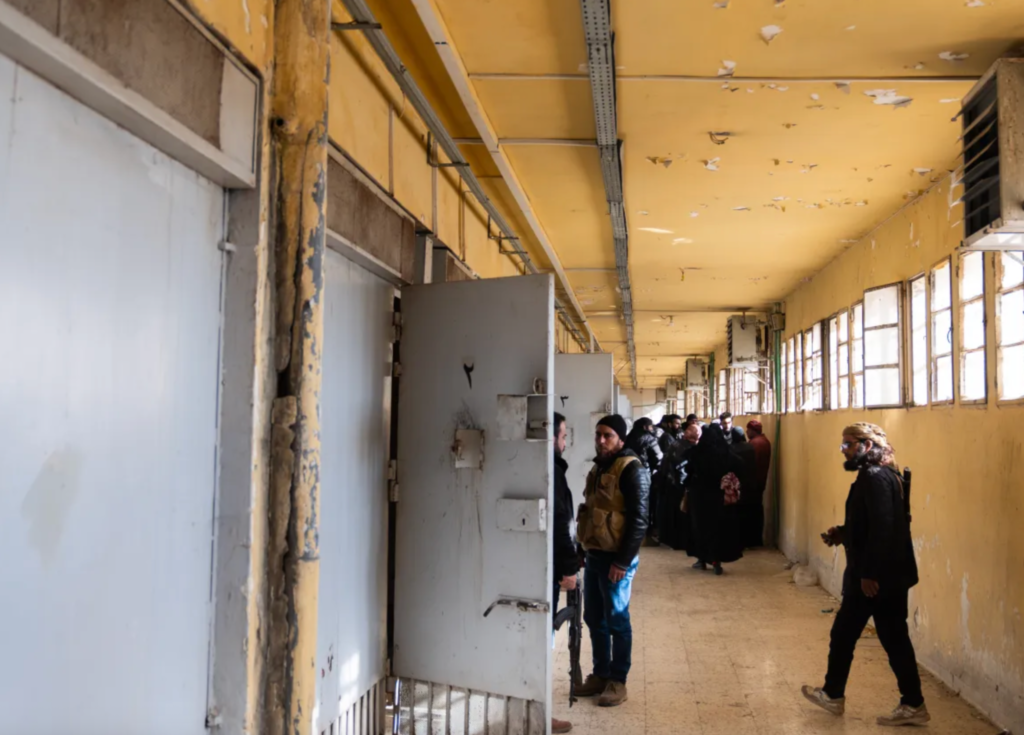
In 2017, Amnesty International accused Syrian authorities of “quietly and methodically” killing detainees at Sednaya Prison.
The Human Cost
Behind every statistic lies a body, a name, a family. For survivors, release did not end the nightmare it simply moved it outside the prison walls.
Torture as Routine
The lexicon of torture in Syria became infamous even beyond its borders:
- Al-Shabeh: prisoners suspended by their wrists for hours, shoulders dislocating under their own weight.
- The Dulab: shoved into a car tire, limbs twisted unnaturally, beaten with sticks and cables.
- The German Chair: a metal device bending the spine backward until vertebrae cracked.
- Bisat al-Rih (“Flying Carpet”): a hinged board where victims were strapped and bent until ribs or bones snapped.
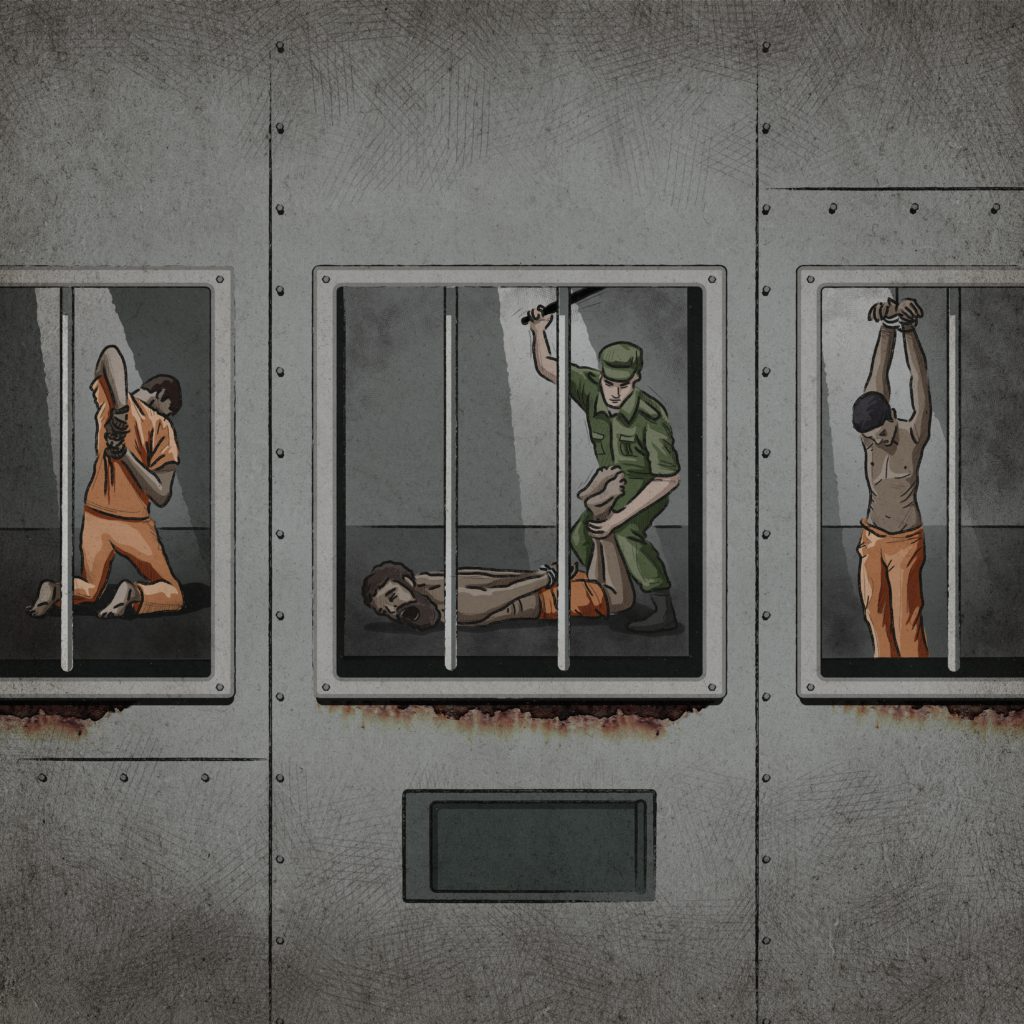
“They made me sit in the German chair for 40 minutes,” recalled Mahmoud, a former university student. “I heard my back break. They laughed and said: ‘Now you are taller.’ I have not been able to walk straight since.”
Sexual violence was another weapon, wielded not just against women but against men and boys. Survivors told of rape, mutilation, forced nudity, and humiliation designed to erase dignity.
Hunger and Filth
Food was weaponized. Former detainees described a diet of spoiled jam crawling with insects, bread too hard to chew, and sometimes only two olives per day.
“We swallowed the pits to trick our stomachs,” said Samer, who spent nine months in Branch 248. “In my cell, people fought over potato skins.”
Disease was rampant. With no medical care, wounds festered, infections spread, and the weak were left to die. Corpses sometimes remained in cells for days.
Families in Perpetual Limbo
While survivors carry physical scars, families of the disappeared live in limbo. Mothers and fathers waited outside prisons year after year, clutching bribes and paperwork, always told their sons were “not here.”
Um Rami, a mother from Homs, still waits: “When Sednaya opened in December, I thought I would see my boy. Instead, other people came out. Not him. Now I know he is on the ground, but I don’t know where.”
The Commission estimates 34,000 deaths in custody since 2011. But the real number may be higher; tens of thousands more remain unaccounted for.
The Graves of Silence
The prisons were not the final destination. Death inside the branches triggered a macabre chain of logistics designed to erase evidence while preserving control.
From Cell to Hospital
When detainees died under torture, starvation, or disease, their bodies were not returned to families. Instead, trucks ferried them to military hospitals such as Mezzeh 601, Tishreen, and Harasta 600. There, doctors and clerks became cogs in the machinery of disappearance.
- Death certificates were issued with falsified causes “heart failure,” “respiratory arrest,” or “sudden illness.”
- Bodies were stripped of names, tagged with numbers, and loaded again for their final journey.
“We were told not to look at the faces,” testified a former hospital worker who later fled Syria. “The orders were clear: process, stamp, and move on. They were not people, just numbers.”
Najha: The Valley of the Disappeared
South of Damascus, in the dusty outskirts of Najha, mass graves began to expand in 2011. Former intelligence officers told investigators that trenches were dug at night. Refrigerated trucks arrived from hospitals, unloading hundreds of bodies at a time. Satellite images from 2011–2013 reveal significant earth disturbances, consistent with the burials described by witnesses.
Lynn Welchman an expert in international law, stressed:
“Every mass grave is not just a site of mourning; it is a crime scene. If properly preserved, it can one day deliver answers to families and evidence for justice.”
Families were later told, quietly, that “their sons” were buried there. No graves marked, no remains returned.
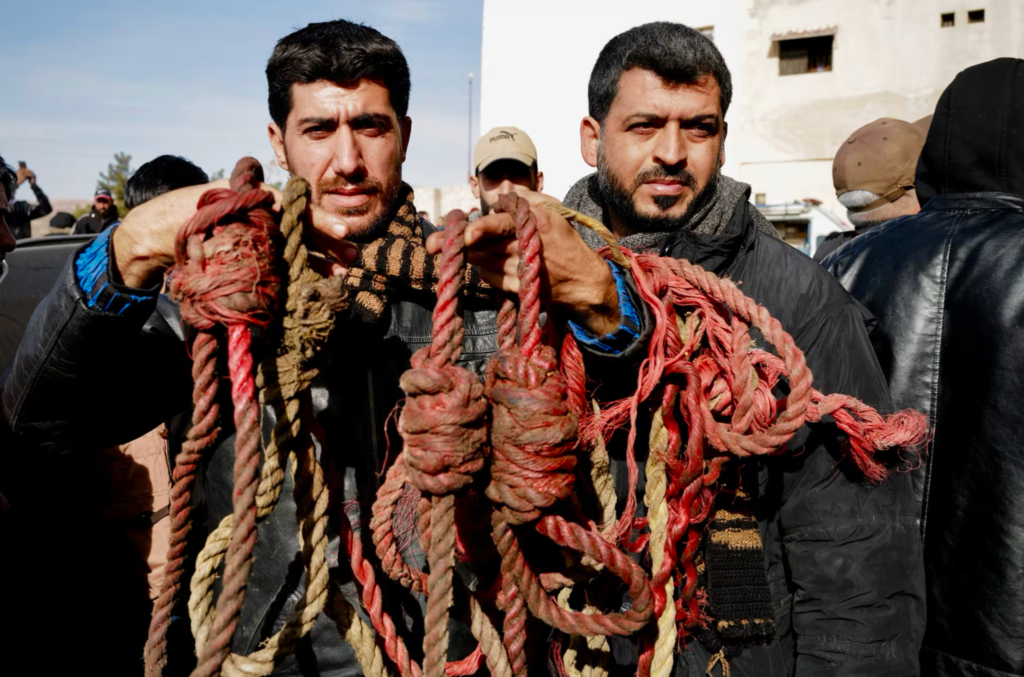
Men hold nooses found at Saydnaya military prison near Damascus on Tuesday.
Qutayfa: Hidden Under the Pines
North of Damascus, the Qutayfa military zone, controlled by the 3rd Division, became another silent cemetery. Bodies from Sednaya and hospitals were delivered under cover of darkness. UN satellite analysis showed fresh excavation between 2014 and 2019. Former insiders estimate thousands lie beneath the soil.
“We buried them in layers,” said one ex-officer who testified in a European court. “Hundreds at a time. Sometimes more.”
Numbers Without Names
The UN Commission estimates tens of thousands buried in Najha and Qutayfa alone. But these are only two known sites. Families suspect dozens of other hidden burial grounds across Syria, from Aleppo to Homs.
For survivors, this absence of graves is a second cruelty. Um Khaled, who lost two sons, told InDepthReports:
“They say the dead are at peace. But how can I have peace when my boys are in the dirt without names, without prayers, without me knowing where?”
The Courts of No Justice
For thousands of Syrians, their final encounter with “justice” came not in a courtroom but in a dimly lit corridor inside a military compound. The so-called Military Field Courts, established under emergency law, functioned as conveyor belts to execution rather than instruments of law.
Trials in Minutes
Detainees were hauled before a panel of officers, sometimes just one, without lawyers, without evidence, without even being told the charges. Hearings lasted no longer than a few minutes.
“They asked me three questions: my name, my father’s name, and whether I belonged to an opposition group,” recalled Rashid, a 41-year-old engineer who survived. “I said no. They sent me back to my cell. My cellmate who said yes never returned.”
Many prisoners didn’t even realize they had been tried. Only later did they understand that the short exchange had sealed their fate.
From Verdict to Rope
Sentences, often death by hanging, were carried out inside Sednaya Military Prison. Survivors describe mass executions conducted at night, bodies stacked in trucks before dawn. Amnesty International once called Sednaya a “human slaughterhouse.” The UN Commission’s new access confirms that executions there were systematic, and part of a broader state policy.
Bureaucracy of Death
The process was disturbingly bureaucratic:
- A quick “trial” in a field court.
- Transfer to Sednaya.
- Execution by hanging, sometimes dozens at a time.
- Transport of bodies to hospitals for numbering.
- Night burials in Najha or Qutayfa.
This was not rogue behavior by a few officers; it was an institutionalized system where judges, officers, doctors, and clerks all played their part.
Justice Denied
The field courts were formally abolished in 2023, but not before sending thousands to their deaths. Families rarely received notice. Instead, years later, some were handed a death certificate with a date of death matching their loved one’s disappearance.
“It was justice only for the state,” said Faten, whose husband disappeared in 2015. “For us, it was a death machine.”
The Survivors and the Silence
When the prison doors swung open in December 2024, survivors stepped into a world they no longer recognized. Some had been gone for a decade. Their children had grown up without them. Their homes were destroyed or occupied. Their bodies, bent and scarred, carried the evidence of years in the cells.
A Syrian human rights lawyer now living in exile explained:
“For years, survivors begged for recognition. Today, we finally have a chance to write their truth into history. If we fail, silence will become another form of violence.”
Living with Trauma
Nightmares, chronic pain, and psychological wounds are now part of daily life. Survivors describe being unable to sleep in closed rooms, panicking at the sight of uniforms, or collapsing at the smell of disinfectant that recalls interrogation halls.
“I was released, but the prison is still inside me,” said Nizar, a former detainee from Hama. “When I close my eyes, I hear the screams again. Freedom is harder than captivity.”
Many survivors suffer untreated injuries broken bones that never healed, blindness from beatings, infertility from sexual torture. Medical care is scarce, and stigma silences their voices.
Social Stigma and Isolation
Communities sometimes treat survivors with suspicion, fearing they may have “confessed” under torture or collaborated to survive. Women survivors face an added layer of shame; some are rejected by families or forced into silence about sexual violence.
“When I told my family what happened, they told me never to repeat it,” said Rania, who spent six months in Branch 227. “They think silence will protect me. But silence is another prison.”
Families Still Waiting
For the families of those who never came home, the silence is heavier. Thousands of mothers and fathers stood outside detention centers this winter, holding faded photographs. For many, their wait ended not with reunion but with the knowledge that their loved ones were buried in Najha or Qutayfa.
The UN Commission estimates at least 34,000 people died in custody, but tens of thousands remain unaccounted for. Each absence is a wound in the social fabric, a constant reminder that the conflict is not over.
A Threat to Peace
Without recognition, care, and justice for survivors, Syria’s transition risks collapse. Trauma fuels resentment; silence breeds mistrust. If survivors’ voices are ignored, reconciliation becomes a hollow slogan.
“Those who died are at peace,” said a father in Dar‘a. “It is we, the living, who suffer more.”
Evidence and the Road to Justice
The collapse of the former government opened a rare and fragile window: detention centers unlocked, archives abandoned, mass graves left exposed. Whether Syria moves toward peace or slides back into cycles of revenge depends on what happens to this evidence.
Safeguarding the Crime Scenes
When investigators entered former intelligence branches in Damascus in January 2025, they found piles of ash where documents had been burned and yet, significant caches of records survived: intake logs, transport lists, fragments of interrogation notes. If preserved and analyzed, these can form the backbone of future accountability.
Mass graves in Najha and Qutayfa are now protected by caretaker forces, fenced off to prevent tampering. The UN Commission warns that without forensic exhumations, vital DNA evidence may decay beyond use. Families are calling for international experts to conduct dignified excavations and identifications.
“Every bone has a name,” said Um Lina, whose daughter disappeared in 2014. “If they protect the graves, maybe one day I will know where she is.”
Building a Unified Registry
Scattered records exist across multiple agencies, hospital death logs, court rulings, prison intake registers. Combined with family testimonies and DNA sampling, they could form a national registry of the disappeared. Such a registry would serve not just as a record, but as recognition transforming “missing” into documented human lives.
Survivors as Witnesses
The testimonies of freed detainees are among the most powerful forms of evidence. More than 550 survivors have already been interviewed by the UN Commission since 2011. But with fear of reprisals now lifted, thousands more may be willing to speak. Documenting their voices, with trauma-sensitive protocols, is urgent.
The Justice Pathways
- Universal Jurisdiction: European courts in Germany and France have already convicted former Syrian officials for crimes against humanity. Expanding such cases remains vital.
- Domestic Accountability: With international support, Syria’s caretaker authorities could establish hybrid courts or truth commissions where survivors and families play a central role.
- Truth-Telling Mechanisms: Beyond trials, public acknowledgment naming branches, publishing lists of the dead, and memorializing sites can restore dignity and prevent denial.
“Justice is not revenge,” said Khaled, a released teacher from Dar‘a. “Justice is when my son learns the truth of what happened, so it will never happen again.”
From Silence to Peace
The fall of the detention empire did not end Syria’s agony. It merely revealed its depth. In basements thick with the stench of death, in fields where bones lie hidden, in the trembling voices of survivors, the country confronts the legacy of a system built to erase its own people.
If ignored, these scars will fester. Without acknowledgment, survivors will carry their silence alone, and families will never heal. Without justice, the cycle of abuse risks repeating, fueled by bitterness and denial.
But there is another path. By protecting archives, preserving mass graves, documenting survivors’ testimonies, and creating credible justice mechanisms, Syria can transform evidence of horror into foundations for peace.
Journalism’s Role in Peace
This investigation shows that uncovering truth is not an act of vengeance, it is an act of peacebuilding. Journalism can give voice to the silenced, preserve memory against erasure, and press authorities and international actors to act before it is too late.
“Peace is not the absence of war,” said a survivor who spent seven years in Sednaya. “Peace is when mothers no longer wait by prison gates.”
For Syria, peace will not be built on forgetting. It will be built on truth, dignity, and the determination that never again will human lives be ground into numbers in secret cells.
A transitional justice expert at the International Center for Transitional Justice (ICTJ) summarized:
“Peace without justice is only a ceasefire. If Syria wants to break the cycle of authoritarianism, it must start by naming the disappeared and holding perpetrators accountable.”
The choice now lies before the new Syria: bury the past in silence, or confront it to build a future where respect for human life is the foundation of reconciliation.
In parallel with international efforts, Syrian civil society groups have already begun organizing to protect the fragile traces left behind. Associations of families of the disappeared, including the Caesar Families Association and the Coalition of Families of the Missing, have called for immediate safeguarding of archives and forensic protection of mass graves.
Dr. Anwar al-Khatib, a transitional justice researcher who has worked closely with Syrian family associations, told InDepthReports:
“Truth is not just memory it is disarmament. Every testimony recorded, every grave preserved, every archive protected dismantles part of the machinery of violence. Without this, peace will be nothing more than a fragile ceasefire. But if we anchor Syria’s future in truth, we are laying the first real stones of sustainable peace.”
In January 2025, a network of local activists launched a pilot initiative to compile a unified registry of the disappeared, combining survivor testimonies with DNA samples voluntarily submitted by relatives. These efforts, though fragile and underfunded, show that Syrian society itself is demanding truth not only as a form of justice, but as a bridge toward reconciliation and the prevention of future cycles of violence.
“No peace can hold if mass graves remain hidden,” said David Tolbert, former president of the International Center for Transitional Justice. “Acknowledging and investigating detention crimes is not only about justice — it is the cornerstone of reconciliation.”
In a final reflection, Dr. al-Khatib added:
“This investigation itself is part of that struggle. It is not just journalism — it is prevention. By unearthing Syria’s buried truths, it seeks not only to honor the dead and comfort the living, but to build a barrier against the repetition of such crimes. Truth here is not memory alone; it is the first practical step toward a peace that cannot be undone.”