The Pakistan–Afghanistan crisis: causes, timeline, the agreement/ceasefire, actors, human impact, verification, and policy recommendations.
Executive summary (TL;DR)
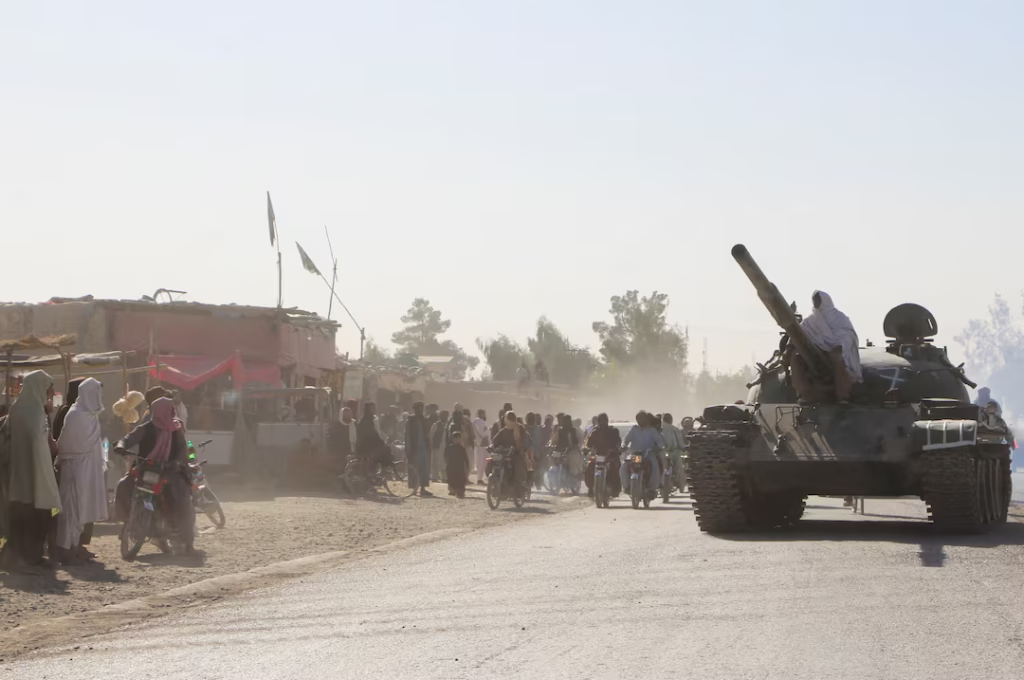
In October 2025 a rapid escalation of violence between Pakistan and Taliban-ruled Afghanistan — including cross-border exchanges of fire and Pakistani airstrikes inside Afghan territory — produced the most serious clashes between the neighbours since 2021. The immediate drivers were Islamabad’s accusations that militant groups based in Afghanistan (notably the Tehrik-e-Taliban Pakistan, TTP) were carrying out deadly attacks inside Pakistan, and Pakistan’s response with strikes and border operations. After a week of intense fighting and mounting civilian casualties, mediators Qatar and Turkey brokered a ceasefire in Doha on 18–19 October; both sides committed to refrain from hostile actions and from supporting anti-state groups, and agreed follow-up talks (Istanbul, 25 October) and monitoring arrangements to prevent re-escalation.
1. Background — longstanding fault lines
- Historical ties and ambiguity: Pakistan historically cultivated links with Afghan militant and political actors to secure strategic depth and manage Pashtun nationalism — a strategy that produced complex relationships with networks such as the Haqqani Network and factions of the Afghan Taliban. Over decades this produced deep but fraught ties rather than stable control. (Context and analysis in regional reporting.
- Durand Line and border governance: The 2,611-km Durand Line is porous, traversed by trade, refugees and insurgent networks. Both states have long accused each other of failing to control cross-border militants and radical groups. Recent years saw a hardening of Pakistan’s policy — including crackdowns on Afghan refugees and stricter border measures — that increased tensions.
- Key non-state actors: The most immediate threat to Islamabad has been the Pakistan Taliban (TTP) and allied Baloch separatist cells — many leaders and fighters are believed to operate from Afghan border provinces. Kabul rejects systematic allegations of sheltering militants as a state policy, while Islamabad insists safe havens exist. This accusation–counteraccusation set the scene for kinetic responses.
2. Triggering events and timeline (October 2025)
- Early October: Islamabad reported a series of high-casualty attacks inside Pakistan attributed to TTP elements — including a suicide bombing that killed Pakistani soldiers — which Pakistan said originated from Afghan territory.
- 9 October: Pakistani aircraft reportedly struck locations in Kabul, Khost, Jalalabad and Paktika — Islamabad characterized the strikes as targeting verified militant camps and senior TTP figures; Afghan authorities and Taliban sources condemned strikes as violations of sovereignty and reported civilian casualties.
- 10–12 October: Cross-border exchanges of fire intensified across multiple sectors of the frontier (Khyber Pakhtunkhwa, Bajaur, Kurram, Dir, Chitral, and across Balochistan), with both sides announcing casualties and closures of key crossings (Torkham, Chaman), severely disrupting civilian life and trade.
- 12–18 October: Death tolls mounted, humanitarian impact increased, and both governments called for mediation. Pakistan closed some border points; Afghanistan accused Pakistan of further air attacks that killed civilians.
- 18–19 October: Doha talks mediated by Qatar and Turkey produced a mutual ceasefire pledge; defence ministers/spokespersons from each side publicly committed to a truce and to further meetings in Istanbul on 25 October to operationalize monitoring and dispute resolution
3. What did the Doha agreement / ceasefire commit to?
The text publicly reported and briefed in the press did not appear as a detailed treaty, but the core commitments announced were:
- Immediate cessation of offensive actions across the border and a mutual pledge to abstain from hostile acts (air strikes, cross-border raids).
- Mutual commitment not to harbor or support anti-state groups that attack the other side (language focused on not providing safe havens).
- Follow-up diplomacy and monitoring: both parties agreed to further talks (Istanbul, 25 Oct) and to mechanisms for monitoring compliance involving third-party mediators (Qatar/Turkey)
Note on verification: at the time of writing there is no publicly released full bilateral text; media accounts are based on statements by Pakistan’s Defence Minister and Taliban spokespeople and on mediator summaries. The absence of a formal text is common in hurried ceasefires; the practical test will be whether the monitoring mechanism prevents renewed strikes and whether both capitals publicly refrain from escalatory rhetoric.
4. Who are the principal actors and their incentives?
- Pakistan (state): Primary incentive — domestic security and political stability. Islamabad faces a rise in domestic militant attacks (the Pakistani military says hundreds of personnel died in 2025 alone). Pakistan’s options include military action, cross-border strikes, or diplomatic pressure; the leadership also risks deteriorating international standing if strikes result in civilian casualties.
- Taliban government (Afghanistan): Incentive — regime survival, international legitimacy, and internal control. The Taliban government denies being a safe haven for Pakistan’s militants and views external strikes as violations. It must balance retaliatory pressure from local armed groups with avoiding large-scale war with Pakistan. The Taliban also seeks diplomatic recognition and relationships with regional powers (Russia, China, UAE).
- Tehrik-e-Taliban Pakistan (TTP): A primary militant actor behind cross-border attacks on Pakistani targets, seeking to destabilize Islamabad and pursue its fight inside Pakistan. Its presence on Afghan soil (whether tolerated or active) is a focal point of Islamabad’s grievance.
- Third-party mediators (Qatar, Turkey): Act as brokers with stakes in regional stability and diplomatic influence; they hosted the Doha talks that led to the ceasefire commitment.
- Other regional actors (India, Iran, China, Russia): India’s reopening of links with Kabul and other regional realignments add layers to the crisis; Pakistan fears strategic encirclement if Afghanistan draws closer to India. Iran and China have their own security and economic stakes.
5. Humanitarian and economic consequences
- Civilians killed and displaced: Media and local reports indicate dozens dead in Afghan provinces and Pakistan border districts during the exchanges; UN reporting flagged civilian casualties from airstrikes and shelling. Trade routes (Torkham, Chaman) closed, stranding traders and passengers and harming cross-border commerce.
- Refugee and migration consequences: Pakistan’s stricter crackdowns on undocumented Afghans earlier in 2025, and forced returns, have amplified a humanitarian vulnerability. The border fighting added pressure on families and heightened the risk of further displacement
- Regional economic flows: Closure of crossings and insecurity in border provinces disrupts supply chains and local economies that depend on cross-border trade and labor mobility.
6. Legal and normative issues
- Sovereignty vs counter-terrorism: Pakistan justifies cross-border strikes as counter-terror operations; Afghanistan invokes sovereignty and international law. Cross-border airstrikes raise questions of jus ad bellum (lawful use of force) and potential violations if civilian harm occurs without proportionality or distinction.
- Non-state actors and state responsibility: The obligation not to allow one’s territory to be used for attacks against another state is central to Pakistan’s claim; conversely, allegations that Pakistan harbors IS-linked fighters or conducts extrajudicial strikes complicate legal accountability.
- Monitoring and verification mechanisms: Any durable agreement requires robust, neutral verification—something historically difficult on the Durand Line. A reliance on third-party mediators (Qatar/Turkey) can help, but sustainability depends on transparent reporting and credible field monitors.
7. Open questions and evidentiary gaps (for further investigative work)
- Command lines and intelligence: What specific intelligence linked TTP cadres to the targeted locations? Can we verify the presence of TTP leadership in the Afghan sites Pakistan struck? (Pakistan asserts this; Taliban denies.)
- Civilian casualty accounting: Independent verification of civilian deaths from strikes — hospital records, morgue logs, and local eyewitness testimony are needed.
- Backchannels and prior negotiations: Was there pre-existing engagement between the ISI and Taliban leaders about TTP leadership presence? Are earlier confidence-building measures recorded?
- Militant networks’ sponsorship: To what extent do external state or non-state actors enable cross-border sanctuaries (material support, logistics)?
- Implementation of monitoring: Who will staff the monitoring mechanism, what access will they have, and will findings be publicly reported?
8. Sources and methods for a full investigative piece
Primary reporting & verification approaches:
- Field interviews with affected families, border traders, hospital staff, and local administrators on both sides (protected, with safety protocols).
- OSINT: geolocation of strike footage and images; cross-referencing timestamps and metadata.
- Document analysis: military statements, crossing-closure notices, flight/airstrike radar data where available.
- Expert interviews: regional security analysts, international humanitarian law specialists, and analysts on TTP structures.
- Cooperation with regional media partners and humanitarian NGOs for corroboration and access.
Key published sources already reporting major events: Reuters, Financial Times, Al Jazeera, Politico and AP have detailed ongoing coverage; these are primary contemporary reporting sources for timeline and official statements.
9. Draft narrative arc for InDepthReports feature
- Hook: A human story — e.g., a family at a border crossing whose livelihood and safety were destroyed by sudden closure and nearby shelling.
- Context: Short explainer on the Durand Line, the TTP, and Pakistan–Taliban historical ties.
- Sequence: Chronological account of the October escalation (airstrikes → cross-border clashes → closures → Doha ceasefire). (Cite official statements and field testimony.)
- Evidence: OSINT analysis of strike footage, interviews with survivors and medics, and documents showing crossing closures and economic losses.
- Accountability: Explore who ordered what, how militants operate across the border, and whether either side violated international obligations.
- Policy/solutions: Describe feasible confidence-building measures, monitoring options, and steps to protect civilians and restore trade.
- Conclusion: The stakes — a fragile peace with high potential cost for border communities and the region.
10. Policy recommendations (for governments, mediators, donors)
- Immediate: Maintain and operationalize the Doha ceasefire with a transparent monitoring mechanism (third-party observers and public reporting).
- Security: Joint (or mutually agreed) cross-border incident response protocol to avoid tit-for-tat escalation; hotlines between military/intelligence counterparts.
- Intelligence cooperation (carefully limited and transparent): Explore limited intelligence sharing or joint patrols that respect sovereignty and civilian protection obligations.
- Humanitarian: Immediate reopening of key crossings for humanitarian flows and expedited assistance to border communities.
- Longer term: Regional dialogue (including China, UAE, Russia, India as stakeholders where appropriate) to address militant sanctuaries, economic incentives, and refugee status issues; invest in local economic stabilization to reduce militants’ recruitment pool.
11. Suggested next investigative steps (operational plan)
- 72-hour plan: Establish secure contacts with desk reporters and humanitarian actors on both sides; collate official statements and all available media clips of strikes.
- 2-week plan: Deploy a small verification team for OSINT geolocation; remote interviews with witnesses; request hospital records via trusted local partners.
- 1-month plan: Field visit to safe border towns (if security permits), cross-check claims about militant leadership locations, and develop a data-driven map of incidents.
- Deliverables: Long-form feature (5–7k words), a short documentary (8–12 mins), an OSINT dossier with geolocated evidence, and a policy brief.
Final note (editorial)
The Doha ceasefire is a diplomatic reprieve but not yet a structural solution. Durable stability will require credible verification, reductions in cross-border militant sanctuaries, and economic and humanitarian measures to reduce the cycles of violence. For an investigative newsroom, this story is ripe: it combines state behaviour, non-state violence, legal questions about cross-border force, and urgent human consequences — and there is scope for impactful OSINT verification and survivor testimony that could materially shape policy debate.