EU leaders have a packed agenda during their one-day summit on Thursday. European Union leaders have gathered in Brussels for a high-stakes summit.
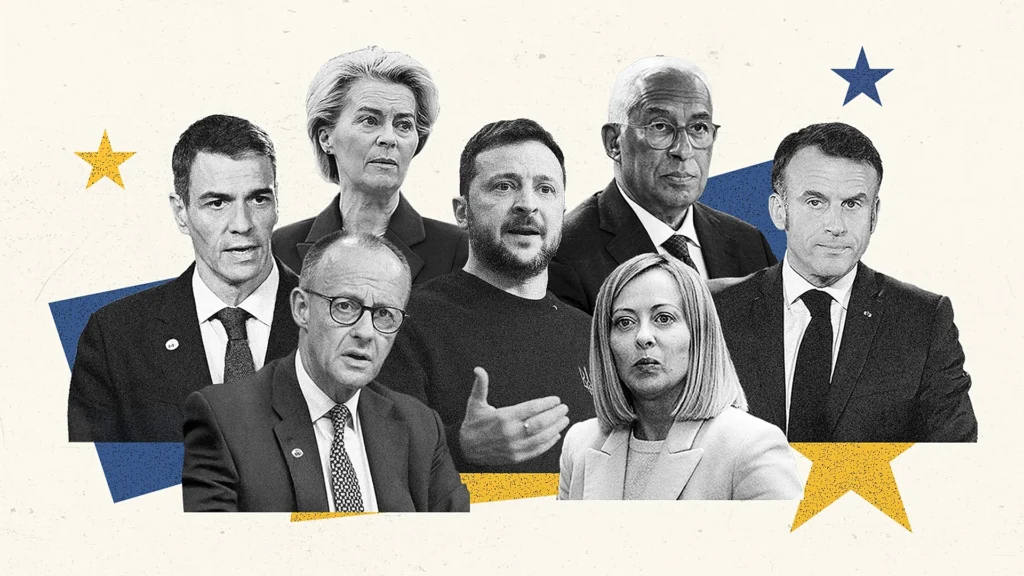
Ukrainian President Volodymyr Zelenskyy, who joined the meeting, welcomed the decisions by the EU and US on Wednesday to slap additional sanctions on Russia. He also made clear that he will accept “no territorial concessions” in peace talks.
One of the thorniest points of discussion will be a bold plan to issue a €140 billion reparation loan for Ukraine using Russia’s immobilised assets held in Brussels.
Belgian Prime Minister Bart De Wever listed three demands to approve the loan, including the “full mutualisation” of any risks that might arise, such as Moscow’s retaliation.
“If these three demands, which are quite reasonable, are met, then we can go forward,” De Wever said. “If not, I will do everything in my power, at the European level and at the national level, politically and legally, to stop this decision.”
Leaders will also discuss initiatives to boost European defence and ways to reconcile the bloc’s competitiveness goals with its climate commitments, which could prove the most contentious part of the day.
Other items on the agenda include the Middle East, migration and housing.
Here’s what leaders will discuss on defence
Over lunch, leaders will discuss efforts to ramp up Europe’s defence readiness before 2030, focusing in particular on closing capability gaps, joint pan-European projects like the so-called drone wall, and how to enable defence companies to rapidly boost their production.
Their talks will be based on the roadmap presented last week by the Commission that outlined nine priority capability areas and four flagship projects (although it is missing price tags for those).
Member states have already started organising themselves in so-called capability coalitions to jointly purchase equipment like missiles, munition, drones, anti-drone systems, and air defence among others. Those that have applied for some of the €150bn the Commission will dish out as part of its defence loan scheme, SAFE, are now working on the plans they have to submit before the end of next month detailing how they want to spend that money.
Among the key issues for leaders to haggle over today will be how to oversee all this work to ensure there is no doubling up. What they want, according to draft conclusions seen by Euronews, is a beefed up role for the European Defence Agency, which already does some coordinating work for them, as well as for defence ministers.
Reminder: Defence is a national competence as it touches upon national sovereignty, so many EU countries, which are also members of the NATO alliance with which they share highly sensitive and classified information already, are wary of handing any more power over the issue to the European Commission.
Leaders are also set to task the EU executive to come up with more simplification measures for the defence industry “as soon as possible”.
Europeans working to assuage Belgium’s concerns on €140 billion loan, new document shows
Euronews has obtained a working document being debated by European leaders to ease Belgian concerns over a plan to issue a €140 billion loan to Ukraine using the Russian immobilised assets. The assets are currently held at a depository in Brussels, exposing the country to Russian retaliation in the future.
Arriving at the summit, Belgian Prime Minister Bart De Wever threatened to block the initiative if his demands for maximum solidarity and risk sharing from the larger member states were not met.
“If we move, we must move all together, that’s European solidarity,” De Wever said. “If these three demands, which are quite reasonable, are met, then we can go forward. If not, I will do everything in my power at the European level and also at the national level, politically and legally, to stop this decision.”
The new text, seen by Euronews, builds upon De Wever’s demands and adds four conditions to the loan:
- Respect for EU and international law.
- EU solidarity and risk-sharing, considering the “specificities and legitimate concerns of affected member states”.
- Reinforcing the EU industry to meet Ukraine’s military needs.
- Burden-sharing and coordination with other G7 allies.
Points 1, 2 and 4 are designed to placate Belgium’s demands. Meanwhile, point 3 is meant to satisfy France, which has pushed for a European preference when it comes to the procurement of weapons using the loan.
The question in the room is: Will it be enough for De Wever to agree? A European diplomat suggested yes. But the debate is still ongoing.
The 19th package of sanctions against Russia has been formally adopted
EU leaders have now formally adopted the 19th package of sanctions against Russia. These target key sectors of the Kremlin’s war machinery, including energy, banking, and cryptocurrencies.
The latest package introduces the bloc’s first-ever ban on Russian LNG imports, which will come into effect on 1 January 2027. This will enable remaining suppliers (Belgium, France, the Netherlands, Spain and Portugal) to invoke force majeure and terminate long-term contracts with Moscow, which could otherwise result in multi-billion-euro lawsuits.
The EU has also agreed to blacklist an additional 117 vessels from the ‘shadow fleet’, which Russia uses to circumvent the price cap on its seaborne oil. This brings the total number of ships on the blacklist to 558.
Latvia’s Silina: If reaching climate targets is ‘too pricey’, member states need ‘flexibility’
Commenting on climate goals and competitiveness, Latvian Prime Minister Evika Silina said EU countries need “more flexibility” in order to reach the targets, as EU leaders will discuss today the means to achieve the 2035 and 2040 climate targets with the ultimate goal of reaching climate neutrality by 2050 — though no decision is expected to be taken.
These flexibilities include technological neutrality, meaning freedom for each member state to decide on the best way forward, in particular in relation to the ban on the sale of new diesel and petrol cars by 2035, which will be open up soon for legislative revision.
“If it’s too pricey for our citizens to reach this direction, we really need to give some flexibility for member states. We cannot afford to lose Europe’s competitiveness,” said Silina.
Shifting from a fossil fuel-based to a carbon-neutral economy will imply a significant ramp-up in investment. However, the raft of simplifications being proposed by the EU executive to ease the burden on economic operators could derail the European Green Deal, the bloc’s pathway to decarbonisation that dominated Ursula von der Leyen’s first term as president of the European Commission.
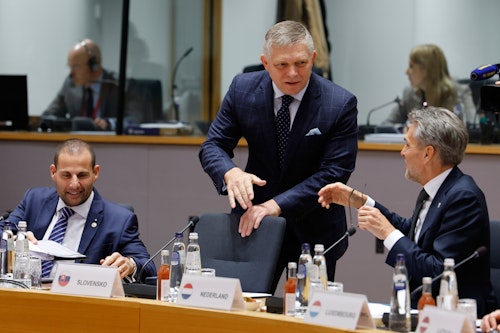
Merz and Fico held talks on car industry
On the eve of the summit, German Chancellor Friedrich Merz and Slovak Prime Minister Robert Fico held a “working meeting” to discuss the future of the automotive industry, Fico’s office said in a statement. Germany’s and Slovakia’s car-making sectors are deeply intertwined.
Merz and Fico have repeatedly criticised an EU law that will effectively ban the new sales of combustion engine cars by 2035. The European Commission has promised to speed up a review of the legislation to potentially allow the use of e-fuels, a controversial alternative that releases CO2 emissions, after the 2035 deadline. The first results are expected to be published by the end of this year.
“Meetings were held in both Germany and Slovakia with representatives of car manufacturers, with the main topic being the discussion on current EU legislation, under which the sale of cars with combustion engines will be banned from 2035,” the statement said.
“Together with the Federal Chancellor, we agreed that the growing pressure will most likely lead to some form of revision of this ban — for example, in the form of continued production of hybrid vehicles.”
The ban will be discussed later today during the segment dedicated to climate policy and competitiveness, two matters that, for many leaders, are becoming increasingly incompatible.
Photo: Associated Press.
Housing crisis makes it to the EU summit – a novelty
For the first time at a meeting of EU leaders, Thursday’s agenda will also include a discussion on the housing crisis.
Between 2010 and 2023, house prices in the EU increased by 48%, while rents increased by 22%. In 2023 alone, almost 9% of the EU population spent 40% or more of their disposable income on housing.
Earlier this week, the EU executive presented its work plan for 2026, which includes two significant housing initiatives.
By spring, Brussels will propose new legislation on short-term rentals, such as those offered on Airbnb or Booking.com. By the end of 2026, there will also be new legislation to accelerate the construction of new homes and reduce bureaucracy for the building sector.
“How can Europe be competitive if people working full-time cannot make a living?” Ursula von der Leyen asked MEPs during the presentation of the Commission’s work programme. “If they cannot afford to live where the good jobs are because they do not find housing?”
EU leaders in Brussels agree that this is a common European problem requiring a European solution. However, such a solution is still a work in progress, given Brussels’ limited powers over housing.
Spain’s socialist Prime Minister Pedro Sánchez and the President of the European Council, António Costa, have already taken credit for prompting such a political discussion today — a move that is seen as an attempt to boost their socialist credentials at a time when their political family is losing ground across the EU.
EU leaders in Brussels are expected to call on the European Commission to “swiftly present an ambitious and comprehensive plan for affordable housing” to support and complement national efforts.
Dan Jørgensen, the EU’s Commissioner for Housing and Energy, will present such a plan in December to address the financialisation of housing. “It is clear that when housing becomes a commodity, something that is used for speculation with no need to take into consideration the rest of the society, then of course that potentially causes problems,” the Danish commissioner said last week.
Paula Soler
Share this article10:58 GMT+2
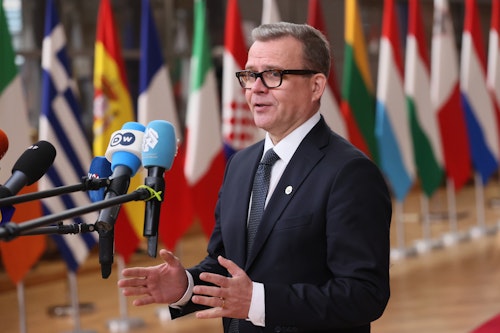
Finland’s Orpo: Combined sanctions with the US a ‘game changer’ against Russia
“The US sanctions can be a real game changer when combined with our 19th sanctions package,” said Petteri Orpo, Finland’s prime minister, upon his arrival at the European Council.
He added that this is a clear step in the right direction, with all measures being coordinated between Europe and the US to maximise their impact.
“The next issue we need to work on is the use of Russia’s frozen assets. I believe a solution is near. We have a solution on the table that is legally sound and takes into account Belgium’s concerns,” he said, adding that ideally the Commission will be able to present a concrete proposal at the beginning of next year so that these funds can be utilised.
“Using Russian assets is the best solution, morally justified because Russia attacked Ukraine. Alternatives include using European countries’ budgets or creating a joint debt instrument,” he said.
Orpo also stated that after hearing Ursula von der Leyen this morning, he is confident that solutions can be found and that all genuine concerns are being taken seriously.
Photo: Associated Press
Merz: Parliament vote against simplification is ‘fatal mistake’
German Chancellor Friedrich Merz called the European Parliament’s vote against simplification rules “a fatal mistake”.
EU lawmakers rejected a bill on Wednesday to simplify rules for European businesses on sustainability reporting and due diligence obligations.
The vote comes amid mounting pressure from some EU member states to pass the bill and from the US and Qatar to scale back the EU’s due diligence law contained in it, which in their view risks disrupting liquefied natural gas trade with Europe.
“We need to discuss this with the European Parliament, the rejection of the simplification plan is unacceptable. We agreed it in the Council, [this vote] is a fatal mistake and it has to be corrected.”
“We will discuss with the parties in Parliament how to proceed, but this is unacceptable. We need a quick decision for the EU industry.”
Merz also said that his letter to the Commission and Council presidents calling for more measures to increase competitiveness has been signed by 20 leaders.
“We are getting bad news from industry across Europe, we need to act a lot quicker than we did in the past, when it comes to making decisions to reduce bureaucracy,” he added.
Cynthia Kroet
Share this article10:54 GMT+2
Lithuanian President warns of ‘disproportionate burden’ to protect the EU’s external border
Lithuanian President Gitanas Nausėda said that his country is facing a “disproportionate” burden in terms of surveillance and protection of the EU’s eastern external border.
“Having in mind how many threats are coming every day, this is actually becoming the routine,” Nausėda argued.
Earlier this week, Vilnius Airport closed overnight after dozens of balloons carrying smuggled cigarettes entered its airspace. Lithuanian authorities blamed Belarus for the incident, which disrupted the travel plans of 4,000 passengers.
The Lithuanian leader said that the EU needs to strengthen its detection capabilities and air defence systems, particularly the short-range ones.
“This is not only my country’s business, but the business of all countries along the eastern border.”
Nausėda stressed the need for national decisions, as well as European programmes capable of scaling up the bloc’s common defences.
The EU is working on four pan-European defence projects which require significant investment.
The most pressing are: The European Drone Wall, a system designed to detect and neutralise drones entering the EU illegally, and the Eastern Flank Watch, which aims to strengthen the ability of frontline states to counter a range of threats, including hybrid operations and drone incursions.
“We need money for that,” said the Lithuanian. ‘We can’t wait until the next multiannual financial framework. We will do our job starting from today”.
Nausėda also argued that the recently announced US sanctions on Russia are a “game changer”.
“It was enough time to understand that you can negotiate with Russia only by putting the gun on the table,” he said.
“Sooner or later they will understand that (not ending the war in Ukraine) leads to the collapse of (the) Russian economy”.
Paula Soler
Share this article10:43 GMT+2
Pedro Sánchez: ‘Spain is a reliable ally when it comes to NATO’
Pedro Sánchez is facing a hard time with regards to his relationship with US President Donald Trump and Spain’s contributions to NATO.
He stressed, when asked by Euronews’s Maria Tadeo upon his arrival at the summit, that “Spain is a reliable ally when it comes to NATO”.
“We are fulfilling these obligations, these commitments and these commitments are linked to capabilities. This is what we agreed at the last NATO summit, and this is what we are delivering,” Sánchez said.
But for the Spanish prime minister, the main item on his agenda walking into the leaders’ gathering, is how will the EU deal with the housing crisis.
The issue, “central” in Spain, can be seen as a ploy by Sánchez to increase his support at home.
“This is the first time in the European Council that we will talk about the housing crisis emergency happening in all Europe, not only Spain,” he said.
Sánchez detailed the three points that Spain will bring to the European Council’s table this Thursday:
- Legal measures to be activated by the EU to stop the purchase of houses for non-residential use.
- Secure some leverage at European level to be able to act in cities where the prices of housing are rising exponentially due to the impact of tourism.
- Secure a dedicated fund for building social housing.
“The inability of young and old (people) to access housing is something shared by Spaniards, Italians, French, and Germans — in short, by any citizen living in Europe. Therefore, when we talk about a Europe that serves its citizens, we also must talk about housing,” Sánchez said.
EU leaders greet each other in the room
EU leaders are pouring into the main room and greeting each other with kisses and handshakes, which means the summit is about to begin.
The latest arrivals include German Chancellor Friedrich Merz, who stopped to speak with reporters, and French President Emmanuel Macron, who completely skipped the press.
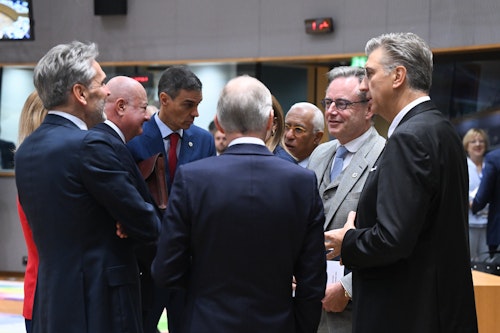
Jorge Liboreiro
Share this article10:26 GMT+2
Greece’s Mitsotakis: Green transition cannot undermine competitiveness
Greek Prime Minister Kyriakos Mitsotakis said competitiveness can’t be discussed “without addressing energy” today.
“The green transition is agreed in terms of climate neutrality goals for 2050, but this green transition needs to ensure that it does not undermine the competitiveness of European industry and the social cohesion,” he said.
Climate policy – on today’s agenda – is increasingly contested by countries like Germany, Italy and Poland. All of them share an aversion to a green law that will effectively ban new sales of combustion engine cars by 2035.
France demanded that leaders have a face-to-face debate on the need to establish an emissions reduction target for 2040 as a bridge to climate neutrality by mid-century.
The European Commission proposed a reduction of 90% by 2040, but with certain flexibilities for governments and industry. The text faces an uphill struggle to be approved as the political backlash against environmental regulations deepens.
Mitsotakis said that “the key word is flexibility.”
“We need to move fast in terms of those technologies that are mature that can bring down CO2 emissions significantly. We need to give time to those technologies that are still immature or that cost a lot of money and ensure that we don’t impose unnecessary burdens on the European industry,” he added.
Cynthia Kroet
Share this article10:32 GMT+2
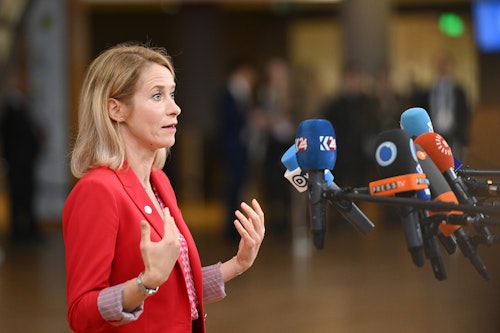
Kaja Kallas hails US sanctions on Russia as ‘important sign of strength that we’re aligned’
High Representative Kaja Kallas has welcomed the US decision to impose sanctions on Russia. The announcement, targeting Russia’s two largest oil companies, Rosneft and Lukoil, marks the first time the second administration of Donald Trump has introduced economic restrictions on Moscow.
“We’re very happy,” Kallas said upon arrival at the summit in Brussels. “It’s an important sign of strength that we’re aligned.”
Kallas defended the ground-breaking project to use Russia’s frozen assets, most of which are held in Belgium, to issue a €140 billion loan to Ukraine. Under the plan, the assets will only be returned if Russia agrees to pay war reparations.
“The fundamental message is that Russia is responsible for the damages caused in Ukraine and has to pay for those damages,” Kallas said.
According to the High Representative, the loan proves to America that “we’re taking very important steps ourselves”.
Asked about Belgian concerns regarding the loan, which threatened to torpedo the plan, Kallas said: “No country should bear the risks or this burden alone.”
Photo credit: Associated Press