In Brussels, the question European leaders quietly ask behind closed doors is no longer whether the United States remains Europe’s most powerful ally. That much is undeniable. The question is whether it remains a reliable one.
By InDepthReports (IDR) — Investigations
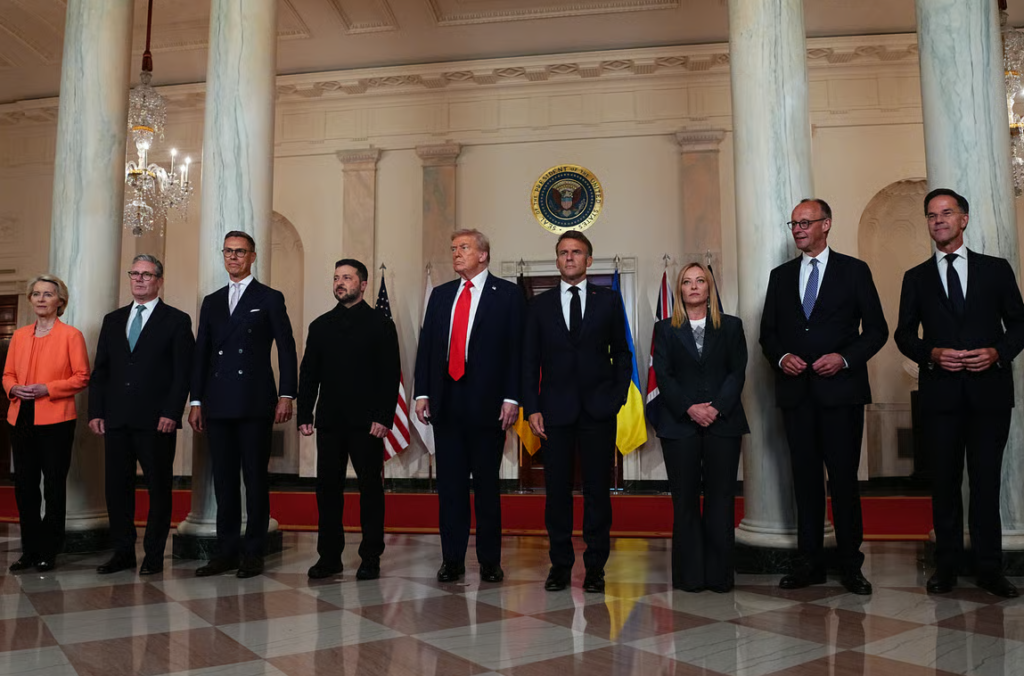
After one year of Donald Trump’s return to the White House, European policymakers have stopped expecting reassurance from Washington. Instead, they are learning—often begrudgingly—to adapt to a transatlantic relationship defined by unpredictability, transactional diplomacy, and public confrontations that challenge long-standing assumptions about shared values and mutual commitments.
This adjustment has not taken the form of rupture or rebellion. Rather, it is a slow, pragmatic recalibration: preparing for American absence without provoking American anger.
Ukraine and the Limits of Dependence
Nowhere has this shift been felt more acutely than in Europe’s approach to Ukraine.
Trump’s fluctuating rhetoric on military aid, coupled with suggestions that Washington could push for a rapid settlement with Moscow, alarmed European capitals already struggling to sustain public support for long-term assistance to Kyiv. While the United States remains the largest single provider of military aid, its political volatility has forced Europe to confront an uncomfortable reality: support for Ukraine can no longer hinge on U.S. domestic politics.
As a result, the European Union has increasingly framed its assistance as a multi-year, self-sustaining commitment—financially, militarily, and industrially. Joint procurement of ammunition, longer-term budget mechanisms, and closer coordination between EU institutions and national defense ministries are no longer abstract ambitions. They are risk-management tools.
Yet European officials privately acknowledge a structural weakness: defense production remains fragmented, slow, and nationally siloed. Raising budgets is easier than aligning factories, standards, and supply chains across 27 member states.
From Strategic Autonomy to Strategic Necessity
For years, “strategic autonomy” was a term more often debated in think tanks than implemented in policy. Trump’s return accelerated its transformation from concept to necessity.
The European Commission and several member states have reframed the goal as “defense readiness” rather than independence. The emphasis is subtle but important. Europe is not seeking to replace NATO or sever ties with Washington. It is trying to ensure that American hesitation does not paralyze European action.
This has meant prioritizing military mobility across the continent, simplifying cross-border deployment procedures, and expanding joint weapons procurement. At the same time, Europe remains dependent on non-European suppliers—particularly American ones—for key technologies, revealing the paradox at the heart of the autonomy push.
Trade: A Relationship of Managed Friction
Security is not the only arena where Europe has felt exposed.
Trump’s renewed embrace of tariffs and trade leverage has revived fears of economic coercion. The reintroduction of duties on European exports—particularly in the automotive and industrial sectors—forced EU leaders into a defensive posture. Rather than escalation, Brussels opted for damage control.
A mid-2025 trade understanding eased immediate tensions but did little to resolve deeper structural disputes. European negotiators described the outcome less as a victory than as a temporary ceasefire—one that underscored the asymmetry of power between a fragmented EU economy and a U.S. administration willing to weaponize market access.
Behind the scenes, EU officials have accelerated efforts to diversify trade partnerships in Asia, Latin America, and Africa. These initiatives, however, face domestic political resistance and cannot quickly replace the scale of the U.S. market.
Values Without Guarantees
Perhaps the most destabilizing element of the past year has been the erosion of assumed political alignment.
Trump administration documents and speeches have portrayed the European Union less as a strategic partner and more as an economic competitor or ideological outlier. European leaders have responded cautiously, avoiding public confrontation while acknowledging privately that the transatlantic alliance is no longer anchored by a shared vision of democracy, multilateralism, or global order.
The result is a relationship sustained by necessity rather than trust.
European diplomats describe the current phase as “transactional coexistence”: cooperation where interests align, insulation where they do not. This approach reflects a recognition that values rhetoric offers little protection when strategic priorities diverge.
China Is Not the Alternative
Some European policymakers hoped that tensions with Washington might allow greater maneuvering room with Beijing. That illusion has faded quickly.
China remains a crucial economic partner but also a strategic challenge—particularly in technology, supply chains, and industrial policy. Europe’s outreach to China has been cautious, selective, and defensive, driven more by hedging than realignment.
In private, EU officials stress that China cannot replace the United States as a security partner. At best, it offers leverage; at worst, a different form of dependency.
What Europe Has Learned
After a year of adapting to Trump’s America, three lessons have crystallized in Brussels:
First, unpredictability is more destabilizing than withdrawal. Planning becomes impossible when commitments fluctuate with political moods.
Second, strategic autonomy is expensive, slow, and politically difficult—but the cost of not pursuing it is higher.
Third, the transatlantic alliance can survive distrust, but not complacency.
Living With, Not Trusting
Europe has not turned away from the United States. Nor has it embraced confrontation. Instead, it is learning to live with an ally that may act decisively one day and retreat the next.
This is not the end of the transatlantic relationship. But it is the end of an era in which European security, trade, and diplomacy could be comfortably outsourced to Washington.
One year into Trump’s return, Europe’s message—to itself, more than to America—is clear: alliances endure not through faith, but through preparedness.