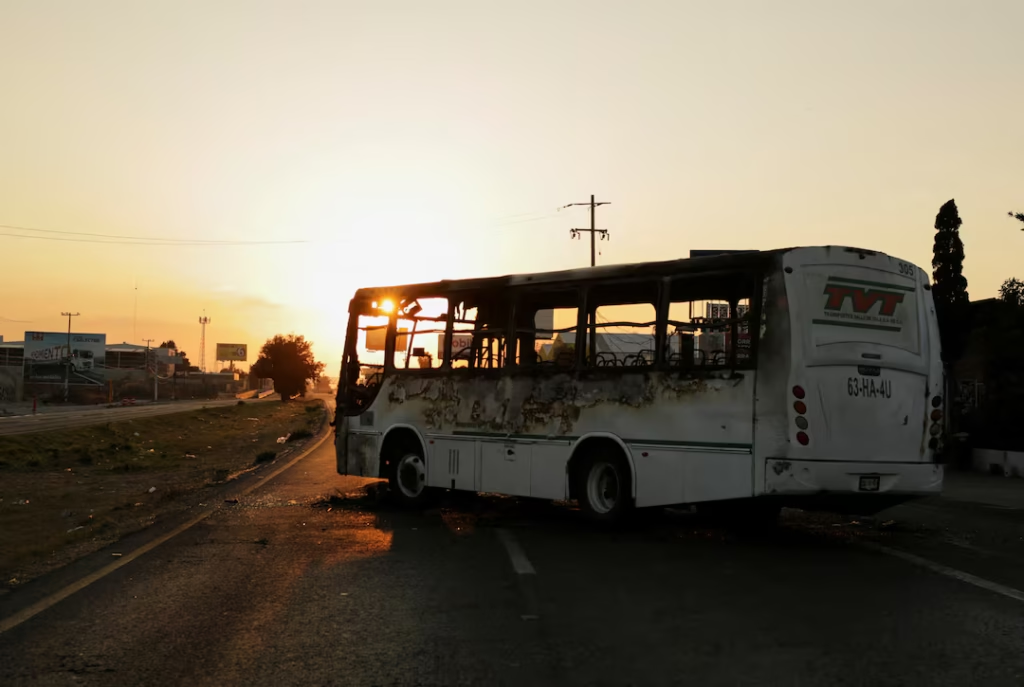
In the rugged landscapes of Jalisco — long regarded as one of Mexico’s most strategically contested territories — security operations have historically blurred the line between tactical victories and systemic uncertainty. The reported killing of Nemesio Oseguera Cervantes, widely known as “El Mencho,” marks one of the most consequential moments in Mexico’s protracted confrontation with organized crime.
“El Mencho” was not merely another cartel leader. He was widely described by international security analysts and U.S. law enforcement agencies as the central figure behind the Jalisco New Generation Cartel (CJNG), an organization associated with rapid territorial expansion, sophisticated logistics, and extreme violence. His death, as covered by international media outlets, immediately reignited a familiar question in Mexico’s security landscape:
Does eliminating a cartel leader weaken criminal structures — or destabilize them further?
Beyond the Individual: Why Leadership Decapitation Rarely Ends Cartels
For more than a decade, CJNG has been portrayed as one of Mexico’s most powerful and adaptive criminal organizations. Unlike smaller or family-bound cartels, CJNG developed characteristics closer to a decentralized enterprise:
- layered command structures
- diversified revenue streams
- paramilitary-style enforcement units
- transnational trafficking routes
Such configurations complicate the assumption that removing a leader results in organizational collapse. Empirical patterns from Mexico and other conflict-affected regions suggest two recurring post-decapitation scenarios:
- Fragmentation and Internal Conflict
Leadership removal triggers violent competition among successors, often escalating localized violence. - Rapid Leadership Substitution
Pre-existing hierarchies enable continuity, preserving operational capacity despite symbolic losses.
In this context, the strategic significance of “El Mencho’s” death lies less in the act itself and more in the structural reactions it provokes.
The Immediate Aftermath: Violence as Communication
Cartel responses to high-level targeting frequently operate as mechanisms of deterrence. Retaliatory violence, road blockades, arson attacks, or intimidation campaigns are not random acts; they function as messages aimed at both the state and society.
This pattern transforms security operations into a volatile signaling game:
The state demonstrates reach.
Criminal networks demonstrate disruption capacity.
For civilian populations, these cycles often translate into heightened insecurity regardless of tactical outcomes.
Epistemic Uncertainty: What Remains Unknown After High-Profile Killings
While operational narratives typically emphasize success metrics — arrests, seizures, neutralizations — deeper uncertainties persist:
- Who controls CJNG’s financial architecture now?
- Do trafficking corridors shift or stabilize?
- Does violence intensify through splinter groups?
- Are local institutions strengthened or pressured further?
Without transparency into organizational adaptation, declarations of strategic victory remain analytically incomplete.
Cartels as Systems, Not Personalities
International enforcement actions against CJNG have long underscored a crucial reality: large criminal organizations are sustained by networks rather than individuals. These systems include:
- financiers and money laundering channels
- logistics coordinators and transport infrastructure
- corrupt intermediaries
- cross-border facilitators
Leadership removal rarely dismantles these enabling layers. In some cases, it may even accelerate reconfiguration as new actors compete for control.
The Governance Dimension: Why This Matters Beyond Mexico
CJNG’s relevance has extended well beyond Mexican territory. U.S. indictments, sanctions regimes, and intelligence assessments have repeatedly framed the cartel as a central actor in transnational narcotics flows. Consequently, shifts within CJNG’s leadership structure may carry implications for:
- regional trafficking dynamics
- financial crime patterns
- violence diffusion mechanisms
- international law enforcement strategies
Key Lines of Inquiry for Deeper Investigation
To move from event-driven reporting to structural understanding, several investigative pathways warrant sustained attention:
1. Succession and Power Redistribution
Which factions consolidate influence? Does internal competition reshape violence patterns?
2. Financial Continuity
Do asset flows, shell structures, or laundering mechanisms exhibit disruption or resilience?
3. Violence Metrics Post-Decapitation
Do homicide rates, forced displacement, or extortion patterns shift measurably?
4. Institutional Responses
Are state institutions strengthened, retaliated against, or strategically bypassed?
Conclusion: Symbolism Versus Structural Change
High-profile killings often produce immediate symbolic resonance. Yet history cautions against equating symbolic disruption with systemic transformation. In complex criminal ecosystems, the removal of a central figure may represent either:
- a genuine weakening of command cohesion
- or the ignition of a more volatile reordering
The decisive question is therefore not solely whether “El Mencho” is gone, but:
What kind of equilibrium — violent or otherwise — emerges in his absence?