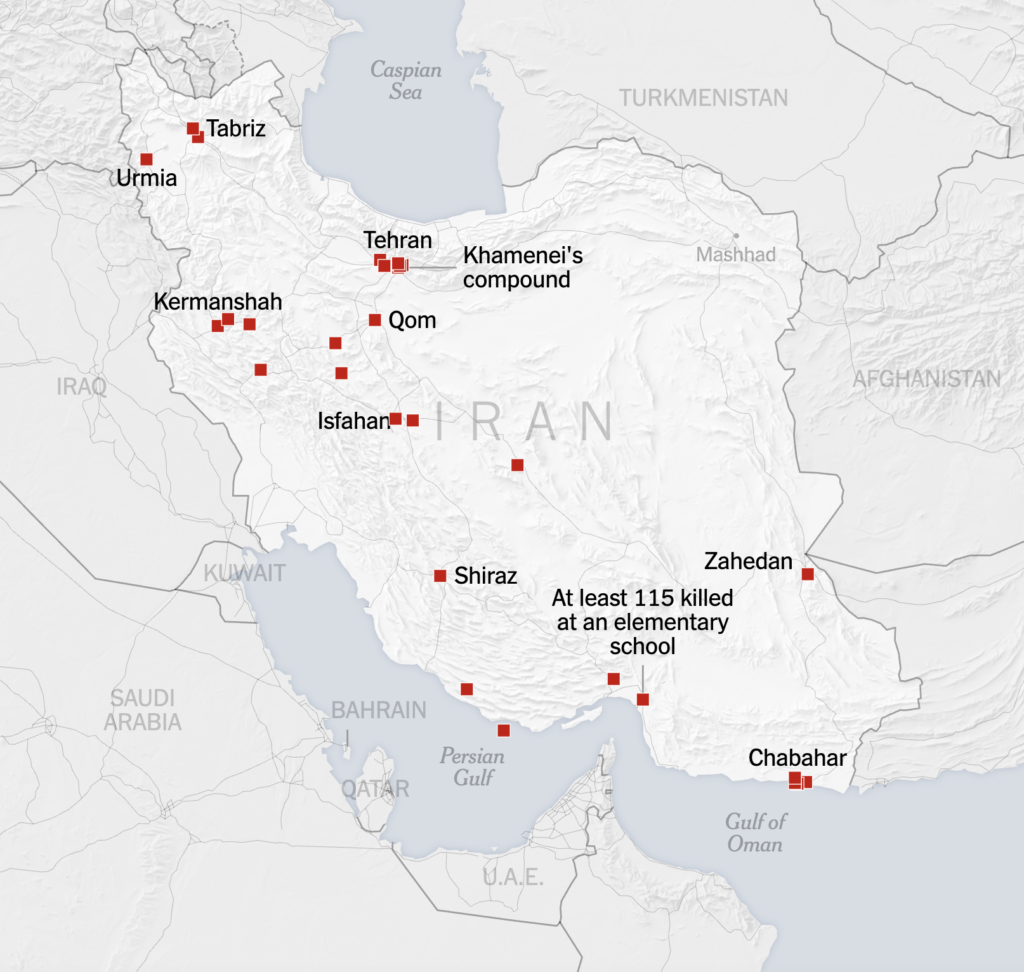
The United States and Israel launched an intense second day of airstrikes and bombing runs on Iran, hitting more than 2,000 targets. Iran continued its retaliatory barrages against Israel and U.S. interests throughout the region.
Strikes in Tehran
Major explosions have targeted Tehran, the Iranian capital, with chaos erupting in the streets. It is one of the heaviest hit cities in Iran.
Where the U.S. and Israel hit Tehran

Sources: Iranian state news agency, verified satellite images and video.
The strike on the high-security compound of Ali Khamenei, Iran’s supreme leader on Saturday, resulted in his death and extensive damage, visible in satellite imagery.

- A strike on Saturday also hit 72nd Square, a residential area in the Narmak district in northeastern Tehran, where Iran’s former president, Mahmoud Ahmadinejad, is known to reside. That strike appeared to hit Hedayat High School, killing two students, according to the U.S.-based Human Rights Activists News Agency.
- Another strike on Saturday hit an area near Iran’s Ministry of Intelligence.
- American strikes on Sunday destroyed the headquarters of the Islamic Revolutionary Guards Corps, according to a U.S. Central Command official.
Strikes on Iran outside Tehran
The United States and Israel have also struck major cities outside of Tehran.
- At least 115 were killed in a strike on Saturday that hit the Shajarah Tayyebeh school, a girls’ elementary school in the southern town of Minab, according to Iranian health officials and state news media. It appears to be one of the worst mass casualty events of the American-Israeli bombing campaign so far. Videos verified by The New York Times show that the school is adjacent to a naval base belonging to Iran’s most powerful military force, the Iranian Revolutionary Guards Corps.
- At least 18 civilians were killed in Lamerd, a city in southern Iran, according to Iran’s state news agency. The report said the strikes hit a sports complex and a hall adjacent to a school, among other sites.
Retaliatory strikes in the region
Iran responded to the attacks with retaliatory strikes aimed at Israel and at U.S. interests in the region, including U.S. facilities in Qatar, Kuwait, Bahrain and the United Arab Emirates. Officials in Jordan and Saudi Arabia said that they had intercepted Iranian attacks.
Editors’ Picks
‘He Opened the Safe and Took Out All the Cash That Was There’What Was It Like to Work at Calvin Klein in the ’90s? Ask Them.The Devil Wears Sasuphi
Where Iran has retaliated

Sources: Iranian state news agency, verified satellite images and video, MarineTraffic and VesselFinder.
- Iran struck a base housing American troops in Kuwait on Sunday, killing three U.S. service members. The fatalities were the first for the United States, and an additional five service members were “seriously wounded.” Several others suffered injuries in the attack.
- An Iranian strike on Sunday also killed at least nine people in Beit Shemesh, an Israeli city about 18 miles west of Jerusalem. Nearly 30 others were wounded. It amounted to the worst casualty event in Israel since the conflict started.
- A missile struck the headquarters of the U.S. Navy’s Fifth Fleet in Manama, Bahrain, on Saturday.
- A drone struck Kuwait’s main airport on Saturday, according to state news media and footage verified by The Times.
- Four people were killed in Syria on Saturday after an Iranian missile struck a building in the industrial zone in the southern city of Sweida, according to a Syrian state news agency. The missile was most likely intended for Israel, as Sweida is close to territory controlled by Israel.
Reporting by Malachy Browne, Ashley Cai, Lazaro Gamio, Samuel Granados, Josh Holder, Malika Khurana, Blacki Migliozzi, Pablo Robles, Helmuth Rosales, Raj Saha, Elena Shao, Daniel Wood and Karen Yourish.
Additional reporting by Devon Lum, Christiaan Triebert, Erika Solomon and Ismaeel Naar.
See more on: Ali Khamenei
- Share full article
More on the Assault on Iran
- Iran’s Supreme Leader Killed: Ayatollah Ali Khamenei died during the U.S. and Israeli military strikes. In more than three decades of authoritarian rule, Khamenei brutally crushed dissent at home and expanded the Islamic Republic’s influence abroad. Large crowds of people in the country celebrated his killing, while many others gathered to mourn.
- Trump and the American Public: Hours after the U.S.-Israeli attacks began, President Trump made unsupported and exaggerated claims in a video posted to social media. The American public’s appetite for an attack on Iran was low before Trump and Israel took action.
- Hope for Regime Change?: Prime Minister Benjamin Netanyahu of Israel has portrayed the Islamic republic as a singular threat to his country and the world for more than three decades. Israel and the United States declared that their attacks would pave the way for regime change in Iran. Trump urged for Iranians to “take over” their government, but questions remained about how much effort his administration would put into changing the Iranian government.
- Iran Claims Children Killed in Strikes: HRANA, an Iranian rights group based in Washington, said late Saturday that at least 133 civilians had been killed and 200 others wounded in the attacks. A strike in the town of Minab was one of two that appear to have hit schools on Saturday.
- Israel’s Shelter Shortage: Iranian missile and drone attacks repeatedly targeted Israel on Sunday, forcing much of the country to take cover and highlighting a shortage of bomb shelters in the country. The Israeli ambulance service said at least nine people were killed after a missile strike in Beit Shemesh, a city about 18 miles west of Jerusalem.
- U.S. Congress Weighs In: After the attack, Democrats and a few Republicans escalated their calls for swift votes on whether to curb Trump’s power to continue using force against Iran without explicit authorization.
- Iranian Americans Find Hope: Some Californians of Iranian descent said they welcomed the possible end of an oppressive government in Tehran that their families had fled.
- World Reacts: Global leaders urged all sides to exercise restraint after the attacks, although some officials backed the campaign. Here’s what other governments are saying.