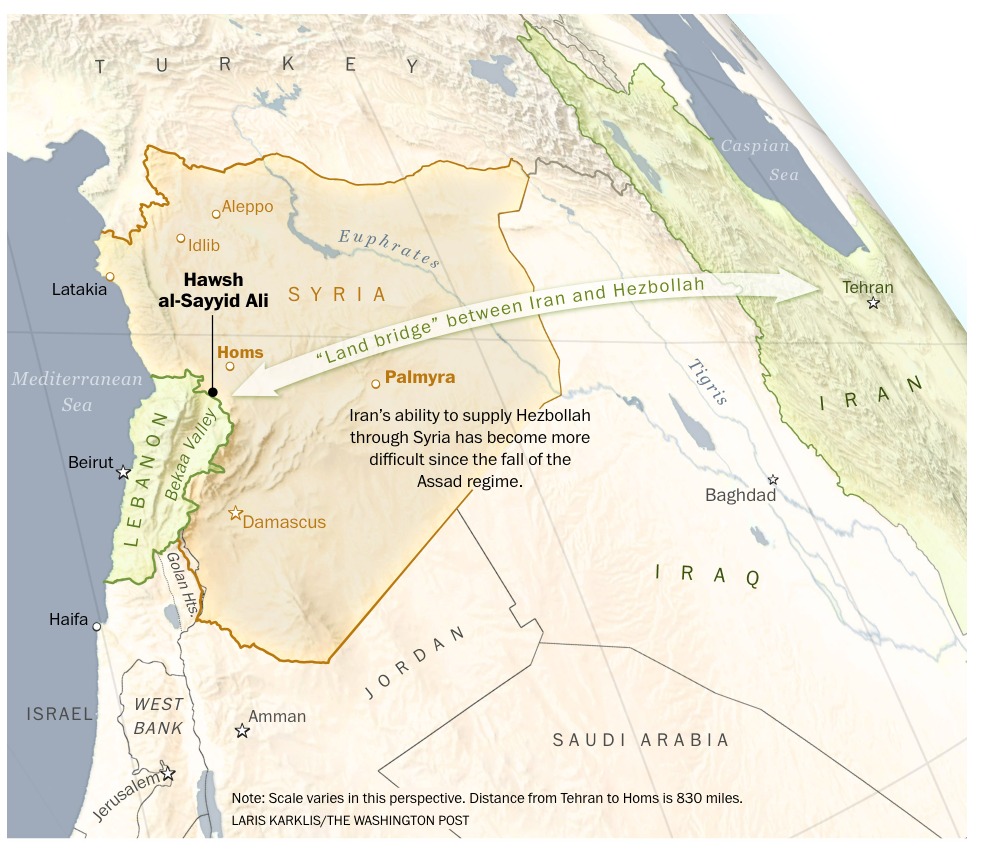
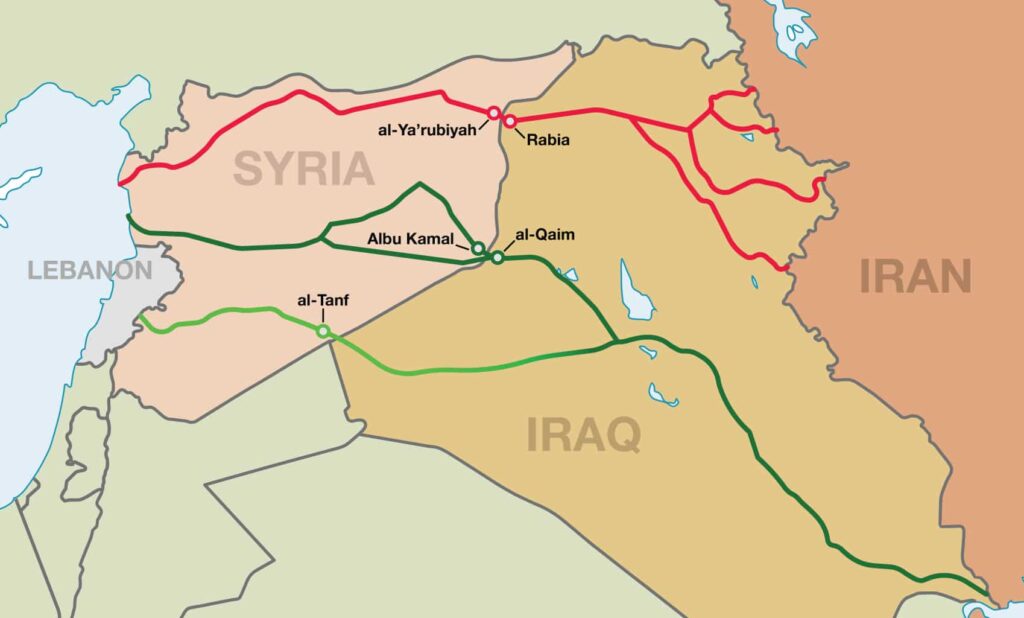
Over the past decade, Iran’s influence in Syria manifested through a sophisticated network of smuggling routes, used to transfer weapons, money, drugs, and fuel to its allies most notably Hezbollah. These routes formed the so-called “land bridge,” connecting Iran to Lebanon through Iraq and Syria.
Investigation Team
Since the outbreak of the Syrian uprising in 2011, the country has become a battleground for competing regional and international interests. Iran quickly seized the opportunity presented by the chaos of war to entrench itself in Syria politically, militarily, and logistically through support for President Bashar al-Assad and the deployment of proxy militias such as Lebanon’s Hezbollah and the Afghan Fatemiyoun Brigade. Over the years, Iran built what analysts have called a “land bridge,” a vast logistical corridor stretching from Iraq through Syria to Lebanon, used to transport weapons, fighters, and funds to bolster its regional allies.
This corridor relied heavily on an intricate network of smuggling routes, often running through remote terrain and informal crossings, especially along Syria’s porous eastern and southern borders. As state control weakened, these Iranian-linked smuggling operations expanded to include not only arms but also narcotics and financial networks used to fund militia operations and circumvent international sanctions.
However, the collapse of Assad’s regime in December 2024 marked a dramatic shift in this landscape. With Islamist factions under Ahmad Al-Shara seizing control of Damascus, Iranian influence was dealt a major blow. The new authorities have since made it a priority to dismantle the remnants of Iran’s logistical presence, particularly along the critical border areas with Lebanon once a lifeline for Hezbollah. What was once a secure and strategic route has become a contested zone, signaling the unraveling of years of Iranian entrenchment in Syria.
In the shadow of a post-Assad Syria, a new conflict is emerging not just over power, but over control of the country’s critical smuggling networks that once served as lifelines for Iran and its regional proxy, Hezbollah. As the interim government led by Ahmad al-Sharaa struggles to assert sovereignty over a fractured landscape, it finds itself battling an invisible enemy entrenched in the terrain: illicit routes used to move weapons, funds, drugs, and fighters across Syria and into Lebanon.
Once the arteries of a powerful transnational alliance, these routes are now contested ground disrupted by regime change, threatened by foreign intervention, and haunted by the ghosts of the Assad era. In this investigation, we travel to the frontlines of this covert struggle, from the rugged hills near the Lebanese border to the decaying remnants of Hezbollah’s former strongholds, uncovering the remnants of a vanishing empire and the quiet war now replacing it.
A senior regional security official, who requested anonymity due to the sensitivity of the matter, told us:
“What we are witnessing now is the unraveling of Iran’s logistical backbone in the Levant. The fall of Assad broke the chain—but what remains is dangerous and far from over.”
In this investigation, we travel to the frontlines of this covert struggle, from the rugged hills near the Lebanese border to the decaying remnants of Hezbollah’s former strongholds, uncovering the remnants of a vanishing empire and the quiet war now replacing it.
Dismantling Iran’s Supply Lines
From the front seat of a black GMC truck near the Lebanese border, Syrian army commander Maher Zaywani radios for clearance on a rural road. Before a reply comes, Syrian fighters on a motorcycle zoom past him, shouting, “Hezbollah! Hezbollah!” warning of an ambush. Soon after, a bloodied car follows. The soldiers report an attack on a government patrol.
In recent weeks, Syrian forces have escalated efforts to shut down smuggling routes spanning the 233-mile border with Lebanon. These remaining corridors were part of the vital land bridge Iran used to sustain both Assad’s regime and Hezbollah. Their closure marks a strategic blow to Iran’s regional project.
The Collapse of a Strategic Corridor
With Assad’s ouster by Islamist fighters in December, Iran’s grip on Syria loosened significantly. Hezbollah’s logistical lifeline was severed, and once-thriving nodes of the smuggling network—like the border village of Hosh al-Sayyid Ali and the militia hubs of Qusayr and Palmyra now lie in ruins. Field investigations confirmed signs of a rushed withdrawal and abandoned military infrastructure.
A New Security Landscape
Though Syrian government troops are regaining control, the situation remains volatile. In one of the fiercest clashes last month, Syrian forces entered Hosh al-Sayyid Ali after a patrol was ambushed. Reinforcements, mostly from Idlib province, were deployed.
Despite gains, Hezbollah is actively attempting to restore its channels. According to Zaywani, tribal factions allied with the group are probing for weaknesses in border enforcement.
Hezbollah’s Disrupted Arsenal
For over a decade, border areas served as hubs for drug manufacturing and arms storage. Syrian raids uncovered 15 captagon labs, generating tens of millions in revenue for Hezbollah and Assad’s regime. In Qusayr, the entire industrial zone was converted into an arms depot the size of 50 football fields.
The site bore remnants of Iranian missiles and unmanned drones, left behind as Hezbollah fled ahead of advancing Islamist forces. According to local security head Samer Abu Qassem, the area was Hezbollah’s “second Hermel.”
Active Smuggling Despite Setbacks
Although much of the infrastructure has been dismantled, analysts like Haid Haid from Chatham House warn that Iran’s networks are not fully dormant. Syrian authorities intercepted over 12 smuggling attempts this year, including drones hidden in livestock feed trucks.
Israeli airstrikes continue to target these caches. The destruction of a key bridge linking Hosh al-Sayyid Ali to Lebanon has complicated Hezbollah’s logistics. But in a chaotic Syria, with its fragmented governance and criminal networks, Iran’s proxies still find ways to operate.
According to regional intelligence assessments and data from European security officials, Iran’s smuggling operations through Syria including arms, narcotics, fuel, and cash generated an estimated $3.5 to $5 billion annually at their peak between 2017 and 2023. The Syrian government’s anti-smuggling campaigns launched in early 2025 have since led to the disruption of more than 40 major trafficking routes, many of which had operated uninterrupted for over a decade.
Recent raids along the Lebanese border uncovered 15 captagon production facilities, with local officials estimating the value of seized drugs to exceed $120 million. Additionally, in the past six months alone, Syrian border units have intercepted over a dozen arms shipments destined for Hezbollah—some concealed inside livestock feed trucks, others buried under false floors of aid convoys.
These figures reflect not only the economic magnitude of Iran’s proxy logistics but also the scale of the task facing Syria’s transitional government as it seeks to dismantle an entrenched, transnational shadow economy.
Iran’s Continued Interference
Beyond smuggling, Iran faces accusations of stirring unrest. Syrian officials allege Iranian involvement in recent sectarian violence on the coast. Though European intelligence sources see no direct proof, they suspect Iran is exploiting Sunni extremists, including ISIS remnants, to destabilize the new government.
This environment has prompted cancellations of high-level diplomatic visits, including a joint German-Austrian delegation in March, due to credible threats from regime loyalists.
Tadmur (Palmyra): Echoes of Occupation
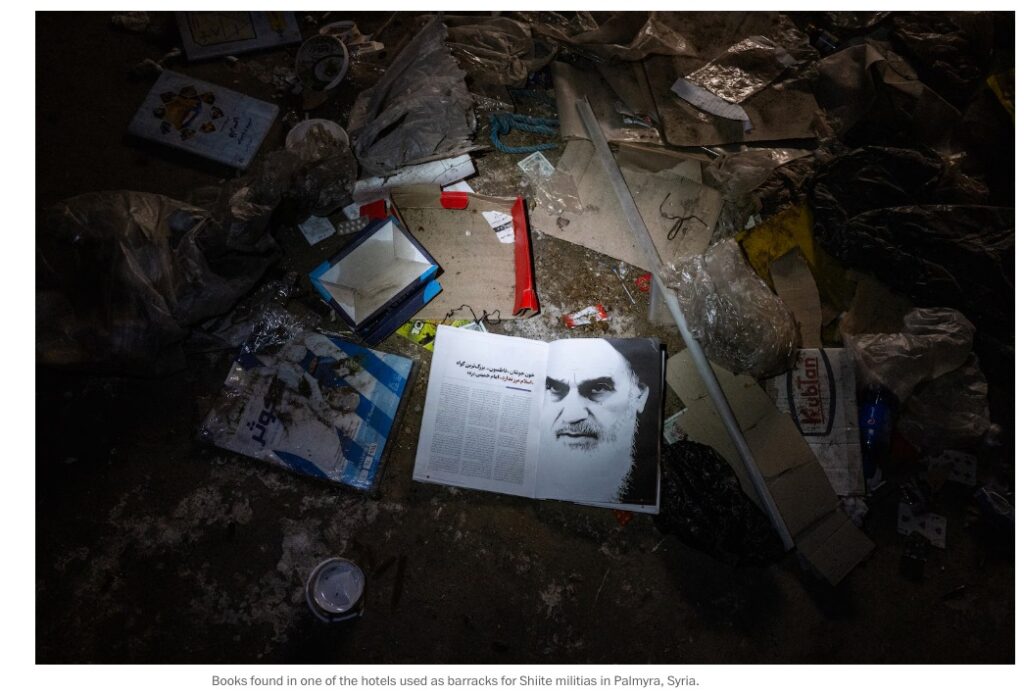
Once a jewel of ancient civilization, Palmyra became a fortified base for Iran-backed militias, notably the Afghan Fatemiyoun Brigade. Slogans like “Death to America” still mark the walls of their former barracks. Syrian forces have since cleared the city of mines, but their grip remains tentative.
Zaher al-Saleem, a local civil volunteer, remarked: “There is no real government control here.”
The fall of Assad and the rapid withdrawal of Iran’s proxies have significantly altered Syria’s strategic geography. What once served as a cornerstone of Iran’s regional dominance is now contested, fragile, and partly reclaimed by a nascent Syrian administration. Yet, the embers of influence persist—through smuggling, sabotage, and covert operations. As Syria navigates its post-Assad future, the struggle for control over its borders and internal stability is far from over.
The unraveling of Iran’s smuggling networks across Syria marks a pivotal moment in the reshaping of the country’s post-Assad reality. Once the cornerstone of Tehran’s strategy to project influence across the Levant, these corridors are now being dismantled under the watch of a transitional government striving to assert sovereignty and stability.
Yet the challenges ahead are far from over. While Syrian forces have reclaimed territory and disrupted operations, the remnants of Iran’s presence—both physical and ideological—continue to cast long shadows. Hezbollah’s desperation to rearm, Iran’s shifting alliances, and the emergence of new regional rivalries leave Syria vulnerable to renewed instability.
As one Syrian security official put it, in a comment provided on condition of anonymity:
“We may have won ground, but the war for Syria’s future is not over—it’s just beginning in a different form.”
With international eyes once again turning toward Damascus, and regional players recalibrating their moves, Syria stands at a fragile crossroads between recovery and relapse, between independence and continued proxy wars.
Whether the new leadership can maintain the gains and shield the country from external meddling will determine not only Syria’s next chapter, but also the future of a region long defined by its fault lines.