By Ali Al-Ibrahim – In Depth Reports
Over a decade ago, Iraq’s Education Ministry launched an ambitious project to build 1,700 new schools. A billion dollars in public funds were spent, but few were ever completed. Now with a new plan to build 7,000 more, it’s not clear the government has learned its lesson.
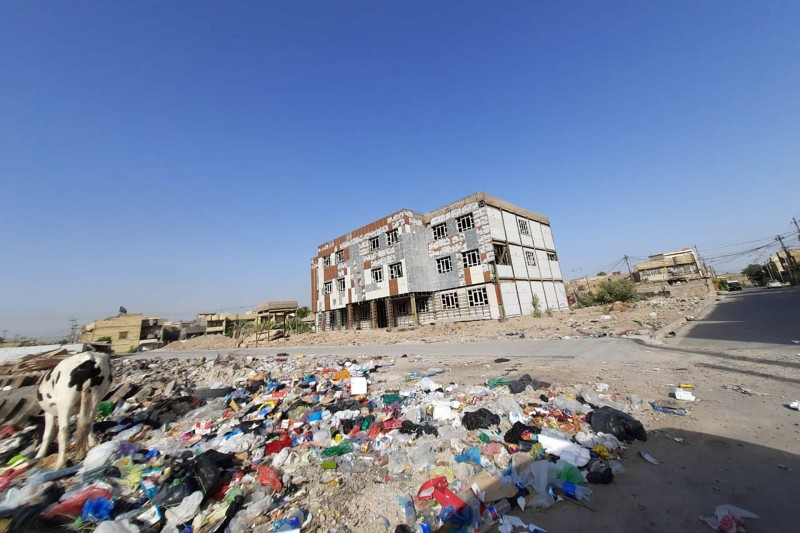
In 2008, Iraq’s Ministry of Education promised a new dawn for a nation scarred by war. Armed with oil revenues topping $100 billion annually and a special allocation of nearly $1 billion for reconstruction, officials announced a bold plan: 1,700 new schools to lift the country’s collapsing education system.
The vision was ambitious. Iraq, once home to the Middle East’s best schools, would rise again. Children would leave crumbling classrooms for safe, modern facilities. Parents dreamed their children could finally escape poverty and instability through education.
But fifteen years later, the dream lies in ruins. Only a fraction of the schools were ever built. Many exist only as skeletal frames of rusted steel or empty lots overrun with weeds and livestock. Others appear in government ledgers as “completed” yet remain hollow shells with no windows, no furniture, and no students.
Meanwhile, billions of dollars have disappeared. Funds meant for classrooms were siphoned off through rigged contracts, shady loans, and blatant conflicts of interest involving powerful businessmen, banks, and government officials. What was supposed to be Iraq’s future has instead become a landmark case study in systemic corruption.
The human toll is devastating: 3.2 million Iraqi children remain out of school, according to the UN. Teachers struggle with sixty or more students crammed into suffocating rooms, often in buildings so unsafe they risk collapse. Iraq’s education system once the pride of the Arab world has been reduced to a crumbling façade.
This investigation by InDepthReports drawing on leaked government memos, bank documents, and site visits across five provinces uncovers how Iraq’s billion-dollar school-building program collapsed into one of the largest corruption scandals in modern history, leaving behind broken promises and a betrayed generation.
The authorities shut down the crumbling elementary school in 2011 to build a new one, but the project stalled .
A Generation Still Waiting
Mohammad remembers the promise vividly. At just 11 years old, his teachers in southern Baghdad told him his class would soon move into a brand-new school with functioning air conditioning, modern desks, and safe walls. For a boy who shared a broken chair with two classmates, it felt like the future was finally within reach.
Today, Mohammad is 24. He now teaches in the very same decaying structure where he once studied. The cracks in the walls have widened, the ceiling leaks when it rains, and in the sweltering summer heat, 60 students are packed shoulder to shoulder into a single classroom. Next door, the “new school” that was promised more than a decade ago remains nothing but a skeleton: rusted steel beams, garbage-strewn lots, and stray cows grazing where children were supposed to learn.
“The modern school we were promised as children remains an elusive dream,” Mohammad told InDepthReports, asking not to be named for fear of losing his job.
His story is not unique. Across Iraq, unfinished schools stand like monuments to failure: concrete shells in Karbala, abandoned frames in Samawah, weed-infested lots in Babylon, and half-built classrooms in Mosul. Parents walk past these ghost projects every day, reminders of billions spent but little delivered.
In Karbala, 12-year-old Hassan studies in a classroom that doubles as a storage room. “There are no windows, just plastic sheets,” his father told us. “They said a new school would be finished by 2016. It is still empty land.”
In Nineveh, Um Qasim, a mother of three, explained how her children attend classes in shifts:
“My eldest starts at 7 a.m., my daughter at 11 a.m., and my youngest at 3 p.m. They come home exhausted. How can they learn like this? We were told new schools would solve this problem, but nothing has changed.”
Teachers, too, are demoralized. Fatima Abbas, who has taught in Babylon for 15 years, described her struggle:
“We have more than 70 students in some rooms. There are not enough textbooks, not enough chairs. We split the day into two or three shifts, but the children are tired, and so are we. Every year we hear promises of new buildings, and every year we see empty lots instead.”
Education experts warn that this is not just about infrastructure, but about lost futures. Dr. Omar Al-Khalidi, a Baghdad-based education researcher, told InDepthReports:
“These children are growing up in overcrowded, crumbling schools that kill motivation and learning. What Iraq is losing is not just classrooms it is an entire generation’s chance at stability, employment, and dignity.”
From Baghdad to Mosul, the landscape is littered with half-finished skeletons of schools symbols of a broken promise. For students like Mohammad, who grew up waiting for classrooms that never came, the failure of Iraq’s school-building projects is more than a scandal. It is a daily lived reality, one that shapes the lives of millions of children who still wait for an education worthy of their dreams.
A ray of light hits a pile of desks inside an abandoned school in east Mosul.
How the “Duwaliya” Projects Began
The scandal traces its roots back to the government of Prime Minister Nouri al-Maliki (2006–2014), an era already infamous for endemic corruption and the disappearance of billions from state coffers. In 2008, then-Education Minister Khudeir Al-Khuzaie announced what was billed as a flagship project for Iraq’s future: the construction of 200 modern steel-structure schools under two contracts collectively worth 282 billion dinars (about $239 million at the time).
Known as the Duwaliya 1 and Duwaliya 2 projects, the initiative was presented as a rapid solution to Iraq’s collapsing school system. But the way the contracts were awarded immediately raised red flags. Instead of open competitive bidding, they were granted directly to four companies: three Iraqi firms and one Iranian contractor, the Iranian ISP Group of Companies for General Contracting Ltd..
Critics warned that the contracts were overpriced from the start. Fadel Al-Massoudi, head of the Iraqi Contractors Union in Babylon, told InDepthReports:
“A standard 12-classroom school in Babylon should cost around $600,000 to $700,000. The Duwaliya contracts priced them at nearly $1.2 million per school. Corruption was built into the design before a single brick was laid.”
The terms of the contracts also created opportunities for abuse. Contractors were allowed to request 20% advance payments, guaranteed by private banks. North Bank for Finance and Investment, chaired by influential Kurdish-Iraqi businessman Nozad Al-Jaf, underwrote the first contract, while Dijlah and Furat Bank guaranteed the second. In theory, these guarantees meant the banks would repay the government if contractors failed to deliver. In practice, they became shields for waste and manipulation.
By 2011, Iraq’s Federal Board of Supreme Audits issued a damning report noting a “low percentage of completion.” The projects had barely advanced despite millions already disbursed. The Ministry of Education was forced to terminate the contracts, leaving most of the schools unbuilt.
The fallout was explosive. Maha Al-Douri, a member of parliament at the time, accused the minister and cabinet of squandering nearly $250 million in public funds. Even within Maliki’s circle, discontent grew: his former finance minister, Baqir Jabr Al-Zubeidi, accused Al-Khuzaie of “destroying Iraq’s education system” by awarding contracts to an Iranian company that “took a 20% down payment and delivered nothing but iron bars.”
Parliamentarian Alaa Al-Rubei later went further, calling the scheme one of the largest in Iraq’s modern history:
“It was the biggest scheme of corruption in the Iraqi state. About 60% of the advance payments simply disappeared. There was no oversight, no accountability—just vanished money and empty promises.”
What was supposed to be a showcase of post-war reconstruction had, within three years, already collapsed into allegations of fraud, mismanagement, and political favoritism. And it was only the beginning of a saga that would entangle private banks, international contractors, and Iraq’s fragile education system for more than a decade to come.
The Bank That Became a Contractor
Here, the scandal took a darker twist. Instead of forcing banks to honor their guarantees and repay lost funds, the Education Ministry struck a deal with Nozad Al-Jaf, chairman of North Bank for Finance and Investment.
Al-Jaf proposed that his own company—Al-Soqour Trading and Contracting—take over the stalled school projects. This created an extraordinary conflict of interest: the bank that guaranteed the contracts was now financing and executing them, through its owner.
Internal documents reveal that Al-Soqour received collateral-free loans from North Bank, even after the ministry stopped payments in 2014 amid the ISIS war and oil price collapse. By 2021, Iraq’s Central Bank reported that while the ministry had paid 235 billion of 242 billion dinars allocated, Al-Soqour’s account at North Bank was overdrawn by 145 billion dinars.
A senior North Bank executive told InDepthReports:
“This project drained the bank completely. Money flowed out with no returns. It was a one-hundred-percent recipe for collapse.”
By 2015, furious depositors stormed North Bank’s headquarters in Baghdad, calling its executives “thieves.” Trading in the bank’s shares was suspended in 2020. Insiders blame the school contracts for accelerating the collapse.
Empty Lots, Hollow Schools
Field investigations by InDepthReports between 2021 and 2023 reveal the sheer scale of Iraq’s broken promises in education. What the Ministry of Education lists as “completed” schools often turn out to be nothing more than cosmetic facades or abandoned shells.
- Baghdad: Several schools recorded as “delivered” were still under construction when visited. Workers were painting walls and fitting aluminum window frames, even as ministry reports declared them finished years earlier. One parent in the Al-Bayaa district pointed at a half-built facility surrounded by piles of garbage and said:
“They cut the ribbon here two years ago. But our children still study in the old building next door.” - Al-Muthanna Province: At least eight sites stand deserted. Steel beams have rusted under the desert sun; foundations are cracked and filled with sand. Children walk past these skeletal structures on their way to overcrowded caravans that serve as makeshift classrooms. Chief engineer Taleb Shabib Hassan explained:
“Even if they restart tomorrow, some structures are already beyond use. Their lifespan has expired. What happened is a catastrophe for our children.” - Karbala and Babylon: Large tracts of land earmarked for schools have become dumping grounds for trash or grazing fields for livestock. In one site outside Karbala, InDepthReports found cows wandering inside the remains of a construction site that had been abandoned for nearly a decade.
In total, only 93 of the 200 schools have been formally handed over, and many of those were so poorly built they required immediate repairs. Officials privately admit that some “completed” schools are unsafe, with cracked walls, leaking roofs, and electrical systems below standard.
Parents and students alike express frustration and despair. In Babylon, Ali, a 13-year-old student, said:
“They told us we would have a new school with computers and labs. But I still study in a room with no ceiling fans, where we share one textbook between three students.”
Local teachers also bear the brunt of the failure. Fatima Abbas, who teaches at a girls’ school in Karbala that was supposed to be replaced, described the conditions:
“We run classes in double shifts, sometimes triple. We have 65 students in one room. The noise is unbearable. How can they learn like this? The new school was supposed to help us, but it’s just another empty promise.”
The discrepancy between what is reported on paper and what exists on the ground is staggering. Ministry reports boast of “completed projects,” but physical evidence tells a different story: hollow buildings, deserted lots, and children left studying in unsafe conditions.
Dr. Jonathan Stevens, a governance expert at Chatham House, noted:
“This is a classic case of paper success versus field failure. The government and contractors report inflated achievements to justify spending, while citizens are left with rusted skeletons and ruined futures.”
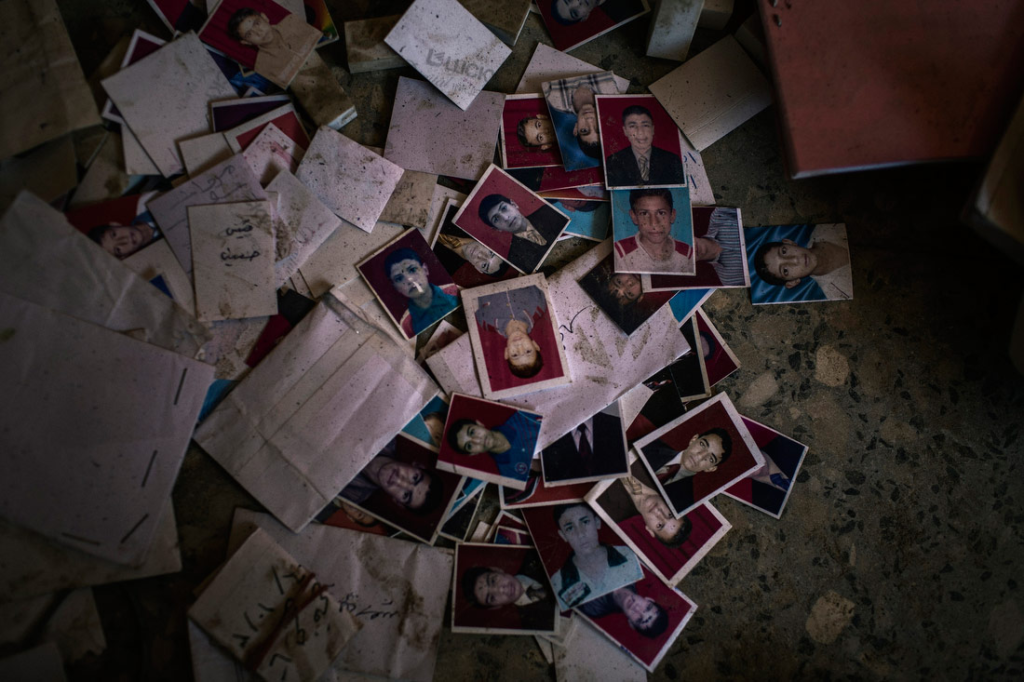
Pictures of students lie on the floor of an abandoned school in Hajj Ali, Iraq.
Billions Spent, Children Left Behind
The collapse of Iraq’s school-building program is not just a financial scandal—it is a humanitarian disaster that has scarred an entire generation.
According to UNICEF, 3.2 million Iraqi children remain completely out of school. Among those who attend, conditions are often dire: nearly one-third of schools run double or even triple shifts, forcing students to learn in rushed sessions lasting only a few hours. In some districts, classes are so overcrowded that children sit on the floor or share broken desks, while others are taught in makeshift tents or caravans.
Dropout rates are climbing, especially among girls in rural areas, where lack of safe facilities and long commutes deter families from sending daughters to school. In Nineveh, aid agencies report dropout rates exceeding 25% in some villages.
Dr. Maria van der Hoeven, an education policy expert at Utrecht University, told InDepthReports:
“When conflict, neglect, and corruption intersect, the result is a generational crisis. Iraq is producing children without literacy, without skills, and without faith in institutions. The damage goes beyond education—it undermines the country’s ability to rebuild socially and economically.”
The Iraqi Education Ministry itself acknowledges the depth of the crisis. In a 2021 report, it admitted the country still needs at least 11,000 new schools just to meet minimal standards. At the current pace of construction, experts estimate it would take two decades to close the gap—even if corruption were eliminated.
The consequences are already visible. Employers complain of a workforce with poor basic skills. Universities struggle to recruit adequately prepared students. A generation of children, born after the fall of Saddam Hussein and the defeat of ISIS, is being left without the tools to escape poverty or participate in rebuilding their country.
Dr. Michael Hanna, senior fellow at the Century Foundation, was blunt in his assessment:
“Iraq once had the best education system in the region. Today it’s one of the worst—not because the money wasn’t there, but because the money was stolen. This is not just a policy failure—it’s a betrayal of Iraq’s future.”
A New Plan, Old Fears
Despite the glaring failures of the Duwaliya projects, the Iraqi government announced in 2022 an ambitious new initiative: the construction of 7,000 schools across the country. Officials portrayed it as a clean break with the past, promising tighter oversight, modern designs, and international partnerships.
But skepticism runs deep. Civil society organizations warn that the same conditions that doomed the first program—opaque contracts, weak oversight, and political interference—remain in place.
Former Minister of Construction Mohamed Al-Daraji told InDepthReports:
“These projects were a failure that should be studied, not repeated. Without transparency, international monitoring, and strict accountability, billions more will vanish while Iraqi children continue to study in ruins.”
Indeed, early signs raise concerns. In late 2022, investigative journalists reported that several contracts under the new plan had already been awarded directly—without competitive bidding—to companies with close ties to political parties. Some contracts bundled construction with supply deals, creating room for inflated costs similar to the Duwaliya era.
Dr. Lara Dihmis, an education governance specialist, warned:
“Throwing billions at the problem without addressing governance is like pouring water into a leaking bucket. Unless procurement is transparent and independently monitored, the 7,000 schools may suffer the same fate as the 1,700 before them.”
For parents like Umm Ahmed, whose two daughters attend a primary school in Baghdad operating in triple shifts, such promises ring hollow.
“They said the same things before. We are still waiting. My daughters study in classrooms without windows, sitting three to a desk. I don’t believe new schools will be built—I believe more money will be stolen,” she said.
The scale of Iraq’s education crisis is undeniable: overcrowding, collapsing infrastructure, teachers underpaid and overstretched, and millions of children excluded entirely. The country stands at a crossroads: either break the cycle of corruption and rebuild its schools, or consign yet another generation to failure.