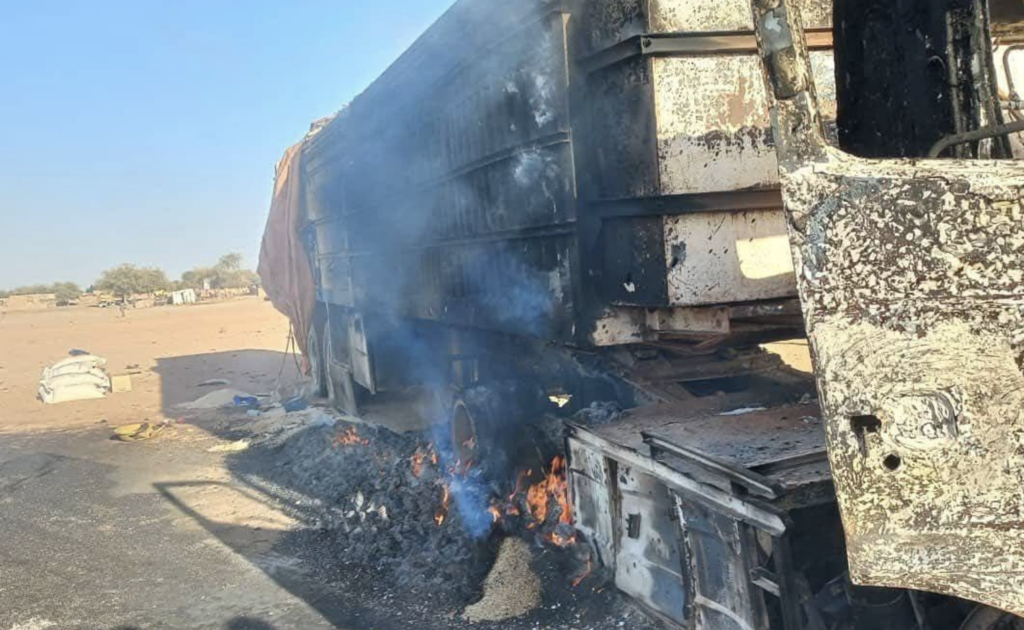
At a time when tens of thousands of families in the city of El-Fasher had been waiting for days for the arrival of food aid convoys as a last lifeline to survive amid tightening siege and escalating hunger, eight relief trucks were targeted while heading toward the city by drones operated by the Egyptian military, whose aerial presence in the Darfur theater has become increasingly evident in recent weeks.
Our team reviewed photos and videos showing fully burned trucks carrying clearly marked humanitarian insignia, including food crates and medical supplies that constituted the only supply route for thousands of civilians trapped in El-Fasher, one of the deepest humanitarian crises in the world.
According to the 2025 UN/OCHA response plan, 30.4 million people—more than half of Sudan’s population are in need of assistance and protection, amid worsening food insecurity and rising risk of famine. Any systematic disruption of relief routes to El-Fasher and North Darfur intensifies the threat of mass hunger and famine-related deaths, making the obstruction of aid convoys a direct strike against civilian survival.
Testimonies from relief workers and local witnesses indicate that the strike occurred despite prior knowledge of the humanitarian nature and declared route of the convoy, which significantly elevates the legal severity of the incident. International humanitarian law prohibits the starvation of civilians as a method of warfare, and forbids the targeting or obstruction of relief convoys. Under the Rome Statute, deliberately attacking humanitarian vehicles or personnel constitutes a war crime if intent and prior knowledge are established.
Photos and videos reviewed by the research team confirm that the strikes caused direct damage to trucks carrying clearly marked relief supplies, resulting in the destruction of food cargo that served as a vital supply lifeline for civilians.
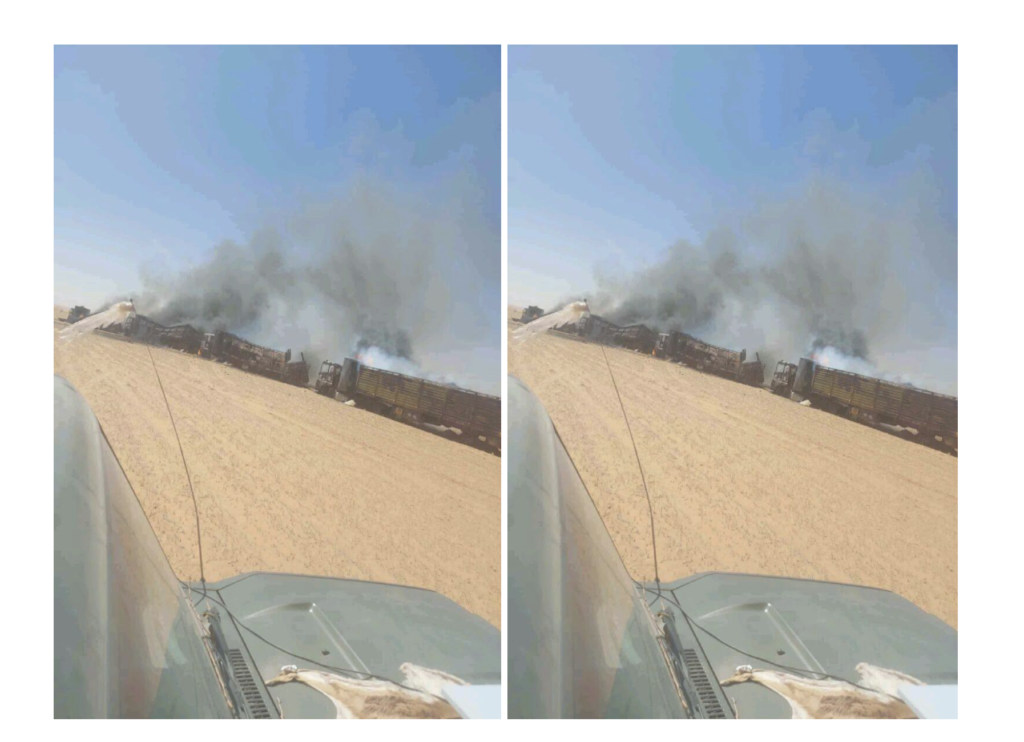
This comes at a time when Sudan is experiencing one of the worst humanitarian crises in the world, with more than half of the population in need of life-saving assistance. Obstructing or targeting aid convoys under the current siege around El-Fasher is not merely a battlefield incident—it may constitute the use of starvation as a weapon by preventing food from reaching civilians. Under international law, this is classified as a war crime if the act is deliberate and the perpetrating party knew the convoy was humanitarian in nature.
Nature of Use
Field sources and testimonies from local relief teams, along with analysis of video footage and munition fragments, indicate the involvement of drone operating units affiliated with the Egyptian military in the strikes that targeted humanitarian convoys around El Fasher.
This assessment is based on correlations in the type of munitions used, flight patterns, and strike characteristics consistent with drone platforms known to be operated and trained on by Egyptian forces in recent years.
Egypt has a documented record of deploying armed unmanned aerial vehicles capable of both reconnaissance and precision strike, including Chinese-made systems such as the Wing Loong. The characteristics of the strike—precision of impact, angle of attack, and fragmentation pattern—align with munitions typically delivered from medium-range tactical drones.
Photos and videos reviewed by the team show the trucks being directly targeted, rather than the surrounding road or distant concentrations, indicating prior aerial surveillance and tracking of the convoy before the strike. This pattern is consistent with drones operated by trained crews capable of distinguishing targets.
Since the trucks carried clear humanitarian markings, striking them despite their obvious identity constitutes the use of starvation as a method of warfare by obstructing vital relief supplies—an act classified under international law as a war crime.
What Does This Targeting Represent in Practice?
On 22 August 2025, the United Nations confirmed that a humanitarian convoy of 16 food trucks was attacked by a drone while en route to northern Darfur (noting that earlier convoys had been waiting for clearance to proceed toward El Fasher). The personnel survived, but the trucks were burned. A senior official at the Office for the Coordination of Humanitarian Affairs (OCHA) stated that dozens of additional trucks remain stranded, awaiting “security guarantees and a humanitarian pause to allow entry into El Fasher.”
At the same time, human rights organizations have documented an escalation in drone strikes around El Fasher since September, including incidents resulting in civilian casualties. This reflects a clear pattern of drone use in an urban environment and along highly sensitive humanitarian supply routes.
International humanitarian law prohibits the starvation of civilians as a method of warfare and forbids attacking, destroying, or obstructing items indispensable to civilian survival, including food supplies and relief operations.
Furthermore, the Rome Statute of the International Criminal Court criminalizes the intentional directing of attacks against humanitarian personnel, assets, or vehicles engaged in relief missions.
Therefore, the targeting of UN humanitarian convoys constitutes a war crime.