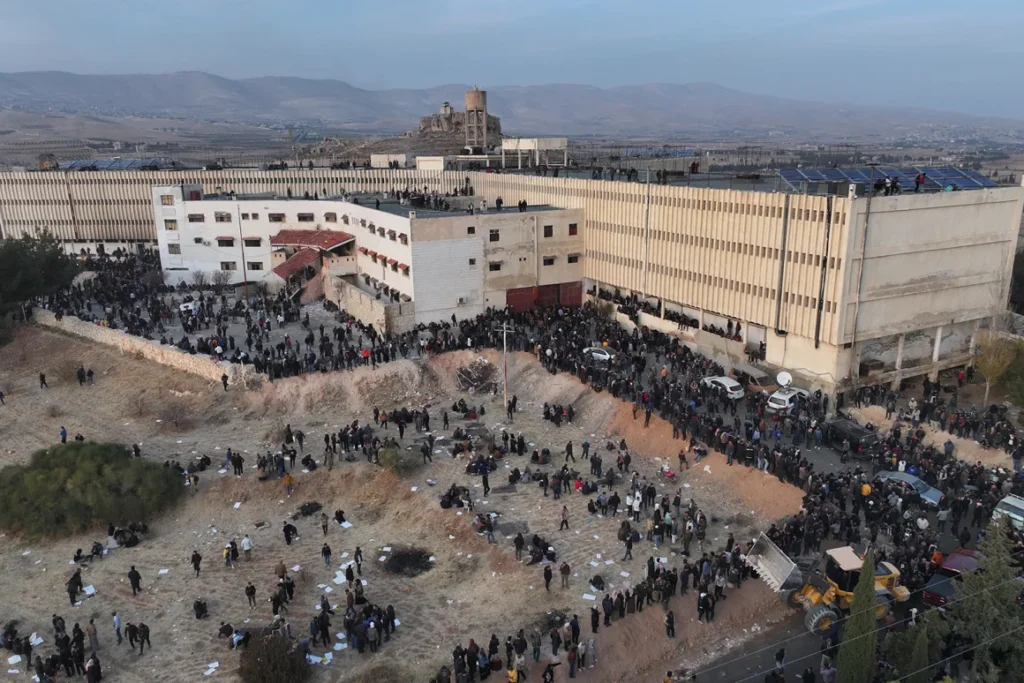
This investigation, based on the analysis of thousands of official documents, reveals how Syria’s Military Field Court evolved into an institutional mechanism for issuing death sentences within minutes, through a process that begins within the security apparatus and ends with secret executions in Sednaya prison. By examining hundreds of case files, the investigation identifies a recurring pattern of sham trials built on confessions extracted under torture and given a veneer of legal legitimacy, before being carried out as systematic executions followed by the enforced disappearance of victims through mass burials, without official documentation or notification to their families.
Damascus, Ali Al Ibrahim
The session in which Youssef Othman was sentenced to death lasted less than three minutes.
No evidence was presented. He was not allowed to defend himself, nor was he informed of the charges against him.
He was asked only one question: “Do you confess?”
He was then returned to his cell.
Weeks later, he was transferred to Sednaya prison.
Months later, he disappeared.
His name was never entered in any death registry. His body was not returned, and his family was never told when he was executed, or by whom.
Years later, they received a brief notice:
“The death sentence has been carried out.”
Documents and survivor testimonies reviewed by the investigation team show that Youssef’s case was not an exception, but part of a parallel judicial system in which thousands of death sentences were issued in hearings lasting only minutes.
Based on the analysis of 5,680 official documents including judicial and security records, this investigation reveals how Syria’s Military Field Court evolved into an institutional mechanism for producing death sentences.
From security branches to Sednaya prison, the process followed a consistent path: decisions were shaped within the security apparatus, then formalized in court before being carried out in secret.
An in-depth review of 2,318 case files allowed the investigation to identify recurring patterns in trial procedures and sentencing decisions.
Verdicts were built on confessions extracted under torture and on unchallengeable security reports, with detainees transferred to Sednaya for execution without any form of independent oversight.
Over more than a decade, this system came to resemble a production line issuing sentences in sequence, while the real decisions were made elsewhere.
Dr. Fadia Al-Khatib, a researcher in international law, explains: “What happened in Syria cannot be described as trials. We were facing a system designed to produce predetermined outcomes, then cloak them in legal form. The judge here was not a decision-maker, but part of an execution chain.”
What this investigation reveals is not only a pattern of violations, but a system engineered to produce death where decisions are made outside the courtroom, then rewritten as judicial rulings within it.
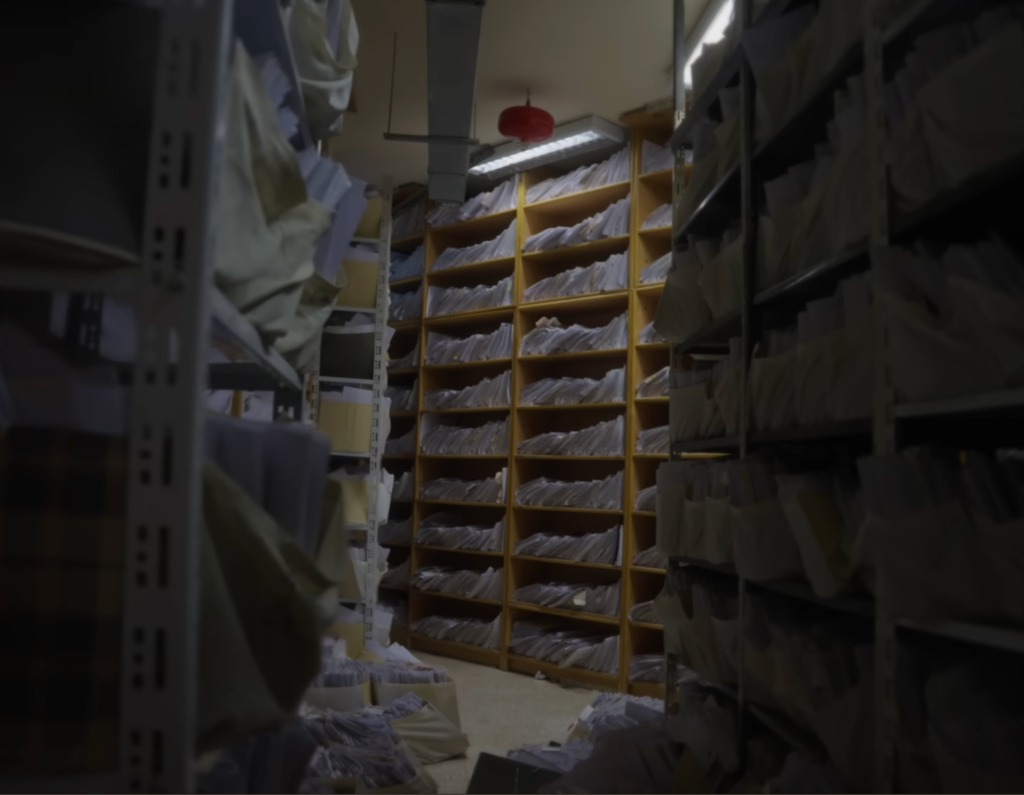
Archive storage of judicial files in Damascus, where thousands of case records reviewed by the investigation reveal fast-tracked proceedings that often ended in death sentences.
A Court Without Justice
For the first time, the documents show that the Military Field Court did not function as a judicial authority, but as a procedural link within a process that both began and ended inside the security apparatus.
Analysis conducted by the investigation team over more than a year reveals that these rulings were not the outcome of a genuine legal process. They were built on confessions extracted under torture, unchallengeable security reports, and direct recommendations issued by intelligence agencies.
In many cases, these so-called “trials” lasted no more than three minutes.
Detainees were then transferred to Sednaya prison where the sentence was carried out beyond any independent oversight.
Inside the prison, executions followed a consistent pattern.
Between 20 and 50 detainees were sent to the gallows each week, without prior notice. They were transported at night and executed before dawn.
These operations were overseen by a committee composed of military, security, and judicial officials, responsible for organizing executions and formally documenting deaths all in the absence of any independent civilian or judicial supervision. In some cases, a cleric was present, adding a symbolic layer of legitimacy to the process.
What makes this system more troubling is that it did not operate solely in secrecy.
It functioned within a carefully constructed legal framework that concealed its nature and shielded those involved from accountability.
Marwan Khair Bek, a war crimes investigator, explains: “The system did not leave a legal vacuum. On the contrary, it produced a seemingly coherent body of documentation that gives the impression everything was carried out according to law. But upon closer examination, these documents conceal a complex network of security decisions that have nothing to do with justice.”
A detailed review of the court’s rulings shows that verdicts were not formulated inside the courtroom, but aligned with decisions made beforehand.
The analysis of 2,318 case files reveals recurring patterns in the formulation of charges and rulings, pointing to a standardized mechanism for issuing decisions.
A comparison between rulings and the attached security reports shows an almost complete overlap in language and conclusions reinforcing the finding that judicial decisions were, in effect, extensions of security recommendations.
Overall, the evidence indicates that the court’s role was largely limited to formalizing pre-determined outcomes, reducing the judicial process to a procedural formality within a closed security system.
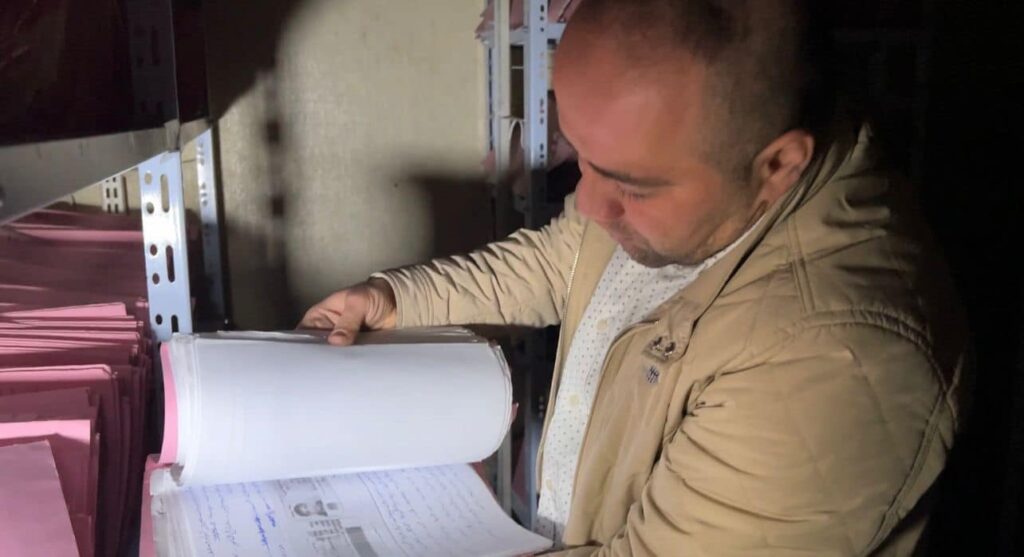
Investigative journalist Ali Al Ibrahim examines case files inside the Military Field Court archive in Damascus.
Inside the Field Court… Minutes Between Life and Death
Access to the Military Field Court did not follow any judicial pathway, but rather a sequence of iron doors beginning in the basements of security branches where detainees were held for months or years and ending in a narrow room that bore none of the features of a courtroom. There, in a nearly empty space furnished only with a table and a few chairs, life-and-death decisions were made within minutes.
Sobhi Al-Qablani, 42, a former detainee who survived a death sentence, recalls the moment: “I was blindfolded. They removed it for a few minutes. I saw a room, a table, and two men in military uniform. There was no judge… there was an officer.”
He was not asked to sit, nor was he allowed to speak or defend himself. He was asked his name, then a single question: “Do you confess?”
Minutes later, he was taken back outside without knowing what had happened.
In those moments, his fate had already been decided.
Testimonies and documents reviewed by the investigation show that these “sessions” were not trials in any legal sense, but procedural formalities used to ratify decisions that had already been made within the security apparatus. There were no lawyers, no disclosure of charges, no witnesses, and no possibility of appeal.
Documents also reveal that what was referred to as a “case file” was largely built on confessions extracted under torture.
Mahmoud Khair Al-Din, a former detainee, explains: “They would tell me: you need to confess so we can finish. If you don’t confess, you’ll never leave. In the end, I signed papers I didn’t even know the contents of.”
These confessions, regardless of how they were obtained, became the primary basis for sentencing.
In this context, Dr. Samer Tayara, a professor of international criminal law, explains that these courts fall under what is known as “sham courts,” where security decisions are given a legal façade without actually being made within the court itself.
The documents further show that many rulings were issued with judges’ signatures but without any legal reasoning or presentation of evidence.
Samer Hamdan, a former judge at the Field Court, confirms: “The decision came from the security agencies. The judge’s role was to read the verdict… not to make it.”
This overlap between judiciary and security was not an exception, but part of a broader institutional structure in which justice was administered from outside the courtroom.
The review of these case files also revealed no reference to the date of execution or the fate of the body, reinforcing the conclusion that the execution process operated separately from any traceable legal documentation.
For the first time, analysis of this volume of documents reveals a recurring pattern showing that decisions were not made inside the court, but outside it before being reformulated into judicial rulings.
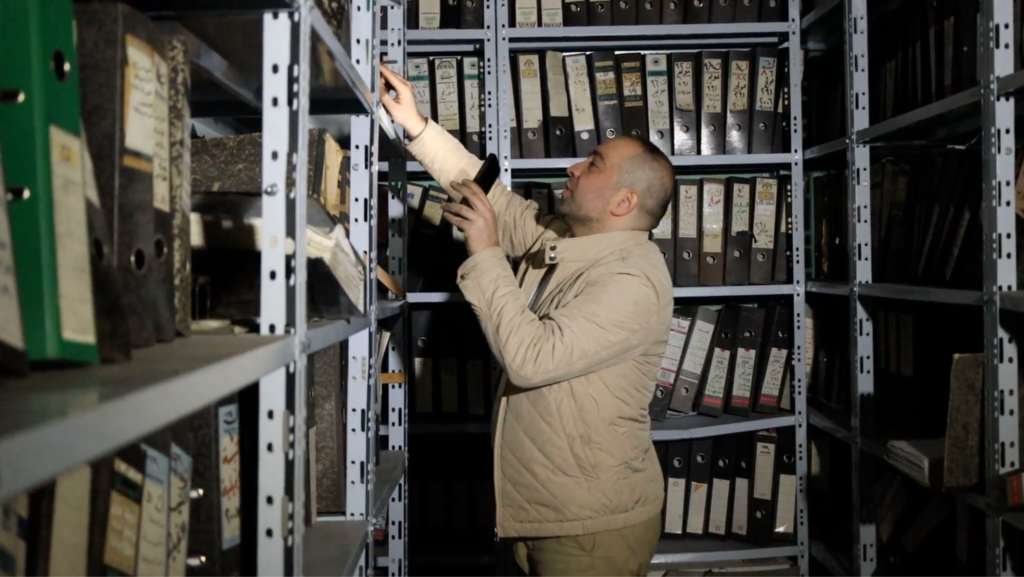
Security records reviewed by the investigation inside the General Intelligence Directorate in Kafr Souseh, Damascus.
From Arrest to the Gallows… How the Execution System Operates
Tracing the cases documented in this investigation reveals a clear and recurring pattern.
It begins with arrest often based on security reports or informants.
This is followed by interrogation inside security branches, where confessions are extracted under torture.
A security recommendation then determines the detainee’s fate.
Only after that is the case referred to the Military Field Court, where a verdict is issued within minutes.
From there, those sentenced are transferred to Sednaya prison, where the sentence is carried out beyond any independent judicial oversight.
In many instances, these proceedings were not conducted individually.
Testimonies indicate that detainees were brought in succession, in rapid cycles, during which dozens of sentences could be issued in a single day.
Malek Abbas, a former employee in the court’s administrative office, recalls: “We would hear names being called… they’d go in and come back quickly. Then they’d whisper to each other: death sentence… death sentence… death sentence.”
What emerges is a system that operates less like a court and more like an assembly line where trials are reduced to routine steps within a structured killing process.
Yet these rulings were formally recorded, assigned case numbers, and signed by judges, giving them the appearance of legal legitimacy.
This contradiction between form and reality is what complicates efforts to hold the system accountable.
Dr. Leila Murad, a Syrian lawyer, explains: “The system did not abolish the law, it used it as a cover. This is the most dangerous form of violation, because it creates an illusion of legality while completely dismantling justice.”
Documents show that referrals to the Field Court did not follow any independent judicial process, but were based on direct decisions by security agencies which held near-total authority over arrest, interrogation, and sentencing outcomes.
Within this structure, the hearing itself was merely a formality.
A former judge at the Field Court states: “The detainee is only asked his name… but the sentence is issued regardless of the answer.”
These procedures often lasted no more than one or two minutes what legal experts have described as a “judicial farce” that, in most cases, ended in death sentences.
A review of the case files shows that the vast majority of rulings relied on confessions extracted under torture and on unchallengeable security reports, with no substantive legal reasoning provided.
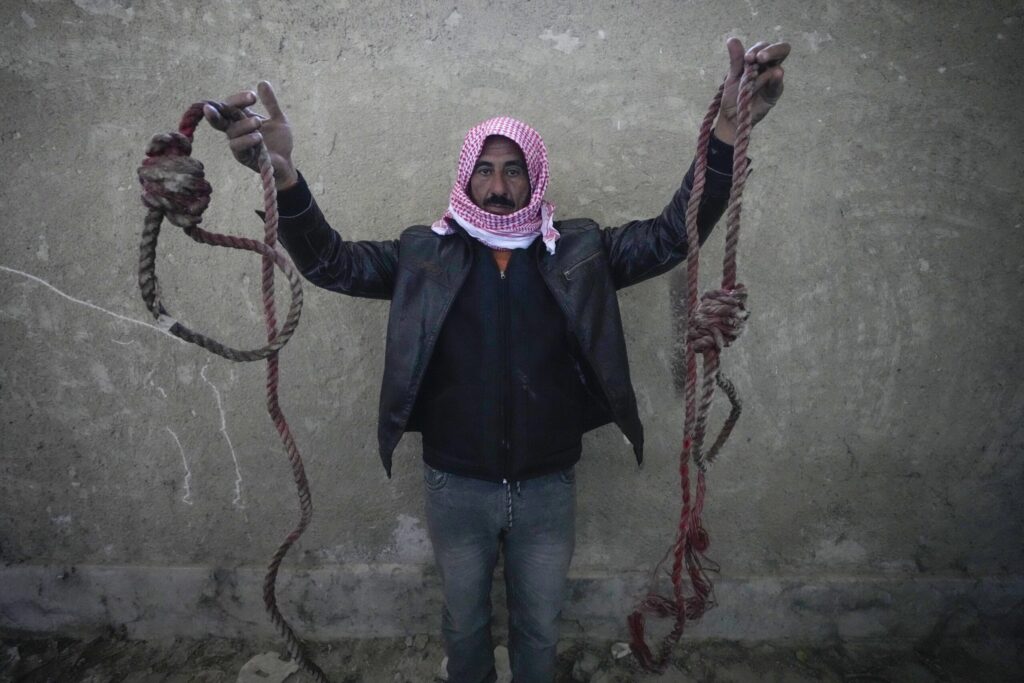
A man shows two ropes tied in the shape of nooses, found in the infamous Saydnaya military prison, just north of Damascus, Syria, December 9, 2024.
Sednaya… Where Sentences Turn Into Death
Sednaya was not merely a prison.
It was the final stage of the system where signed rulings were turned into death.
The facility sits atop an isolated hill, surrounded by military checkpoints and minefields.
Its design was not only for security, but for total isolation. Inside, detainees were cut off completely from the outside world with no communication, no documentation, and no trace.
By the time a detainee arrived in Sednaya, the process was already over.
This was not a place of detention, but of execution.
Testimonies and documents reviewed by the investigation show that those sentenced were transferred suddenly, often at night, without being informed of the decision issued against them.
They were moved from their cells to holding areas then taken to execution sites before dawn.
Executions followed a precise and organized routine.
Detainees were brought in groups. Sentences were carried out in sequence.
A committee composed of military and security officials oversaw the process, along with a forensic doctor responsible for confirming death.
In some cases, a cleric was present not as a safeguard, but as a symbolic gesture of legitimacy.
What defines this system is not only its organization, but its complete isolation from oversight.
There was no independent judicial presence. No verifiable documentation. No notification to families.
After execution, bodies were not returned.
Deaths were not recorded in any clear legal framework.
Names simply disappeared from daily prison records without appearing anywhere else.
In this sense, Sednaya was not merely where sentences were carried out.
It was where people vanished.
A detainee’s life ended there.
For their families, uncertainty began.
At the end of this chain from arrest, to interrogation, to trial there was no record, no grave, no answer.
Only disappearance.
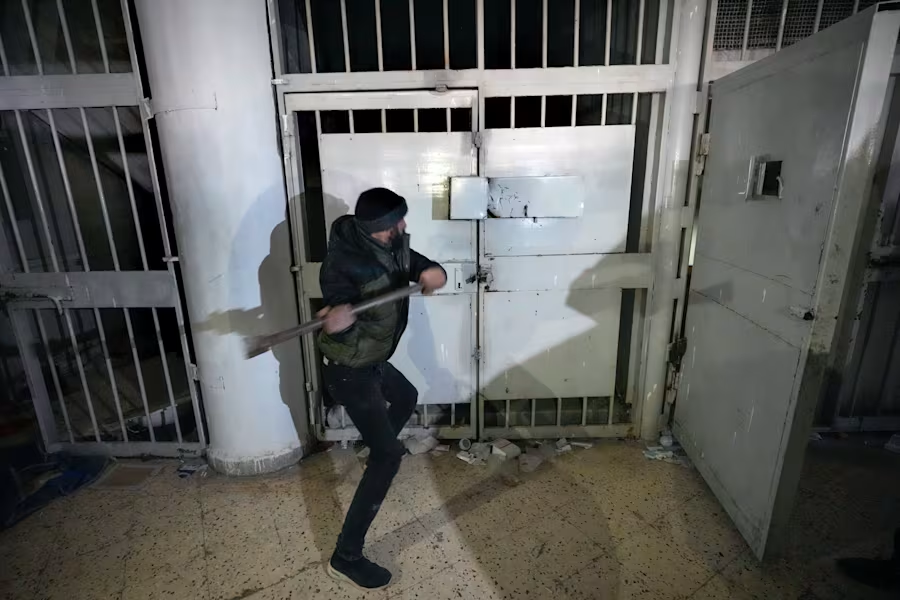
A man breaks the lock of a cell in the infamous Saydnaya military prison, just north of Damascus, Syria, Monday, Dec. 9, 2024. Crowds are gathering to enter the prison, known as the “human slaughterhouse,” after thousands of inmates were released following the rebels’ overthrow of Bashar al-Assad’s regime on Dec. 8, 2024.
A Judiciary Engineered to Kill
The Military Field Court was not an exception within Syria’s system; it was its most explicit expression of how the judiciary had been transformed into a security instrument. Instead of serving as a space for resolving disputes, the court became part of a system that produced ready-made verdicts, executed swiftly, and wrapped in procedural formalities that gave them the appearance of legality.
Dr. Samer Tayara, a professor of international criminal law, explains: “We are not talking about a court that failed to deliver justice, but about an institution that was never created to do so. These courts were designed to function as instruments of execution, not judgment.”
Documents analyzed by the investigation show that the court was merely one link in a broader process, in which decisions originated within the security apparatus and were later submitted for approval at higher executive levels, within a chain involving security, military, and judicial bodies.
Marwan Al-Ash, Secretary of the Syrian Detainees Committee, states: “The authority that refers cases, the authority that issues the ruling, and the authority that approves it are all part of the same system one that begins within the security agencies and does not end until it reaches the highest levels of the executive structure.”
The evidence shows that this system did not operate randomly, but within a clear hierarchical structure involving security, judicial, and military institutions indicating that executions were not the result of individual decisions, but part of a broader institutional policy.
According to a comprehensive review of the documents, the investigation team identified no fewer than 18,621 death sentences issued between 2011 and 2024, of which at least 8,652 were carried out, including against women and children.
Yet these figures, as significant as they are, represent only part of the reality.
The evidence suggests that this process was not incidental, but part of a coordinated institutional structure involving multiple levels of authority.
According to the same documents, the bodies of victims were not returned to their families, nor were families officially informed of executions, leaving thousands trapped in a prolonged state of uncertainty caught between hope and fear.
This concealment was not the result of chaos, but a systematic policy aimed at erasing evidence and preventing any legal pathway that could lead to accountability.
In this context, Marwan Khair Bek, a transitional justice researcher, explains: “What makes these crimes particularly complex today is not only their scale, but the way they were carried out within an apparent legal framework. This creates a real challenge for accountability, because the crime was committed in the name of the law itself.”
Testimonies and documents further indicate that victims’ bodies were buried in mass graves, including sites in Najha and Al-Qutayfah locations that the investigation team documented through field visits following the fall of the regime in December 2024.
How Victims Disappeared After Execution
The moment of execution in Sednaya prison was not the end of the story, it was only the beginning for the victims’ families.
After sentences were carried out, bodies were not returned, death certificates were not issued, and families were given no information about the fate of their loved ones. Instead, names simply vanished, erased from the prison’s daily records, without appearing in any other official registry.
Testimonies from 36 survivors, along with interviews with a truck driver responsible for transporting bodies and former officers at Sednaya prison, reveal that execution was not the final step, but part of a broader system designed to conceal the crime itself.
According to these accounts, the bodies of thousands of victims were transported at night in military trucks, under direct supervision of security agencies, to secret burial sites most notably mass graves in Najha and Al-Qutayfah, south and north of Damascus.
Satellite images analyzed by the investigation show a gradual expansion of mass burial sites near Damascus over the years of conflict, coinciding with the peak of executions in Sednaya.
International investigators say that the pattern of burial was not random, but part of a “systematic process of body management” within the detention system.
What makes these crimes even more complex is the absence of any official documentation. Even after executions were carried out, deaths were not recorded in civil or judicial registries, leaving thousands of families trapped in a gray zone between life and death.
Mariam Bitar, the mother of one of the victims, says: “We don’t want anything… We just want to know where he is. If he’s dead, where is his grave?”
This question, repeated across dozens of testimonies, captures the essence of the tragedy: execution was not the end of a detainee’s life, it was the beginning of their disappearance.
Hind Abdul Salam, a transitional justice expert, explains: “What happened in Sednaya was not only a system of execution, but a system of disappearance. The crime does not end with death, it continues in the absence of truth.”
In this system, execution was not the end of the process; it was part of a broader mechanism designed to erase both the victim and the evidence.
Thus, the chain of killing does not end at the gallows; it extends beyond to mass graves, to empty records, and to families left waiting for answers in a system that does not merely take life, but systematically erases both the victim and the possibility of truth.
Marwan Al-Ash, Secretary of the Syrian Detainees Committee, concludes: “These practices cannot be understood as isolated incidents, but as a systematic pattern of violations that may amount to crimes against humanity…this was not justice. It was a system designed to kill.”