While Russia is now a major money spinner, North Korea still depends on China for up to 95% of its legitimate trade.
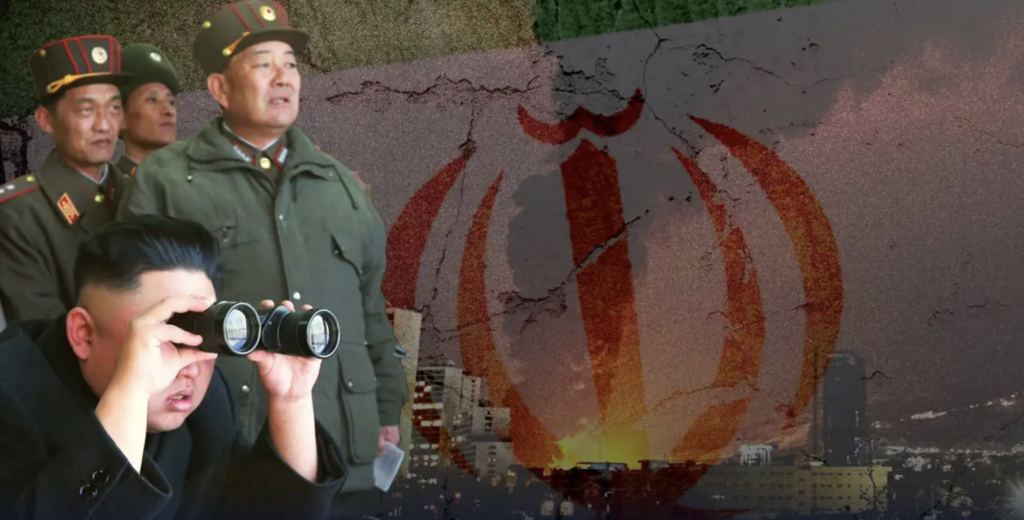
North Korea runs one of the most bizarre economies on the planet. Despite being one of only a handful of nations with nuclear weapons, its 2024 gross domestic product (GDP) was a paltry $26.6 billion (€22.9 billion).
This is about 70 times smaller than South Korea’s $1.86 trillion economy and about a fifth of the annual revenue of the world’s top-traded company, NVIDIA.
Thanks to a centrally planned economy that prioritizes domestic production, North Korea is nowhere near as reliant on trade as your average free-market economy, partly due to United Nations sanctions, introduced in 2017 over its nuclear weapons and ballistic missiles program.
The North’s total imports and exports account for just a small fraction of GDP, versus the South, where international trade makes up around 80% of the economy, according to the World Bank.
How important is China in North Korea’s economy?
You could say that China plays almost an exclusive role in North Korea’s minimal reliance on trade.
Advertisement
According to the Washington-based think tank The National Committee on North Korea, Pyongyang depends on China for up to 95% of total trade and 85% of its exports.
Almost all imports also come from China. In 2024, North Korea’s legitimate imports totaled just $2.33 billion — tiny by global standards.
With no domestic oil production, these deliveries from China include petroleum and other fuels and are essential in keeping the economy functioning, along with food, textiles, machinery, electronics and vehicles.
This gives Beijing enormous economic clout over North Korean leader Kim Jong Un. A recent report suggested that US President Donald Trump is now trying to leverage that muscle to bring Pyongyang back to the negotiating table over its contentious nuclear weapons program.
South Korea’s Yonhap news agency reported recently that Chinese President Xi Jinping is expected to visit Pyongyang in the next few weeks, playing a key mediator role to help bridge the gap between Trump and Kim in the long-running dispute. Beijing is yet to confirm the trip.
What is North Korea allowed to export to the rest of the world?
The rogue state’s legitimate exports are even less impressive. According to the Korea Trade-Investment Promotion Agency (KOTRA), North Korea’s exports barely reached $360 million in 2024.
Those foreign sales are strikingly modest, with fake hair and wigs the country’s only best seller, making up about 40% of exports, primarily to China, which then reexports them to the rest of the world.
North Korea turned to wigs for vital foreign income after sanctions blocked its traditional big exports like coal and minerals, while fake hair was not explicitly banned.
The communist country also has an abundant supply of low-cost and often forced labor — perfect for a highly labor-intensive and low-tech business like wigmaking.
Other goods like tungsten and other ores, frozen fish, iron and steel and watch components each make up less than 10% of the country’s exports.
Since the sanctions were imposed, Pyongyang has lost roughly $2.2 billion annually in export revenue, according to the Korea Economic Institute of America think tank.
How else does Pyongyang make money?
Beyond its meager exports, North Korea generates significantly more hard currency through its shadow economy.
The country sends tens of thousands of workers overseas, many to Russia and China, to work in construction, logging, factories and fisheries.
This program is widely seen by human rights groups and the UN as another form of forced labor.
The state then seizes most of their wages, generating around half a billion dollars annually, according to the UN Panel of Experts.
Thousands of North Korean computer professionals also work remotely for US, South Korean and European Union-based companies, pretending to be legitimate freelancers, using false — often stolen — identities.
Often, they earn high salaries, which are then funneled back to the regime. In 2024, these loyalty remittances brought in $800 million for the state, according to the US Treasury Department.
North Korea also operates one of the world’s most sophisticated and lucrative hacking programs, prompting one US think tankto label its cybercriminals “the most dangerous state-sponsored threat to the financial services sector.”
Last year, North Korean hackers stole a record $2.02 billion in cryptocurrency, representing over half of all global digital currency theft that year, the blockchain intelligence firm Chainalysis calculated.
Yet, the communist nation’s biggest — and most shadowy — money spinner has been fueled by the war in Ukraine and Pyongyang’s longstanding close ties with Moscow.
North Korea has supplied Russia with millions of artillery shells, rockets and ballistic missiles, boosting the Kremlin’s war machine and earning Kim’s regime an estimated $7 billion to $13.8 billion since 2023, according to South Korea’s Institute for National Security Strategy.
These revenues, according to Seoul-based intelligence officials, are being used to accelerate the North’s nuclear and ballistic missile program, as well as source additional oil and food from China.