By In Depth Reports
Europe is facing one of the most severe climate emergencies in its modern history. What began as an intense summer heatwave has rapidly evolved into a continent-wide crisis affecting public health, energy infrastructure, water security, agriculture, transportation, and economic productivity. From France and Spain to Germany, the United Kingdom, Italy, Belgium, and the Netherlands, record-breaking temperatures have pushed national emergency systems to their limits, raising urgent questions about whether Europe is adequately prepared for the accelerating consequences of climate change.
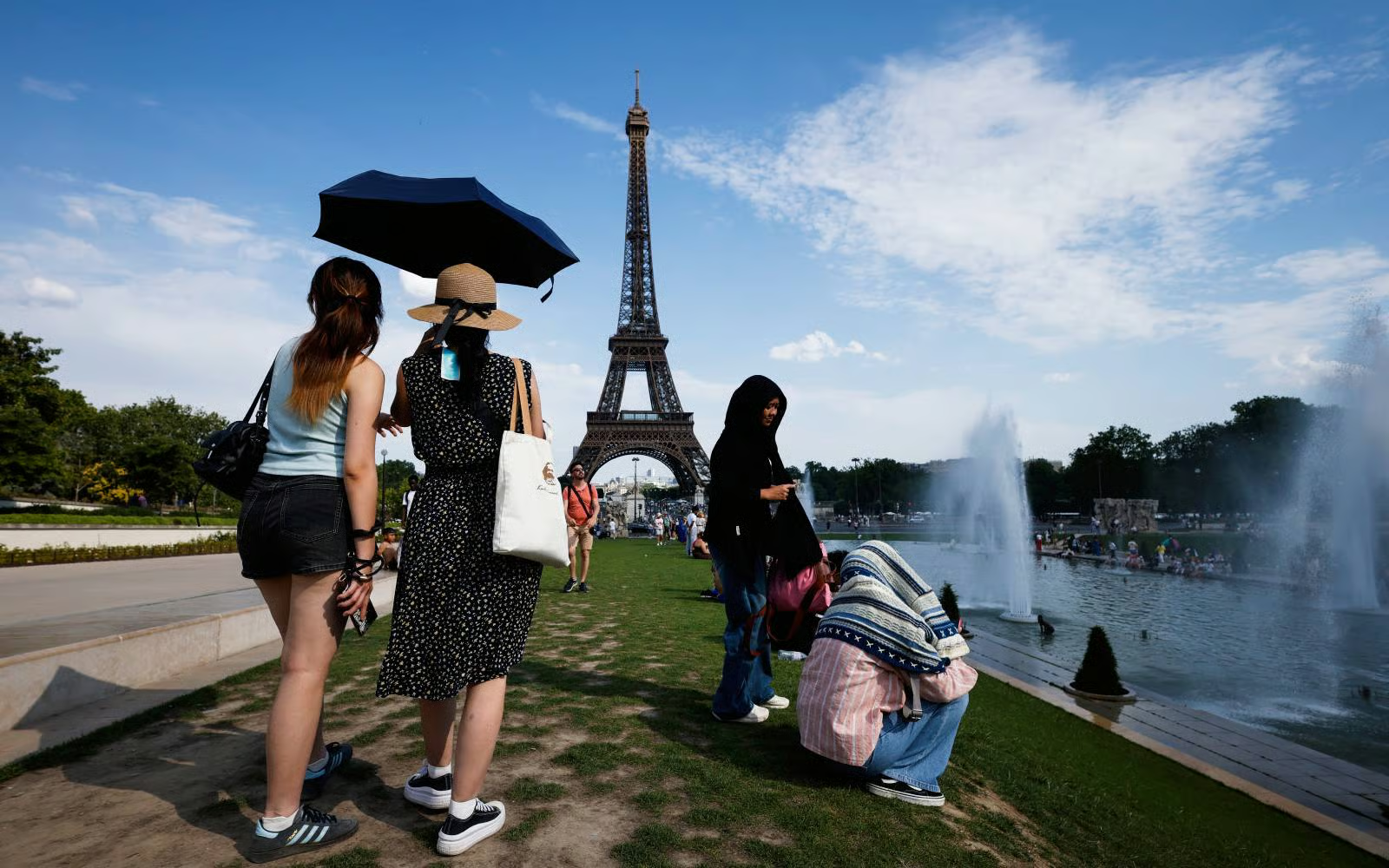
France has recorded its hottest day since national temperature records began in 1947, with the country’s national temperature indicator reaching an unprecedented 30°C. Paris approached 41°C, while parts of western France exceeded 43°C. Across the country, red heat alerts have been issued, thousands of households have experienced power outages, and public authorities have closed schools, reduced transportation services, and restricted access to major tourist attractions. Even iconic landmarks such as the Louvre Museum and the Eiffel Tower shortened operating hours because existing infrastructure was unable to cope with the extreme temperatures.
The consequences have extended far beyond inconvenience. Authorities have linked dozens of deaths to the heatwave, including drownings as people sought relief from the extreme temperatures. Wildfires have intensified across several regions, forcing the deployment of hundreds of firefighters, while hospitals have reported increasing admissions related to heat exhaustion, dehydration, and respiratory complications. Similar patterns are emerging across Spain, Italy, Germany, and the United Kingdom, where June temperature records have been shattered in multiple locations.
This is no longer an isolated weather event. Scientists increasingly describe Europe as the world’s fastest-warming continent, with average temperatures rising at approximately twice the global rate. This accelerated warming is transforming what were once considered exceptional heatwaves into increasingly frequent and prolonged climate events. The implications extend far beyond seasonal discomfort. Extreme heat is becoming a structural challenge for European societies.
One of the most immediate vulnerabilities exposed by the current heatwave is Europe’s aging infrastructure. Much of the continent’s transport systems, public buildings, electricity networks, and urban environments were designed for a cooler climate. Railways experience thermal expansion, roads soften under prolonged heat, electricity demand surges as air conditioning usage increases, and power generation itself becomes less efficient as cooling water temperatures rise. Urban centers, dominated by concrete and asphalt, trap heat and create so-called “urban heat islands,” where temperatures remain dangerously high even after sunset.
The economic implications are equally significant. Heatwaves increasingly reduce labour productivity, particularly in construction, manufacturing, agriculture, logistics, and outdoor services. Employers face growing pressure to modify working hours, suspend operations during peak temperatures, or invest in expensive cooling technologies. Agricultural production is also under increasing stress as prolonged heat accelerates soil moisture loss, reduces crop yields, and increases irrigation demand at a time when water resources are becoming scarcer.
Water security has emerged as another major concern. Authorities in parts of Germany have already urged residents to reduce water consumption as reservoirs and rivers experience declining levels. Similar concerns are being reported across southern Europe, where repeated summer droughts have become increasingly common. Water scarcity now affects not only households but also agriculture, industry, hydroelectric generation, and inland navigation. As climate change intensifies, competition over freshwater resources is likely to become one of Europe’s most significant long-term governance challenges.
The heatwave also highlights growing concerns about public health resilience. Heat has become one of the deadliest natural hazards in Europe, particularly for elderly populations, individuals with chronic illnesses, outdoor workers, and socially vulnerable communities. Unlike floods or storms, heatwaves often produce relatively little visible destruction while causing substantial increases in mortality. Public health experts increasingly argue that extreme heat should be treated as a major health emergency rather than simply a seasonal weather phenomenon.
Climate change is simultaneously reshaping Europe’s energy transition. Renewable energy remains central to European decarbonization strategies, yet prolonged heat creates new pressures on electricity systems. Air conditioning demand increases sharply during heatwaves, placing additional strain on power grids. At the same time, reduced river flows may affect hydroelectric generation, while thermal power plants often face operational constraints because rivers become too warm to provide sufficient cooling. The interaction between climate adaptation and energy security is becoming increasingly complex.
Urban planning is another area undergoing fundamental reassessment. Cities originally designed to maximize economic activity rather than climate resilience now face increasing pressure to adapt. Expanding green spaces, planting urban forests, redesigning public buildings, introducing heat-resistant construction materials, and improving passive cooling systems are rapidly becoming central components of municipal planning across Europe. The current crisis demonstrates that climate adaptation can no longer be viewed as a long-term objective; it has become an immediate governance priority.
The political implications are also becoming more pronounced. Governments are increasingly being judged not only by their climate mitigation policies but also by their ability to protect citizens from climate impacts that are already occurring. Investment in adaptation infrastructure, emergency preparedness, public warning systems, and resilient healthcare services is becoming just as politically important as reducing greenhouse gas emissions. The distinction between climate policy and national resilience is steadily disappearing.
Scientists caution that the 2026 heatwave is unlikely to remain an exceptional event. Climate projections indicate that Europe will continue experiencing more frequent, longer-lasting, and more intense heatwaves unless global emissions decline substantially. Even under optimistic scenarios, many impacts are now unavoidable due to the cumulative warming already locked into the climate system.
For Europe, the challenge is therefore no longer whether climate change will reshape society. That transformation is already underway. The central question is whether governments, businesses, and communities can adapt quickly enough to protect lives, maintain economic stability, and preserve critical infrastructure in a continent that is becoming progressively hotter each year.
The 2026 heatwave should therefore be understood not as a temporary weather emergency but as a warning. It demonstrates that climate change is no longer a future environmental concern. It has become an immediate security, economic, public health, and governance challenge capable of influencing every aspect of European society. How Europe responds to this new reality may ultimately determine not only its environmental future but also its long-term resilience in an increasingly unstable climate.