By InDepthReports
Europe is entering a new arms race, but this time the central battlefield is not only on NATO’s eastern flank or in the trenches of Ukraine. It is inside ammunition plants, missile factories, shipyards, drone workshops, steel mills, electronics suppliers, and defence procurement offices across the continent. After decades of shrinking military budgets and reduced industrial capacity, European governments are now attempting to rebuild a defence base capable of sustaining long-term deterrence against Russia while continuing to arm Ukraine and prepare for a less predictable transatlantic future.
The urgency is visible everywhere. Defence spending across Europe has risen sharply since Russia’s full-scale invasion of Ukraine, with EU member states increasing expenditure from around €218 billion in 2021 to roughly €392 billion in 2025, according to the Swedish Institute for European Policy Studies. Yet the central challenge facing Europe is no longer simply whether governments are willing to spend more. The real question is whether European industry can turn political promises and budget increases into actual weapons, ammunition, air defence systems, drones, missiles, and spare parts fast enough to meet the demands of modern war.
The war in Ukraine has exposed a hard reality that many European capitals had avoided confronting for decades: modern high-intensity warfare consumes military equipment at a pace far beyond peacetime production models. Artillery shells are fired by the thousands, drones are lost and replaced in days, air defence missiles are consumed faster than manufacturers can produce them, and damaged vehicles require continuous repair. European defence industries were not designed for this tempo. They were structured for limited procurement cycles, export orders, and gradual modernization, not for industrial-scale war on the continent.
This is why Europe’s rearmament debate has shifted from defence spending to defence production. NATO members can announce new targets, sign communiqués, and increase budgets, but deterrence depends on what factories can actually deliver. The Centre for European Reform estimates that European NATO allies and Canada spent $574 billion on defence in 2025, with equipment investment among EU NATO members reaching nearly €130 billion. However, higher spending has not automatically solved shortages in ammunition, missiles, air defence interceptors, heavy vehicles, and critical components.
The most visible gap is ammunition. Since 2022, Europe has dramatically increased artillery shell production, yet demand from Ukraine and NATO stockpiles continues to exceed available supply. The European Union created emergency instruments such as the Act in Support of Ammunition Production to expand manufacturing capacity and help member states refill depleted stocks. The European Commission also launched the European Defence Industry Programme, a €1.5 billion initiative intended to strengthen production capacity, modernize the defence industrial base, and ensure a steadier supply of military equipment to member states.
But the industrial problem goes deeper than artillery rounds. Ukraine’s battlefield needs have revealed shortages in air defence systems, missile interceptors, radar components, electronic warfare equipment, counter-drone systems, armoured vehicles, and battlefield communications. CSIS has noted that Ukraine’s demand for air defence interceptors alone is estimated at around 4,800 units annually, far beyond current European production capacity. This gap matters not only for Ukraine’s survival, but for NATO’s own credibility. If Europe cannot sustain Ukraine while rebuilding its own forces, adversaries may conclude that NATO’s deterrence is politically strong but industrially fragile.
In response, defence companies are moving quickly. Rheinmetall, Saab, MBDA, BAE Systems, Leonardo, KNDS, Thales, Airbus Defence and Space, and dozens of smaller firms are expanding production lines, signing long-term contracts, and investing in new facilities. In July 2026, Lockheed Martin and Rheinmetall signed a memorandum of understanding to jointly produce ATACMS missiles in Germany, marking the first time these US-designed systems would be manufactured outside the United States. The agreement reflects a broader shift: Europe is no longer only buying weapons; it is trying to bring production closer to the continent’s future battlefields.
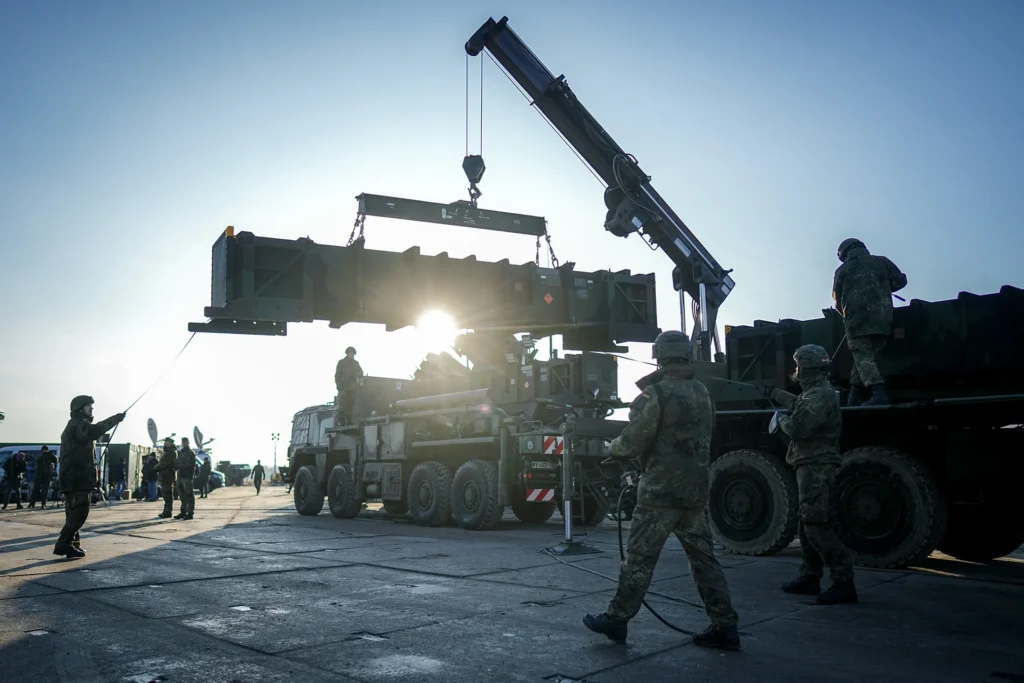
At the NATO Industry Forum held alongside the alliance’s summit in Ankara, several major defence agreements illustrated the scale of this transformation. Saab entered formal negotiations to provide NATO with GlobalEye airborne early warning aircraft. The United States announced plans for a European maintenance facility for PAC-3 air defence missiles, with possible future overseas production. NATO allies also moved forward with plans to purchase MQ-4C Triton surveillance drones and expand airlift capabilities through Airbus A400M aircraft and additional tanker capacity. These deals show that Europe’s defence build-up is not limited to traditional land warfare; it includes surveillance, logistics, missiles, air defence, space launch, and command-and-control infrastructure.
Yet the pace of expansion remains constrained by structural bottlenecks. Defence manufacturing cannot be scaled like consumer technology. Ammunition requires explosives, metals, propellants, specialized machinery, safety-certified facilities, trained labour, environmental permits, and predictable orders. Missile production depends on microelectronics, rocket motors, sensors, guidance systems, rare materials, and highly specialized supply chains. Many of these inputs remain vulnerable to global disruption. Even when governments provide funding, factories require years to expand safely and efficiently.
This is one reason why defence executives consistently demand long-term contracts rather than emergency political declarations. For decades, European governments purchased weapons in small batches, delayed procurement decisions, and prioritized cost efficiency over industrial readiness. Companies had little incentive to maintain excess production capacity. Now governments are asking the same firms to expand rapidly, but industry wants guarantees that demand will last beyond the current political cycle. Without predictable multi-year orders, companies are reluctant to invest billions in facilities that could become underused if political attention fades.
The economic implications are enormous. Rearmament is becoming a central pillar of European industrial policy. Defence production supports steel, chemicals, electronics, engineering, artificial intelligence, aerospace, cybersecurity, and advanced manufacturing. It creates high-skilled jobs and strengthens technological capacity. At the same time, it places new pressure on public budgets already strained by healthcare, ageing populations, energy transition costs, housing shortages, and post-pandemic debt. Europe is therefore facing a difficult trade-off: military readiness is increasingly urgent, but the fiscal and political cost of sustained rearmament will be substantial.
The United States remains deeply embedded in Europe’s rearmament drive. Despite calls for European strategic autonomy, many of the most advanced systems being purchased or co-produced still involve American companies, technologies, or intellectual property. NATO’s top leadership has argued that European arms orders support a significant number of US defence jobs, reflecting the continued interdependence of the transatlantic defence market. This creates both opportunity and vulnerability. American technology can help Europe rearm faster, but overreliance on US suppliers may limit Europe’s ability to act independently during future crises.
Ukraine has become the testing ground for this industrial transformation. The war has shown that innovation cycles can be dramatically shortened when military necessity is immediate. Ukrainian forces have rapidly adapted drones, electronic warfare systems, battlefield software, and improvised technologies in ways that traditional procurement systems would have taken years to approve. European defence planners are now attempting to absorb these lessons. The challenge is whether Europe can combine Ukrainian battlefield innovation with European industrial scale.
This is particularly important in the drone sector. Cheap unmanned systems have changed the economics of warfare. Expensive tanks, artillery systems, and air defence platforms remain essential, but they now operate in an environment saturated with low-cost drones, loitering munitions, electronic jamming, and real-time surveillance. European defence industries must therefore produce not only traditional platforms but also disposable systems at scale. The industrial model of the future may require both high-end precision weapons and mass-produced low-cost battlefield technologies.
The political dimension is equally complex. European governments agree broadly that rearmament is necessary, but they disagree over how it should be organized. Some countries prioritize NATO frameworks and US-linked procurement. Others support EU-based defence industrial policy and stronger European content requirements. The EU’s proposed financing instruments, including large-scale defence loans and European content rules, aim to strengthen the continent’s industrial base, but they also raise questions about access for non-EU allies such as the United Kingdom, Norway, and Turkey, all of which remain important to European security.
There is also a risk of duplication. If each country attempts to protect its own defence champions, Europe could spend more money without solving fragmentation. The continent already operates too many different weapons systems, vehicle types, aircraft fleets, and ammunition standards compared with the United States. This weakens interoperability and increases maintenance costs. A serious European rearmament strategy will require more standardization, joint procurement, shared stockpiles, and cross-border industrial planning.
The stakes are high because deterrence is ultimately a matter of credibility. Russia and other potential adversaries will not judge NATO only by summit declarations or defence spending percentages. They will assess whether European countries can mobilize industry, replenish losses, sustain operations, and support allies under pressure. If Europe’s factories cannot keep pace with NATO’s military ambitions, then higher defence spending may produce the appearance of strength without the substance of readiness.
The new arms race in Europe is therefore not simply about weapons. It is about whether democratic societies can rebuild strategic industries after decades of assuming that large-scale war had become unlikely. It is about whether governments can align budgets, factories, supply chains, labour markets, technology, and political will. It is also about whether Europe can support Ukraine while preparing for a future in which the United States may expect Europeans to carry a far larger share of their own defence burden.
The coming years will determine whether Europe’s rearmament becomes a genuine strategic transformation or another cycle of ambitious promises followed by slow delivery. The continent has money, technical expertise, and world-class defence firms. What it still needs is speed, coordination, and long-term political discipline. In the age of industrial war, deterrence begins not only at the front line, but on the factory floor.