By In Depth Reports
The latest escalation between the United States and Iran suggests that the conflict has entered a far more dangerous phase than previous rounds of military confrontation. After several consecutive nights of American strikes targeting Iranian military infrastructure along the country’s southern coastline, Washington has moved beyond limited retaliatory operations toward a broader strategy aimed at restricting Iran’s maritime capabilities and reasserting military control over one of the world’s most strategically important waterways. At the same time, Iran has responded by expanding the geographical scope of its military actions beyond its own territory, targeting commercial shipping in the Strait of Hormuz while launching missile and drone attacks against American partners across the Gulf.
These developments indicate that the confrontation is no longer confined to direct military exchanges between Washington and Tehran. Instead, the Strait of Hormuz has once again become the central arena where military escalation, global energy security, commercial shipping, and regional geopolitics intersect. Every missile launched in the Gulf now carries implications extending well beyond the Middle East, influencing international oil prices, maritime insurance costs, shipping routes, financial markets, and diplomatic calculations from Brussels to Beijing.
Unlike previous crises, the current escalation has directly targeted the infrastructure supporting global maritime commerce. Reports of attacks against commercial tankers, the temporary disruption of navigation, and renewed discussions surrounding naval blockades have fundamentally altered international perceptions of maritime security in the Gulf. Even without a complete closure of the Strait, uncertainty alone has proven sufficient to disrupt commercial planning and raise operational costs for shipping companies operating across one of the world’s busiest energy corridors. The psychological impact on global markets has become almost as significant as the physical disruption itself.
Washington’s latest military operations also reveal an important strategic shift. Rather than concentrating exclusively on Iran’s nuclear infrastructure or missile facilities, recent strikes have increasingly focused on coastal defence systems, naval assets, drone installations, and maritime military infrastructure stretching from Bandar Abbas to Chabahar. This reflects a broader American objective: limiting Iran’s ability to threaten international shipping and preserving freedom of navigation through the Strait of Hormuz. The maritime domain has become the primary battlefield of this confrontation, illustrating how control over sea lanes is now considered as strategically significant as control over airspace or territory.
Iran, meanwhile, appears determined to demonstrate that any attempt to isolate it militarily will carry regional consequences. Missile and drone attacks claimed by Iranian forces and affiliated actors against Bahrain, commercial shipping, and other strategic targets suggest an effort to widen the operational theatre while increasing pressure on American allies throughout the Gulf. This strategy seeks not necessarily to defeat superior military forces directly, but to raise the political and economic costs of continued military operations by creating persistent instability across multiple fronts.
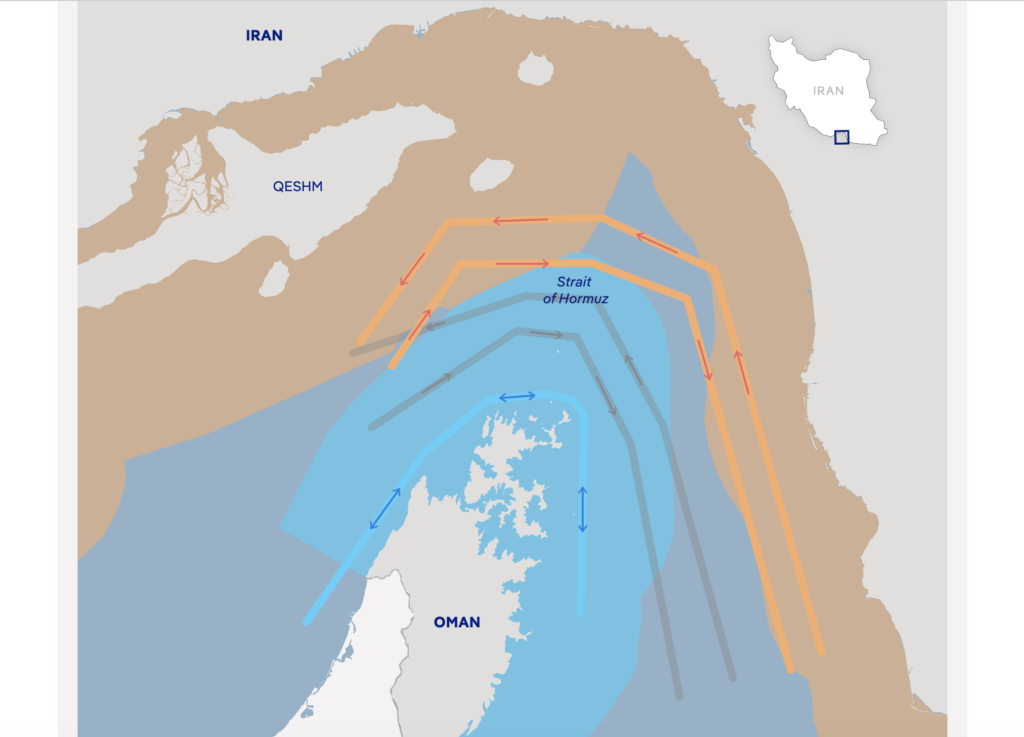
The attacks against commercial vessels are particularly significant because they challenge one of the fundamental principles underpinning the international economic system: freedom of navigation through international waterways. Modern global trade depends upon predictable maritime transport. Any sustained disruption in the Strait of Hormuz immediately affects energy exporters, import-dependent economies, insurance providers, shipping companies, commodity markets, and manufacturing industries. For Europe and Asia in particular, maintaining uninterrupted access through the Gulf has become inseparable from broader economic security.
Equally important is the widening diplomatic dimension of the crisis. India’s formal protest following the death of one of its nationals aboard a commercial tanker illustrates how countries traditionally seeking to avoid regional military disputes may increasingly find themselves drawn into the crisis because of its impact on civilian shipping and international trade. Similar concerns are emerging among major shipping operators and governments whose economic interests depend upon secure maritime commerce. As civilian casualties aboard commercial vessels increase, diplomatic pressure on all parties is likely to intensify.
Another notable development is the growing overlap between military operations and economic coercion. Discussions surrounding new transit fees, maritime restrictions, naval blockades, and commercial access indicate that economic instruments are becoming increasingly integrated into military strategy. Rather than separating military and economic pressure, both sides appear to be combining them into a broader campaign designed to influence political decision-making without necessarily expanding into full-scale conventional war. This reflects a wider transformation in contemporary conflict, where financial markets, energy infrastructure, logistics networks, and commercial shipping have become legitimate strategic objectives.
Perhaps the most significant lesson emerging from the current escalation is that the Strait of Hormuz is no longer simply an energy corridor. It has evolved into one of the world’s most consequential geopolitical pressure points, where military confrontation, international commerce, diplomacy, and economic stability converge. The current crisis demonstrates that future conflicts in the Gulf are unlikely to remain regional in their consequences. Instead, they will continue to generate immediate global repercussions affecting governments, multinational corporations, financial institutions, and international organizations alike.
As military operations continue and diplomatic efforts struggle to contain further escalation, the central question is no longer whether the Strait of Hormuz can remain open. The more important question is whether the international system can preserve confidence in one of its most critical maritime arteries while regional conflict increasingly targets the infrastructure upon which global trade depends. The answer will shape not only the future of Gulf security but also the resilience of the international economic order itself.