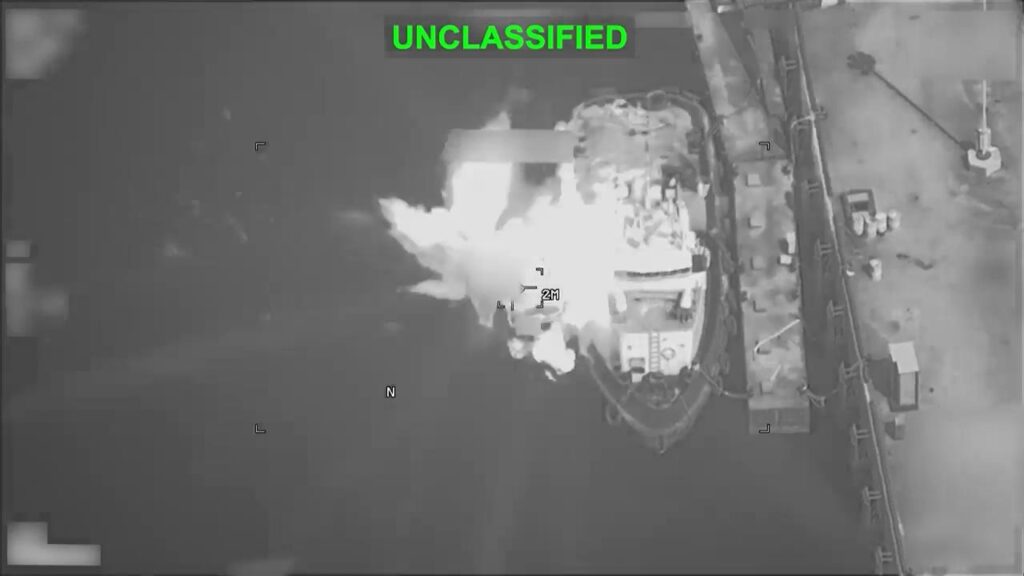
As U.S. strikes enter their thirteenth consecutive night, the confrontation with Iran is evolving from a limited military campaign into a broader struggle over who controls the world’s most strategic maritime corridors.
In Depth Reports
The latest wave of U.S. military operations against Iran is no longer being framed as a temporary response to isolated attacks. With U.S. Central Command confirming a thirteenth consecutive night of strikes targeting military command centers, drone storage facilities, communications networks, coastal surveillance systems, and maritime capabilities, Washington appears to be pursuing a broader strategic objective: reshaping the balance of power around the Strait of Hormuz rather than merely punishing Tehran.
The United States argues that the campaign is intended to reduce the Islamic Revolutionary Guard Corps’ ability to threaten commercial shipping and ensure freedom of navigation. Yet the geographical expansion of the strikes—from southern to northern Iran—combined with the reimposition of a naval blockade around Iranian ports suggests that the operation has moved beyond protecting merchant vessels toward placing sustained military and economic pressure on Iran.
From Tehran’s perspective, however, the campaign represents an effort to strip Iran of the deterrence architecture it has built over decades, including its missile arsenal, drone capabilities, asymmetric naval forces, and network of regional allies.
From the Strait of Hormuz to the Red Sea
Perhaps the most significant development is that the confrontation is no longer confined to the Strait of Hormuz.
In the Red Sea, Yemen’s Iran-backed Houthi movement claimed responsibility for attacks on two Saudi oil tankers, extending the crisis to another critical global shipping artery connecting the Bab el-Mandeb Strait with the Suez Canal.
The strategic connection between Hormuz and the Red Sea is far from accidental. If one maritime corridor becomes unstable, global energy markets can partially compensate through the other. But if both routes are simultaneously threatened, shipping alternatives become longer, more expensive, and significantly less efficient.
For major oil exporters such as Saudi Arabia, avoiding high-risk waterways could require tankers to reroute around the Cape of Good Hope, adding weeks to delivery times while substantially increasing fuel, insurance, and operating costs.
The conflict has therefore evolved beyond military confrontation into an economic contest over who can impose the highest costs on global commerce.
Iran’s Strategy: Weaponizing Geography
Iran understands that it cannot match the United States in conventional naval or air power. Instead, its long-standing strategy relies on asymmetric deterrence.
Rather than attempting to destroy the U.S. Navy, Tehran only needs to make maritime trade unpredictable. By increasing insurance premiums, forcing shipping companies to reroute vessels, delaying cargo movements, and maintaining uncertainty around one of the world’s busiest energy corridors, Iran can generate significant economic pressure without formally closing the Strait of Hormuz.
In energy markets, perception is often as powerful as reality. Oil prices tend to rise before supplies are interrupted, insurance costs increase before ships are damaged, and shipping companies alter their routes long before governments officially declare waterways unsafe.
Washington’s Strategy: Protecting Navigation—or Controlling It?
Washington presents its military operations as a defense of international freedom of navigation. However, the reimposition of a blockade targeting Iranian ports introduces a strategic contradiction.
On one hand, the United States argues that Iran has no right to interfere with international shipping. On the other, U.S. naval forces are actively preventing vessels from accessing Iranian ports under the framework of the renewed blockade.
This raises broader legal and political questions. Is the United States defending open navigation for all commercial shipping, or is it enforcing a maritime order shaped by American strategic interests?
The longer the blockade continues, the more difficult it becomes to distinguish between protecting commercial shipping and economically isolating Iran.
Expanding the Battlefield
Iran has warned that any country assisting U.S. military operations could be considered a legitimate participant in the conflict.
This warning extends beyond Washington itself. States hosting U.S. military bases—or allowing their territory or airspace to support American operations—could increasingly become potential targets for Iranian retaliation.
Recent security incidents in Bahrain, Kuwait, and near Erbil International Airport in Iraq demonstrate how quickly the conflict could spread beyond Iran’s borders.
For Gulf states, the dilemma is increasingly apparent. Hosting American military infrastructure enhances regional security under normal circumstances but also increases vulnerability during periods of direct confrontation between Washington and Tehran.
The Houthi Factor
The Houthis’ entry into the conflict introduces an additional layer of strategic complexity.
Attacks on Saudi oil tankers place pressure on Riyadh from two maritime fronts simultaneously: the Persian Gulf to the east and the Red Sea to the west.
For Washington, this creates a difficult strategic calculation. A direct military response against the Houthis risks expanding the conflict into Yemen, while restraint could undermine U.S. credibility as the guarantor of maritime security and regional stability.
For Tehran, however, the involvement of allied non-state actors provides strategic flexibility by increasing pressure on adversaries without necessarily requiring direct Iranian military engagement.
Trump’s Proposal to Use Frozen Iranian Assets
President Donald Trump’s proposal to compensate future shipping losses using frozen Iranian assets introduces another dimension to the conflict.
Politically, the proposal seeks to demonstrate that Iran will ultimately bear the financial consequences of any disruption to international commerce.
Legally, however, the idea raises complex questions. Using sovereign assets to compensate for future damages not yet adjudicated by international courts could establish a controversial precedent extending far beyond the current crisis.
Such a move could also encourage other governments to reconsider the extent of their financial exposure within U.S.-controlled financial institutions.
The Global Economy Enters the Battlefield
The consequences of the conflict are no longer limited to military operations.
Higher insurance premiums, longer shipping routes, rising transportation costs, and volatility in energy markets all contribute to renewed inflationary pressures worldwide.
For energy-importing countries, particularly developing economies, sustained instability around the Strait of Hormuz and the Red Sea could translate into higher fuel prices, increased food costs, and mounting pressure on public finances.
In this sense, the struggle over these waterways is no longer merely a regional security issue—it has become a global economic challenge.
Has Deterrence Worked?
The central strategic question remains whether thirteen consecutive nights of strikes have meaningfully reduced Iran’s ability—or willingness—to threaten maritime security.
While U.S. airpower may successfully degrade Iranian military infrastructure, eliminating Tehran’s broader asymmetric capabilities is considerably more difficult.
Missiles can be dispersed, drones relocated, and regional partners can continue operating beyond Iran’s borders.
More importantly, military attrition does not necessarily alter political decision-making. Continued strikes may weaken Iran militarily while simultaneously strengthening its determination to demonstrate that American coercion has failed.
The conflict increasingly resembles a classic escalation dilemma: restraint risks appearing as weakness, while continued escalation raises the probability of a wider regional war.
What Comes Next?
Three broad scenarios appear plausible.
The first is a prolonged war of attrition involving sustained U.S. strikes, intermittent Iranian attacks on maritime targets, and continued Houthi operations in the Red Sea. This scenario would maintain elevated energy prices and persistent uncertainty in global shipping without necessarily triggering full-scale war.
The second is regional escalation. A large-scale attack causing significant American casualties or major damage to Gulf infrastructure could prompt Washington to expand its target list beyond military assets toward critical state infrastructure.
The third remains a negotiated de-escalation under pressure. Temporary arrangements guaranteeing maritime navigation in exchange for a reduction in military operations remain possible, although both sides are likely to resist any agreement that appears to signal political retreat.
The latest U.S. strikes against Iran represent far more than another chapter in a military confrontation. They are part of a wider struggle over maritime dominance, economic leverage, and strategic influence across two of the world’s most important shipping corridors.
Washington seeks to reinforce its role as the principal guarantor of international navigation. Iran, meanwhile, aims to demonstrate that geography itself can become a powerful strategic weapon capable of imposing costs on even the world’s strongest military power.
The outcome of this confrontation will shape not only the future security architecture of the Middle East but also the resilience of the global economy, energy markets, and international trade for years to come.