An In Depth Reports
The shutdown of Romania’s only nuclear power plant and Hungary’s emergency efforts to raise the Danube around the Paks facility mark a significant escalation in Europe’s emerging energy-security crisis. What was once considered a seasonal operational concern — unusually low river levels during hot summers — is becoming a structural vulnerability for nuclear power systems built around predictable access to cooling water. The events unfolding along the Danube in August 2026 show that climate pressure is no longer testing isolated infrastructure. It is beginning to challenge the assumptions underlying national electricity planning across Central and Eastern Europe.
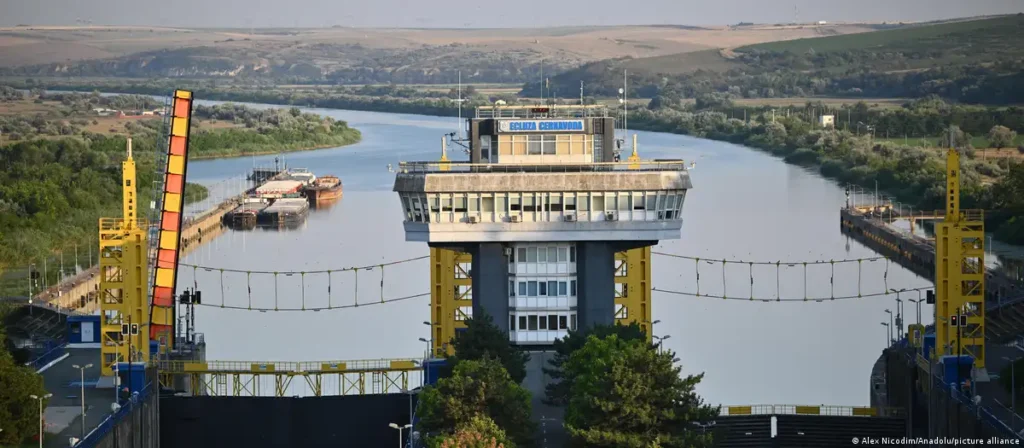
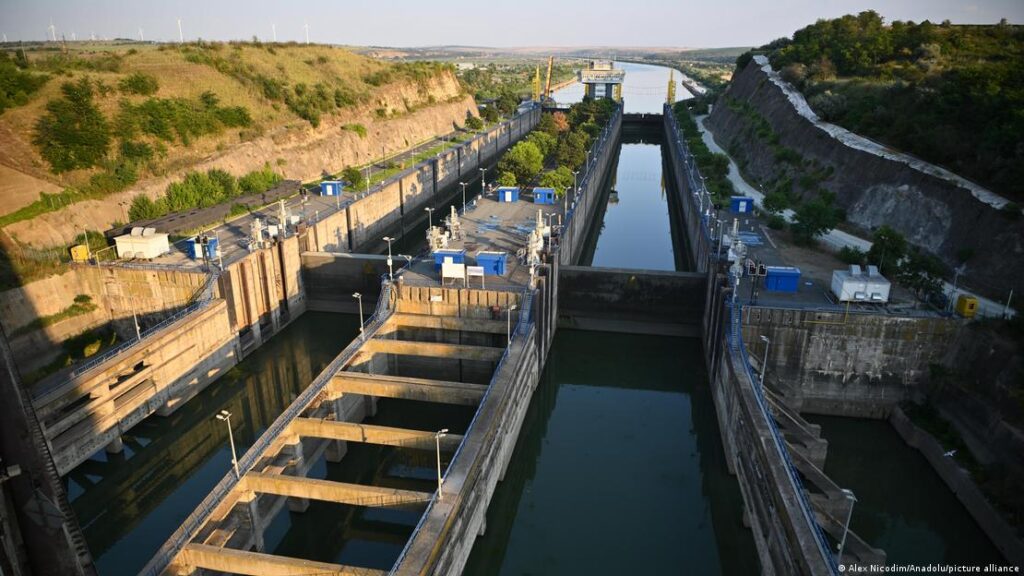
Romania’s decision to completely shut down the Cernavoda nuclear plant is especially significant because the facility normally generates around one-fifth of the country’s electricity. The plant depends entirely on the Danube for cooling water, and the continued collapse in river levels eventually made operation impossible. One reactor had already been shut down in July, and the second was taken offline after the plant operator concluded that water levels had fallen too far to guarantee continued operation. The shutdown is expected to last at least ten days, although the exact restart date will depend on hydrological conditions rather than purely technical maintenance schedules. That distinction matters: the plant is not unavailable because of mechanical failure, but because the river itself can no longer support normal operation.
The measures taken before the shutdown underline how serious the situation had become. Romanian authorities worked with the Navy to alter the riverbed and redirect more water toward Cernavoda, including controlled underwater demolitions of exposed rock formations. These efforts were extraordinary precisely because they attempted to adapt the physical river system around the needs of the nuclear plant. Their failure demonstrates the limits of emergency engineering when drought becomes severe enough to change the fundamental hydrology of a major European waterway.
Hungary is now attempting an even more ambitious intervention to avoid the same outcome. The Paks nuclear power plant, normally responsible for roughly half of Hungary’s electricity generation, is currently operating at a fraction of its usual capacity, with only one of four reactors online. To prevent a full shutdown, the Hungarian government has begun constructing a temporary low weir intended to raise the Danube’s water level in front of the plant’s cooling system. Before the structure is completed, authorities plan to sink two large barges across the river to create an initial damming effect. Soldiers are reportedly working around the clock, and the project is expected to raise the local water level by more than one meter.
The significance of these interventions goes far beyond Romania and Hungary. Two European countries are now altering one of the continent’s most important rivers simply to keep nuclear electricity production viable during extreme drought. This is not merely an engineering story. It is a warning that climate adaptation is becoming inseparable from national energy security.
The vulnerability comes from the basic design of large thermal power stations. Nuclear plants generate electricity by producing heat, but a large portion of that heat must ultimately be removed through cooling systems. Inland facilities commonly depend on nearby rivers for this purpose. As long as water levels remain sufficiently high and temperatures sufficiently low, the arrangement is highly effective. But prolonged drought changes both conditions simultaneously. Less water is available, and the water that remains is often warmer, reducing the efficiency of cooling systems and increasing the risk of violating environmental temperature limits when heated water is discharged back into the river.
The Danube crisis therefore exposes a fundamental contradiction in Europe’s current energy strategy. Nuclear power is increasingly regarded as an important tool for reducing carbon emissions, stabilising electricity systems and limiting dependence on imported fossil fuels. Yet many existing reactors were designed in a climatic environment where prolonged river droughts of today’s intensity were significantly less common. The issue is not whether nuclear power is compatible with climate policy. The issue is whether ageing infrastructure built around twentieth-century hydrological assumptions is prepared for twenty-first-century climate extremes.
Romania’s response also shows how quickly a climate event can become an industrial and economic problem. The Energy Ministry has moved to secure alternative electricity through wind generation and imports, while asking consumers to reduce demand. Large industrial users could face restrictions if shortages worsen. Ford and Dacia have already agreed to pause production temporarily in order to save electricity. The closure of a nuclear plant therefore propagates far beyond the power sector: manufacturing schedules, industrial output, trade flows and employment can all be affected.
This is precisely why nuclear cooling should now be treated as an economic-security issue rather than a technical one. A plant providing one-fifth of national electricity cannot be removed from the system without consequences. Imports may compensate in the short term, but neighbouring countries may be experiencing the same heat and drought. Wind generation can help, but it is variable. Gas-fired power can provide flexibility, but at the cost of higher fuel consumption and potentially higher emissions. The more climate stress affects multiple power sources simultaneously, the more limited the alternatives become.
Hungary’s case is even more exposed because Paks accounts for such a large share of domestic electricity generation. When one facility carries that much of the national load, river conditions effectively become a matter of strategic security. A few additional centimetres of water can determine whether reactors remain online. This is an extraordinary level of dependence on a natural system that climate change is making less predictable.
The use of emergency weirs and barges may buy time, but it cannot solve the underlying problem. Raising water levels locally may improve intake conditions for cooling, yet it does not create new water across the Danube basin. It can also alter river flows, navigation and ecological conditions downstream. As drought becomes more persistent, national efforts to retain water may increasingly create cross-border tension because major European rivers are shared systems. What benefits one country’s power plant may affect another country’s agriculture, transport or ecosystems.
This raises an issue that European energy policy has not yet fully confronted: water itself is becoming a strategic resource. Energy, agriculture, transport, cities and ecosystems all depend on the same river systems. During normal conditions, these demands can coexist. During extreme drought, priorities begin to conflict. Governments may eventually be forced to decide whether scarce water should be preserved for electricity generation, drinking supplies, farming, navigation or environmental protection. The politics of energy security may therefore increasingly become the politics of water allocation.
The Danube is particularly important because it crosses or borders numerous European states. Low water levels affect not only power generation but also commercial shipping, agricultural irrigation and industrial logistics. When the river becomes too shallow, vessels may need to reduce cargo loads or stop operating entirely. This means a severe drought can simultaneously weaken electricity supply and freight transport — two essential systems for industrial economies. Such compound disruptions are precisely the type of risk that conventional infrastructure planning has tended to underestimate.
Romania’s shutdown also demonstrates that adaptation measures cannot wait until a crisis is already underway. Blasting rocks in the riverbed or diverting flows may provide temporary relief, but these interventions occur after the system is already close to failure. More durable resilience will require redesigning cooling systems, improving storage and intake infrastructure, diversifying generation sources and developing contingency plans based on more severe drought scenarios.
For existing reactors, this may require expensive retrofits. Dry or hybrid cooling systems can reduce water dependence, but they can also lower efficiency and require additional investment. Alternative water-storage infrastructure may help during short droughts but may offer limited protection during prolonged basin-wide shortages. Coastal plants may be less exposed to river drought but face different climate risks, including rising sea temperatures and coastal flooding. There is no single climate-proof design.
The strategic answer must therefore be diversification. Europe’s energy system will need a combination of nuclear, renewables, storage, stronger grids and flexible backup generation so that failure in one part of the system does not translate into a national emergency. The Danube crisis shows the danger of relying too heavily on one large facility or one cooling source.
The events in Romania and Hungary are also a warning for governments planning new nuclear investment. A reactor commissioned in the 2030s may operate well into the second half of this century. Designers will therefore need to plan for river temperatures, drought patterns and water scarcity that could be very different from those observed historically. Climate resilience must be built into new nuclear projects from the beginning, rather than added later as an expensive retrofit.
Europe also needs better regional coordination. A drought affecting the Danube basin does not stop at national borders, yet nuclear contingency planning remains largely national. Shared river systems require shared forecasts, shared emergency protocols and shared decisions on how limited water should be managed during severe drought. Without coordination, countries may adopt competing interventions that protect domestic infrastructure while shifting risks elsewhere.
The deeper lesson from Cernavoda and Paks is that Europe’s energy transition is entering a more difficult phase. Building low-carbon generation is no longer enough. That generation must also remain reliable under the physical conditions created by climate change. Energy security and climate adaptation are now the same policy problem.
Romania’s shutdown should therefore not be dismissed as a rare anomaly. It is the second time Cernavoda has been forced offline because of drought and heat, and the measures now being taken in Hungary show that the same vulnerability is emerging elsewhere. If drought continues to intensify across Europe, such events could become more frequent rather than exceptional.
Europe’s nuclear debate has traditionally revolved around safety, waste, cost and carbon emissions. The Danube crisis adds another question that will be increasingly difficult to ignore: what happens when the water required to cool the reactors is no longer guaranteed?
The answer will shape not only the future of nuclear power, but the resilience of Europe’s entire electricity system. In a continent where heatwaves, drought and energy insecurity are increasingly converging, the river itself is becoming part of the power grid — and that may be one of Europe’s most underestimated strategic vulnerabilities.