Europe’s worsening drought problem is exposing a fundamental weakness in the way the continent has traditionally thought about water. For decades, scarcity was often treated as a regional problem associated primarily with Mediterranean countries such as Spain, Greece and Italy. That assumption is becoming increasingly difficult to sustain. Dry conditions are moving northward, river levels are becoming less predictable, reservoirs are coming under pressure and governments that once considered water abundance almost automatic are being forced to debate restrictions, infrastructure investment and competing claims over increasingly stressed supplies. The dried sections of Germany’s Edersee reservoir in August 2026 are therefore more than an unusual seasonal image. They represent a European water system entering a period in which historical expectations about availability may no longer provide a reliable guide to the future.
The geographical expansion of drought is particularly important. According to the material provided, satellite observations during August 2026 showed extremely dry conditions reaching as far north as Denmark and Sweden, while Central, Western and southeastern Europe are increasingly vulnerable. At the same time, major waterways such as the Rhine and Danube have experienced exceptionally low levels, affecting inland shipping, while farmers across a broad area stretching from Germany to Ukraine have reported below-average harvests. Water restrictions have appeared in countries including the United Kingdom, Switzerland and Germany. Europe is therefore not confronting one drought crisis but several interconnected crises involving agriculture, energy, transportation, industry and household consumption.
This distinction matters because public discussion often concentrates on the most visible forms of water use. When drought becomes severe, governments may restrict garden watering, swimming pools, car washing or other household activities. These measures can be necessary during acute shortages and can encourage conservation, but the underlying European water balance reveals their limitations. According to the data presented in the source material, households account for less than 20 percent of overall water use in many European countries. Agriculture and electricity generation consume substantially larger quantities. If Europe approaches a structural water crisis primarily by telling households to take shorter showers, it risks concentrating political attention on the smallest part of a much larger problem.
The European water challenge is consequently less about individual consumption than about the architecture of the economy. Approximately two-thirds of water withdrawals across the continent are associated with agriculture and cooling for electricity generation, according to the figures cited in the source material. The exact balance varies sharply by country. In drought-prone Greece, Turkey and Spain, agriculture dominates withdrawals, while electricity cooling is particularly important in countries including Bulgaria, Hungary, the Netherlands and Estonia. There is therefore no single European water crisis and no single European solution. What works in Spain may have limited relevance in Estonia, while the most effective intervention in Romania may differ fundamentally from the priorities of Denmark.
This is why the estimate cited from the European Environment Agency is so significant. Targeted measures could potentially reduce annual water use by between 10 and 40 percent across EU countries. Such figures suggest that Europe’s problem is not simply that climate change is reducing water availability. A substantial part of the challenge concerns how existing water is used, transported, priced, recycled and allocated. Drought therefore needs to be understood as both a climate problem and an infrastructure-efficiency problem.
Europe’s Water Crisis Is Really an Allocation Crisis
The politically difficult question is not simply how Europe can obtain more water, but who should receive water first when there is not enough for every existing use. During periods of abundance, competing demands can coexist with relatively little political conflict. Farmers irrigate crops, power stations withdraw water for cooling, industries use water in manufacturing, municipalities supply households and rivers remain sufficiently deep for shipping and ecosystems. Severe drought changes that equation because these demands begin competing against one another.
A government may then face choices that have no painless outcome. Restricting irrigation can protect drinking-water supplies but reduce agricultural output. Allowing farmers to continue withdrawing large quantities can protect harvests while increasing pressure on rivers and groundwater. Limiting water available to power stations can protect ecosystems but reduce electricity generation during periods when air-conditioning demand is elevated by extreme heat. Restricting industrial consumption can preserve municipal supplies while damaging production and employment.
Water scarcity therefore becomes a political allocation problem. The central question is no longer simply whether sufficient water physically exists, but which economic and social activities governments consider most important when availability declines. These decisions inevitably create winners and losers, making drought management a question of political legitimacy as well as environmental policy.
This is one reason household restrictions remain politically attractive. They are highly visible, comparatively easy to communicate and distribute responsibility across millions of citizens. Banning the filling of swimming pools sends an immediate message that a government is responding to drought. Replacing kilometres of leaking municipal pipes is much more expensive, technically difficult and politically invisible. Yet the second intervention may save vastly more water over time.
The gap between political visibility and hydrological effectiveness may become one of the greatest obstacles to European adaptation.
Europe Is Losing Water Before Anyone Uses It
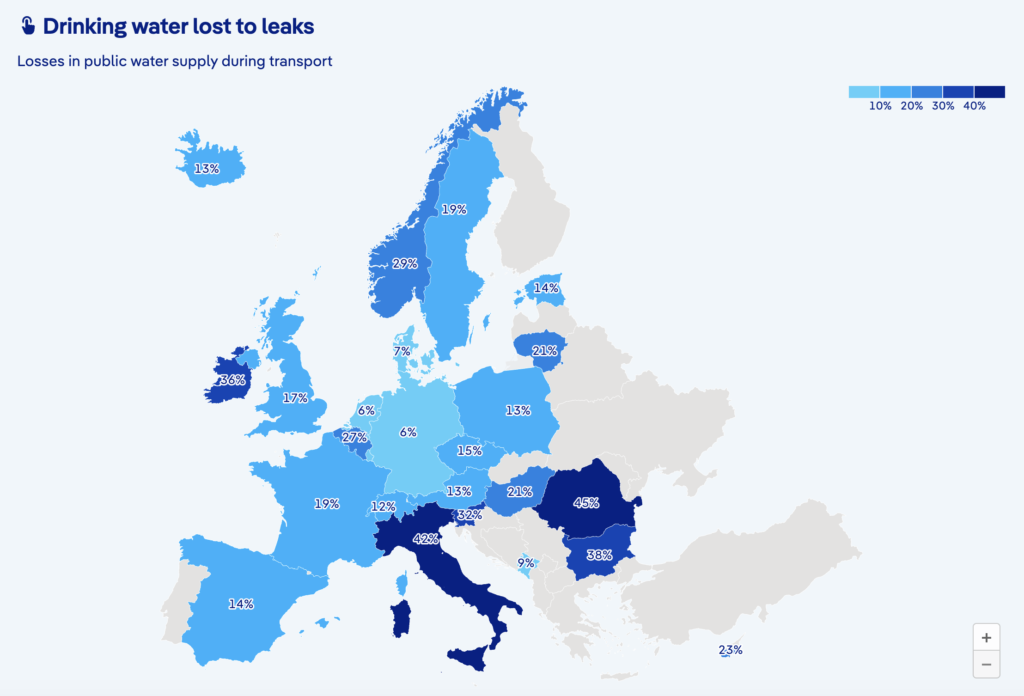
Perhaps the clearest example is leakage. According to estimates cited from EurEau in the source material, roughly one quarter of drinking water entering public supply systems across EU countries is lost through leakage and evaporation before reaching its destination. In Romania and Italy, the proportion exceeds 40 percent. The European Environment Agency analysis cited in the article suggests that reducing these losses represents most of the potential savings available within the EU public water-supply sector.
These figures fundamentally change the debate over personal responsibility. Asking households to conserve water is reasonable, particularly during emergencies, but the political credibility of those demands becomes harder to maintain when enormous quantities of treated drinking water disappear from poorly maintained infrastructure before consumers receive it.
Leaks are also economically inefficient because the lost water has already consumed resources. It has often been extracted, treated and pumped through the system before disappearing underground. The waste therefore includes not only water but also energy, treatment costs and infrastructure capacity.
Europe’s water adaptation strategy will consequently require an enormous but politically unglamorous infrastructure programme. Pipes must be mapped, monitored, repaired and replaced. Digital sensors can help utilities detect abnormal pressure and identify leaks more rapidly. Investment needs to prioritise networks where losses are highest rather than treating every municipality identically.
The problem resembles Europe’s wider infrastructure challenge: decades of systems designed for relatively stable environmental conditions now need to operate under substantially greater stress.
Agriculture Is Where the Hardest Decisions Will Be Made
If leakage represents one of the clearest opportunities for efficiency, agriculture represents one of the most politically difficult areas for reform. In parts of southern Europe, irrigation accounts for the majority of water withdrawals. Agriculture therefore cannot be excluded from any serious drought strategy.
The potential solutions are already well understood. Open irrigation channels can be replaced by closed pipes, reducing evaporation. Surface irrigation can be replaced with sprinklers or drip systems capable of delivering water more precisely. Soil management can improve moisture retention, and farmers can shift toward crops better suited to increasingly dry conditions.
Yet technological efficiency alone will not resolve the problem.
More efficient irrigation can sometimes encourage expansion of irrigated agriculture because using less water per hectare makes additional production economically attractive. The result can be a rebound effect in which technological improvements reduce water consumption per unit of production without reducing total withdrawals sufficiently.
Europe therefore needs to combine efficiency with allocation. Governments may eventually need to reconsider which crops make economic sense in regions experiencing structural water scarcity. Growing extremely water-intensive products in increasingly arid regions may become difficult to justify simply because the practice was historically viable.
This is politically explosive because agriculture is not simply an economic sector. It involves rural employment, regional identity, food security, land ownership and electoral politics. European governments already face significant farmer dissatisfaction over environmental regulation, energy costs, imports and agricultural policy. Water restrictions could add another source of tension.
Drought adaptation will therefore succeed only if farmers are treated as participants in the transition rather than simply as consumers whose access to water must be restricted.
Europe’s Energy Transition Is Also a Water Strategy
One of the most important findings in the source material concerns the relationship between electricity generation and water consumption. Thermal power stations—including nuclear plants and fossil-fuel facilities—can require substantial quantities of water for cooling. Wind and solar generation require far less operational water.
Europe’s transition toward renewable electricity therefore has an overlooked benefit: it can reduce water stress.
The source material notes that European water withdrawals have already declined by roughly a quarter over the past two decades, with more efficient electricity cooling playing an important role. The European Environment Agency analysis cited there suggests that expanding renewable energy and improving cooling systems could generate very large additional savings in the electricity sector.
This creates a significant connection between climate mitigation and climate adaptation. Replacing fossil-fuel generation with wind and solar can reduce greenhouse-gas emissions while simultaneously reducing dependence on water for electricity production. A policy designed primarily to limit future warming can therefore also make the energy system more resilient to the warming that has already become unavoidable.
Nuclear power creates a more complicated dilemma. Nuclear generation provides low-carbon electricity and can contribute to energy security, but plants relying on river or coastal water for cooling can become vulnerable during extreme heat and drought. The problem is not necessarily that Europe must choose between nuclear energy and water security. Rather, cooling technologies, plant locations, river conditions and climate projections increasingly need to be incorporated into long-term energy planning.
The strategic lesson is broader: European energy policy can no longer be designed independently of water policy.
Low Rivers Can Become an Industrial Problem
The Rhine and Danube illustrate how drought can spread from an environmental event into an economic shock. Both rivers function not simply as ecosystems but as major transportation corridors. Low water levels can force cargo vessels to reduce loads because fully loaded ships require greater depth. Transportation capacity therefore declines even when rivers remain technically navigable.
The economic consequences can spread through supply chains. Industries located along rivers depend on barges for raw materials, chemicals, fuels and manufactured products. When ships must operate with reduced cargo, transportation becomes more expensive and companies may need alternative road or rail capacity.
Drought can therefore produce a hidden logistics tax.
A company may have sufficient water for its own industrial processes but still suffer because the river carrying its inputs has become too shallow for efficient shipping. Agricultural production can decline while transportation costs rise simultaneously, creating multiple inflationary pressures from the same climatic event.
This makes water security relevant to European industrial competitiveness. Governments investing heavily in reshoring manufacturing, strategic autonomy and defence production must recognise that industrial resilience depends partly on physical environmental conditions. A factory is not strategically resilient merely because it is located inside Europe. Its energy, water, raw materials and transportation networks must also withstand increasingly extreme climate conditions.
Water Could Become a Constraint on Europe’s Industrial Ambitions
This challenge will become more important as Europe attempts to expand sectors considered strategically essential. Semiconductor manufacturing, data centres, battery production, chemicals and some forms of hydrogen production can involve significant water demands. Attracting these industries into regions experiencing increasing drought could create new competition between industrial development and local water needs.
The example mentioned in the source material of semiconductor manufacturers in Saxony studying Singapore’s expertise in wastewater reuse points toward a potential solution. Europe does not need to invent every technology required for adaptation. Regions that have experienced water scarcity for decades already possess expertise in recycling, desalination, efficient irrigation and urban water management.
Singapore is particularly relevant because it demonstrates how wastewater can be transformed from a disposal problem into a strategic resource. Highly treated wastewater can support industrial processes that would otherwise consume drinking-quality supplies. The principle is straightforward: not every economic activity requires water of the same quality.
European systems frequently use highly treated potable water for purposes that could be supplied by reclaimed water. Separating these uses could substantially reduce pressure on freshwater resources.
Europe Needs a Circular Water Economy
The next stage of European water policy may therefore resemble the transformation already occurring in energy and materials policy: the transition from linear consumption toward circular use.
The traditional model extracts water, treats it, uses it once and discharges it. A circular system attempts to reuse water several times depending on the quality required for each application. Wastewater from households could be treated for industrial use. Rainwater could be captured for irrigation. Industrial water could be recycled internally rather than continuously replaced with freshwater.
This requires infrastructure investment and public acceptance. Recycled wastewater can encounter psychological resistance even when treatment makes it technically safe for specific uses. Governments therefore need transparent standards and communication.
Water reuse also requires different economic incentives. If freshwater remains extremely cheap, industries and households have limited financial motivation to invest in recycling technologies. Pricing therefore becomes part of the adaptation debate.
Yet pricing is politically sensitive because water is also a basic human necessity. A system designed purely around market prices could disproportionately affect poorer households.
The solution will probably involve distinguishing between essential and discretionary consumption. Basic household needs can remain affordable while excessive or highly water-intensive uses face stronger price signals during scarcity.
Why Banning Swimming Pools Is Not a Water Strategy
Restrictions on swimming pools, garden watering and car washing have become symbols of European drought policy because they are easily understood and rapidly implemented. They can reduce demand during acute local shortages and demonstrate that scarcity requires behavioural adjustment.
But they should not be confused with structural policy.
If agriculture and electricity generation account for most withdrawals and public networks lose enormous quantities before water reaches households, focusing the political debate overwhelmingly on individual consumers risks creating an illusion of action. Households matter, but the scale is different.
The source material estimates that even extensive behavioural and technological improvements inside households would reduce per-capita domestic consumption by roughly 10 to 40 percent. That is meaningful, but because household consumption itself represents a relatively small share of overall withdrawals, it cannot independently solve the continental problem.
The most effective European strategy is therefore not choosing between personal responsibility and structural reform. It is ensuring that household conservation complements rather than substitutes for reforms in agriculture, energy and infrastructure.
The Politics of Water Will Become Harder
Water policy has historically received less political attention than energy policy because scarcity appeared distant for much of Europe. That is changing rapidly. The source material notes that EU-level attention to water scarcity and drought has expanded considerably since 2022, with participation in relevant policy discussions increasing as governments recognise the scale of the problem.
This political awakening is likely to accelerate because water has characteristics that make conflict difficult to avoid. Unlike many commodities, it has no straightforward substitute. A household can switch energy sources. A factory can sometimes replace one material with another. Agriculture cannot function without water.
Allocation therefore becomes unavoidable during severe scarcity.
Who receives priority—the public water supply, farmers, electricity generators, ecosystems or industry—will increasingly become a political question.
Governments that wait until reservoirs are already critically depleted will be forced to make emergency decisions under pressure. Those decisions are likely to be more economically damaging and politically controversial than policies designed years earlier.
Water resilience therefore needs to become part of electoral and economic planning rather than emergency management.
The North–South Divide Is Becoming Less Useful
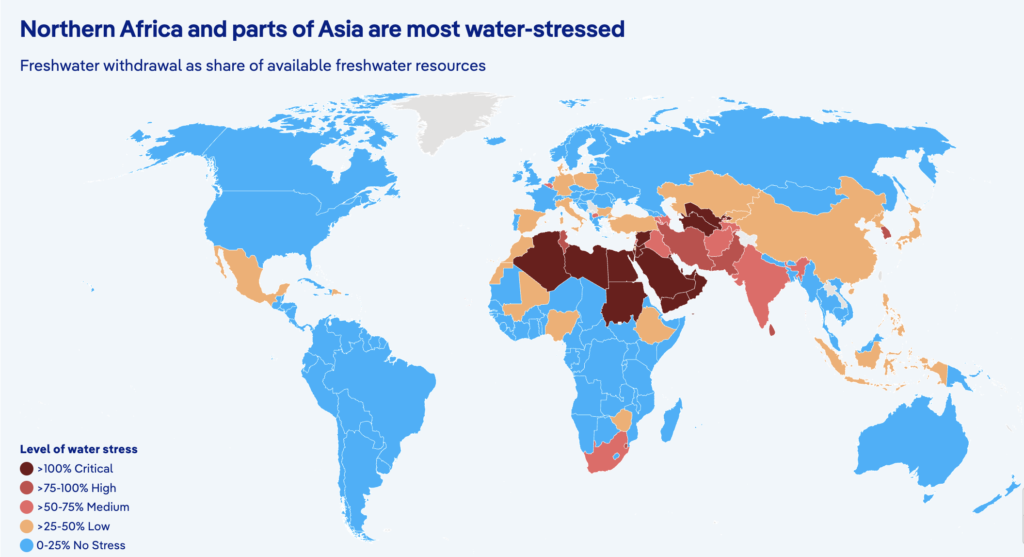
Europe has traditionally imagined water scarcity through a north-south divide: dry Mediterranean states facing chronic shortages while northern Europe remained comparatively secure.
The conditions described in 2026 undermine that assumption.
Drought risk moving into Central, Western and northern Europe means countries with little historical experience of persistent scarcity may possess infrastructure and regulatory systems poorly adapted to the new climate.
Paradoxically, some traditionally dry countries may possess valuable expertise precisely because scarcity forced them to adapt earlier.
Southern Europe should therefore not be viewed solely as the continent’s climate vulnerability. It can also become a source of adaptation knowledge. The same applies globally.
North Africa, the Middle East and parts of Asia have managed severe water stress for decades. Europe can learn from irrigation systems, desalination strategies, wastewater recycling, groundwater management and drought planning developed elsewhere.
Climate adaptation may consequently reverse the traditional direction of technological learning. European countries that historically exported environmental technologies may increasingly import water-management expertise from societies that have spent generations surviving conditions Europe is only beginning to experience.
El Niño Could Expose How Prepared Europe Really Is
The possibility that the current El Niño event will contribute to even hotter and drier conditions in 2027 adds urgency. One severe year can be treated as an emergency. Repeated drought changes economic expectations.
Farmers alter crop choices. Insurers reassess risk. Energy companies reconsider cooling systems. Municipalities rethink water infrastructure.
Industries reconsider where to locate production. Property markets can eventually respond to water availability.
The transition from episodic drought to structural scarcity therefore represents a much larger economic change than seasonal restrictions suggest.
Europe’s challenge is to adapt before markets begin adjusting through crisis.
Infrastructure planning is especially important because water projects require years. Replacing municipal pipes, constructing recycling systems, modernising irrigation networks or changing industrial cooling systems cannot be accomplished during a summer emergency.
The decisions determining Europe’s water resilience in the 2030s therefore need to be made while water is still flowing.
Water Security Is Becoming Economic Security
The deeper lesson from Europe’s drought is that water can no longer be treated primarily as an environmental issue. It is becoming an economic-security variable.
Agricultural production depends on it. Electricity systems depend on it. Industry depends on it. River transportation depends on it. Cities depend on it. Ecosystems that protect communities from extreme heat and environmental degradation depend on it.
A shortage in one sector can therefore migrate into others.
Drought can reduce harvests, increasing food prices. Low rivers can increase transportation costs. Electricity plants may face cooling constraints at the same time that heatwaves increase power demand. Industries may compete with municipalities for available supplies.
The result can be a compound crisis in which environmental pressure becomes inflationary, industrial and political simultaneously.
Europe learned after Russia’s invasion of Ukraine that energy dependence could become a strategic vulnerability.
Water may be the next resource forcing the continent to rethink the relationship between infrastructure, markets and security.
What Actually Works
The evidence presented in the source material points toward a strategy that is considerably less dramatic than emergency bans but potentially much more effective. Europe needs to repair leaking public networks, modernise irrigation, replace open channels where appropriate, expand water-efficient agricultural practices, accelerate renewable electricity, improve cooling technologies, reuse wastewater, harvest rainwater and introduce stronger incentives for efficient consumption.
None of these measures alone will solve the problem. Their strength comes from combination.
The policy mix must also vary geographically. Agricultural reform will matter most where irrigation dominates consumption. Electricity-sector reform will generate greater savings where thermal generation accounts for large withdrawals. Leakage reduction should be prioritised where municipal networks lose extraordinarily high shares of treated water. Industrial recycling will become essential in regions attempting to attract water-intensive manufacturing.
Europe therefore needs water policy based on hydrological reality rather than uniform political targets.
Conclusion: Europe Cannot Conserve Its Way Out of Drought Without Rebuilding Its Water Economy
The most important lesson from Europe’s worsening drought is deceptively simple: the continent has more options than the language of emergency often suggests. Water scarcity does not automatically mean that European households are approaching a future in which taps routinely run dry. But avoiding that outcome will require much more than asking citizens to consume less during summer heatwaves.
Europe’s greatest savings are hidden inside the systems that consume and transport water at industrial scale. They are found in irrigation networks losing water to evaporation, ageing pipes leaking treated supplies, electricity technologies requiring enormous cooling volumes and industrial processes that use freshwater where recycled water could potentially suffice.
Households still have a role. Efficient appliances, rainwater collection, reduced unnecessary consumption and awareness of the water footprint embedded in consumer choices all contribute. During severe local shortages, temporary restrictions may also be unavoidable. But individual conservation cannot become a political substitute for infrastructure investment and structural reform.
The real European water transition will therefore occur largely out of public view. It will happen beneath streets when leaking pipes are replaced, on farms when irrigation systems are modernised, inside power stations when cooling technologies change, inside factories when wastewater is reused and within electricity systems as generation becomes less dependent on water-intensive thermal processes.
For InDepthReports, the central conclusion is that Europe’s drought crisis is not fundamentally a story about whether citizens should be allowed to fill swimming pools. It is about whether a continent built during an era of comparatively predictable water availability can redesign its economy for an era in which water becomes less predictable, more geographically uneven and increasingly contested.
Europe has spent the past several years debating energy security, strategic autonomy and industrial resilience. Water now belongs inside the same conversation. A Europe that cannot reliably supply water to its farms, industries, power system and cities cannot be economically resilient regardless of how much it spends on other forms of strategic security.
The countries that adapt successfully will not necessarily be those that receive the most rainfall. They will be those that lose the least water, reuse the most, allocate it most intelligently and begin rebuilding their systems before scarcity becomes an emergency.
Europe’s coming water crisis will ultimately be determined not only by how much water climate change leaves behind, but by how intelligently Europe manages every liter it still has.