An InDepthReports
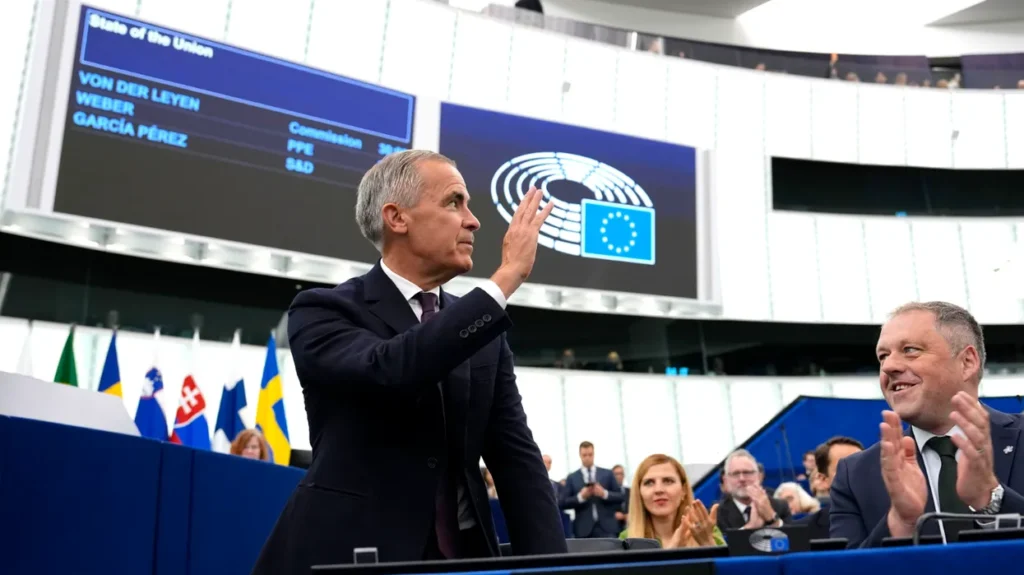
Canadian Prime Minister Mark Carney’s appearance before the European Parliament on September 17, 2026, was significant not because Canada is about to join the European Union. It is not. The proposed category of EU “associate membership” does not currently exist in the Union’s treaties, its legal meaning has not been defined, and turning the idea into an institutional arrangement would require difficult negotiations among European governments. What made Carney’s speech important was something much larger: one of the United States’ closest allies and most economically integrated neighbours is openly exploring a new strategic relationship with Europe at precisely the moment when its relationship with Washington has deteriorated sharply.
Carney deliberately presented the initiative as something other than the construction of an anti-American alliance. His message was that Canada and Europe should build what he has called a “unique alliance” based on economic security, defence, critical minerals, artificial intelligence, energy, space and digital trade. The underlying concept, in Carney’s formulation, is not national self-sufficiency but “collective resilience.” That distinction matters. Ottawa is not suggesting that Canada can economically detach itself from the United States, nor is Brussels proposing to transform Canada into a conventional EU member. Both are instead exploring whether a network of politically aligned middle powers can reduce their vulnerability to increasingly coercive great-power competition.
That makes the Canada-EU initiative more consequential than its unusual institutional label suggests. The real story is not whether Canada becomes an “associate member” of the European Union. It is whether the fragmentation of the Western economic and security order is creating a new category of strategic partnership—deeper than a free-trade agreement, less comprehensive than political union and designed specifically for an era in which countries no longer assume that traditional allies will always provide predictable economic or security relationships.
The United States Is Still Canada’s Essential Partner — and That Is the Problem
Few advanced economies are as deeply connected to another country as Canada is to the United States. Geography, integrated manufacturing, energy networks, cross-border supply chains and decades of trade liberalisation have created an economic relationship that cannot simply be replaced by political decision. Reuters reported this week that roughly 72 percent of Canadian exports still go to the United States. Europe can become a much larger Canadian partner, but it cannot quickly reproduce the economic gravity created by the world’s longest international border and decades of continental integration.
This is precisely why the deterioration in US-Canadian relations has become strategically important for Ottawa. Dependence is manageable when the larger partner is predictable. It becomes a vulnerability when access to that partner’s market can be used as political leverage. The escalating trade dispute between Washington and Ottawa has therefore changed the way Canada evaluates economic security. The objective is no longer merely maximizing the efficiency of North American integration. It is reducing the political risk created by excessive concentration.
Carney’s government has set an objective of doubling Canadian trade with countries outside the United States over the next decade. Europe is central to that strategy because it offers something most alternative markets cannot: scale combined with relatively close political, regulatory and security relationships. Canada and the EU already have the Comprehensive Economic and Trade Agreement, or CETA, while bilateral trade has expanded substantially since its provisional implementation. Reuters Breakingviews calculates that trade increased by 81 percent between 2016 and 2025, although the overall macroeconomic effects remain relatively modest compared with Canada’s enormous US relationship.
The strategy is therefore diversification rather than substitution. Canada cannot replace the United States with Europe. But it may be able to make the United States less irreplaceable.
That is a fundamentally different objective.
Trump’s Tariff Threat Reveals Why the Proposal Matters
US President Donald Trump’s reaction has unintentionally highlighted the strategic importance of the proposal. Trump described the possibility of Canadian associate status as “laughable” and threatened additional tariffs against Europe if he considered the initiative hostile to the United States. The European Commission responded by defending its ability to develop international partnerships, while French European Affairs Minister Benjamin Haddad said Washington could not veto European geopolitical choices.
The disagreement exposes a deeper transformation in transatlantic relations. For much of the postwar era, stronger cooperation between Canada and Europe would have been viewed as strengthening the broader Western alliance. Canada, the United States and most EU countries already cooperate through NATO, the G7 and numerous other institutions. Greater Canadian-European trade would traditionally have appeared complementary to North American integration rather than competitive with it.
The fact that the initiative can now be interpreted in Washington as a potentially hostile act shows how economic relationships are increasingly being understood through the language of geopolitical alignment. Trade agreements are no longer merely commercial instruments. Supply chains, investment flows, technology standards and access to strategic resources are increasingly treated as components of national power.
This creates an unusual situation. Canada and Europe are not seeking greater cooperation because they have abandoned the transatlantic system. They are considering it partly because they are less certain that the traditional transatlantic system will continue functioning in the same way.
“Associate Membership” Is Still More Political Idea Than Legal Reality
The terminology nevertheless risks getting ahead of the substance. There is currently no established EU status called “associate membership.” European Commission President Ursula von der Leyen proposed making Canada the first country to receive such a relationship, but the institutional architecture remains undefined. Reuters notes that implementing it could require agreement among all 27 member states and potentially treaty changes, depending on what rights and obligations were eventually included.
This is important because “membership” creates expectations that ordinary strategic partnerships do not. Full EU membership involves participation in institutions, obligations under European law, contributions to the EU budget and extensive integration into the Single Market. Canada is geographically outside Europe and neither Ottawa nor Brussels is currently proposing conventional accession.
The real challenge will therefore be determining what associate status provides that existing agreements do not.
If it is largely symbolic, the initiative may generate geopolitical controversy without producing significant additional integration. If it provides substantial access to European programmes, defence procurement, research, digital markets or industrial initiatives, Brussels will have to determine how much regulatory alignment Canada must accept in exchange.
That question could become politically difficult in Ottawa. Deeper access to the European Single Market generally requires accepting European standards. Canada’s economy, however, has developed for generations around North American standards and US supply chains.
Canada could therefore discover that strategic diversification creates regulatory trade-offs.
The Real Prize Is Not Trade Alone
The most important elements of a deeper EU-Canada relationship may lie outside traditional trade. Europe and Canada possess strikingly complementary strategic assets.
Canada has enormous reserves of energy and critical minerals. Europe is attempting to reduce vulnerabilities created by dependence on Russian energy and Chinese-controlled mineral supply chains. Canada wants investment and diversified export markets. Europe wants reliable suppliers located in politically stable allied countries.
The same complementarity exists in defence. Canada is seeking to diversify its military partnerships while Europe is expanding defence production and procurement. Canada has already moved toward participation in European defence initiatives, while on September 16 it formally applied to join the UK-led Joint Expeditionary Force, a ten-country rapid-response grouping composed of northern European NATO states. Ottawa is also exploring closer defence-industrial cooperation with Britain and has observer status in the Global Combat Air Programme.
These developments suggest that Canada’s European pivot is not confined to Brussels.
A wider northern security architecture is emerging involving Canada, the United Kingdom, Nordic states, Baltic countries and the European Union. Geography makes this particularly significant because Canada and northern Europe share interests in the North Atlantic and Arctic.
The potential Canada-EU relationship could therefore connect economic security with defence geography.
The Arctic Could Become the Partnership’s Strategic Centre
The Arctic may ultimately provide the strongest geopolitical logic for deeper cooperation. Canada is an Arctic state with enormous northern territory. Denmark, Finland and Sweden are EU members with Arctic interests, while Norway is deeply integrated with the European economy despite remaining outside the Union. Russia possesses the largest Arctic coastline, and the region is increasingly important for military operations, critical minerals, energy, infrastructure and emerging transportation routes.
Climate change is simultaneously transforming the physical geography of the region. Reduced sea ice is increasing accessibility while creating severe environmental and security challenges. Infrastructure that was previously peripheral can become strategically important. Satellites, communications systems, maritime awareness and northern logistics are becoming increasingly relevant.
Canada and Europe therefore have overlapping interests that extend far beyond trade.
A deeper partnership could combine Canadian geography and resources with European capital, technology and industrial demand. Cooperation on satellites, Arctic surveillance, critical minerals, energy infrastructure and defence could create a transatlantic northern economic-security corridor.
This would also explain why the relationship cannot be understood purely through CETA. A trade agreement reduces tariffs. A strategic partnership attempts to organise capabilities.
Critical Minerals Could Turn Political Rhetoric Into Economic Reality
Critical minerals provide perhaps the clearest test of whether the proposed partnership can move from symbolism to material integration. Europe wants to reduce dependence on concentrated global supply chains, particularly where China possesses dominant positions in processing and refining. Canada possesses significant mineral resources and wants to attract investment capable of developing them.
On paper, the match is obvious.
In practice, extracting minerals is only one part of the supply chain. Processing, refining, transportation, financing and long-term purchasing contracts determine whether resources actually become strategically useful.
If Brussels and Ottawa are serious about collective resilience, they will need to build supply chains rather than simply sign declarations.
European manufacturers could enter long-term purchasing agreements with Canadian producers. European investment could help finance extraction and processing capacity. Canadian resources could feed European battery, aerospace, electronics and defence industries.
The strategic objective would not be complete independence from China or the United States. That would be unrealistic and economically costly. The objective would be optionality: ensuring that political confrontation with one major power does not automatically paralyse essential industries.
Defence Cooperation May Advance Faster Than Economic Integration
Paradoxically, defence may prove easier than deep economic integration. Canada and European states already operate within NATO, share military standards and confront many of the same security challenges. Defence-industrial cooperation can therefore expand through existing structures without resolving every question surrounding EU associate status.
Canada’s application to join the Joint Expeditionary Force illustrates this possibility. The JEF links Britain with Denmark, Estonia, Finland, Iceland, Latvia, Lithuania, the Netherlands, Norway and Sweden. Canadian participation would create an even stronger connection between North American and northern European security.
Meanwhile, Europe’s own defence architecture is changing. Von der Leyen has proposed a European Security Council that could include non-EU partners such as Britain, Norway, Ukraine and Canada, alongside a new mechanism for coordinating responses to hybrid threats. The concept remains politically and institutionally unsettled, but its architecture is revealing: European security is increasingly being imagined as broader than EU membership itself.
That may ultimately provide the model for Canada.
Instead of attempting to fit Canada inside institutions designed for European states, Brussels could construct concentric circles of integration. The EU would remain the political core, while strategically aligned non-members participate selectively in defence, economic-security, technology and resilience structures.
Canada could become the most ambitious test of that model.
Europe Is Also Searching for Insurance
It would be misleading to portray this simply as Canada fleeing an increasingly difficult relationship with Washington. Europe has its own reasons for seeking closer Canadian ties.
European governments are questioning how much strategic dependence on the United States remains prudent. That does not mean abandoning NATO or assuming an inevitable transatlantic rupture. The United States remains deeply embedded in European security, and American military capabilities remain extraordinarily important to NATO.
But uncertainty itself changes strategic behaviour.
Reuters reported on September 17 that European defence planning is already being reshaped by questions surrounding the future American commitment to NATO, while some European states are diversifying defence procurement and investing more heavily in their own capabilities.
Canada therefore offers Europe something beyond resources and trade.
It offers another democratic, technologically advanced NATO country with significant military, energy and mineral capabilities that shares many European security interests but is not an EU member.
For Brussels, deeper Canadian integration is therefore also diversification.
Both sides are effectively buying geopolitical insurance.
A Coalition of Middle Powers?
Carney’s most interesting idea may be the least dramatic one. He has explicitly rejected the idea of creating a third great-power bloc designed to rival the United States or China. Instead, his language points toward cooperation among countries that are powerful enough to shape international rules collectively but not powerful enough to dominate the international system individually.
This concept of middle-power cooperation is not new, but the international environment is making it more relevant.
Countries such as Canada depend heavily on open trade, predictable rules and stable alliances because they cannot independently dictate global economic conditions. European countries face a similar problem individually. Even the EU, despite its enormous market, struggles to translate economic scale consistently into geopolitical power.
Closer coordination could allow these states to reduce their exposure to coercion from larger powers without attempting to become a rival superpower themselves.
The distinction is important.
Strategic autonomy does not necessarily mean strategic isolation.
It can mean creating enough alternative relationships that no single partner possesses overwhelming leverage.
The China Question Will Eventually Surface
The United States is not the only factor driving closer Canada-EU cooperation. China is equally important, even if the current political drama centres on Washington.
Europe depends heavily on China for numerous manufactured goods and strategic inputs. Canada has its own complicated economic relationship with Beijing. Both are seeking ways to preserve trade while reducing vulnerabilities in sectors considered essential to national security.
Critical minerals, batteries, artificial intelligence, telecommunications and clean-energy technologies therefore create obvious areas for cooperation.
But differences will emerge.
European governments do not always agree among themselves on how aggressively to reduce economic exposure to China. Canada must similarly balance economic opportunities against security concerns.
A meaningful strategic partnership will therefore require more than shared declarations about resilience. Ottawa and Brussels will eventually need to decide which dependencies they consider tolerable, which require diversification and which technologies require coordinated protection.
That could prove considerably harder than agreeing that cooperation is desirable.
Canada Risks Becoming a Rule-Taker
One of the most difficult questions for Ottawa is regulatory sovereignty.
The European Union’s economic power derives partly from its ability to establish standards that companies adopt because access to the European market is valuable. If Canada wants substantially deeper participation in the Single Market, it may have to align with European regulations in sectors ranging from digital services and environmental standards to product safety.
But Canada would not necessarily possess an equal role in writing those rules.
Reuters notes that this is one of the central dilemmas surrounding associate status: Canada could potentially gain greater market access while becoming more of a regulatory rule-taker, resembling aspects of the relationship experienced by European Economic Area countries that implement significant amounts of EU legislation without full participation in EU decision-making.
For Canada, the problem is even more complicated because its largest trading relationship remains with the United States.
Diverging significantly from American standards to align with Europe could increase friction inside North American supply chains.
Ottawa may therefore find itself navigating between two enormous regulatory systems.
Associate membership would not eliminate Canada’s geopolitical constraints.
It would institutionalise the management of them.
The Proposal Could Create Problems Inside Europe
There is also an internal European question that should not be overlooked. Offering Canada a bespoke “associate membership” could create political tension with countries that have spent years undertaking difficult reforms to qualify for EU accession.
Ukraine, Moldova and Western Balkan candidate states could reasonably ask why a wealthy non-European country should receive a prestigious new status without undergoing the same accession process.
Reuters has reported that the idea is already attracting attention in Ukraine, while analysts warn that Brussels must avoid creating the impression of preferential treatment.
The EU will therefore need to distinguish clearly between accession and strategic association.
Canada is not seeking voting rights inside EU institutions or a conventional pathway to membership. Associate status would need to be presented as a framework for external strategic partnership rather than a shortcut into the Union.
Otherwise, an initiative designed to strengthen European partnerships could inadvertently weaken the credibility of enlargement.
The Real Transformation Is the End of Automatic Alignment
The deeper meaning of the Canada-EU debate lies beyond Canada.
For decades, Western strategy operated on the assumption that political, economic and security alignment largely reinforced one another. NATO allies traded extensively with each other, the United States provided security guarantees, Europe provided a vast market, and Canada operated comfortably inside a North American economic system while participating in a wider Western political alliance.
That architecture is becoming less automatic.
Countries increasingly distinguish between military allies, trading partners, technology suppliers and resource providers. A state can cooperate with another on defence while simultaneously fighting it over tariffs. It can share intelligence while competing over industrial policy. It can remain inside the same alliance while attempting to reduce economic dependence on its partners.
This does not necessarily mean the Western alliance is collapsing.
It means alliance relationships are becoming more transactional, diversified and compartmentalised.
Canada’s European strategy is one response to that world.
Conclusion: Canada Is Testing a New Model of Western Alignment
Mark Carney’s Strasbourg speech should therefore not be remembered primarily for the unusual suggestion that Canada could become an “associate member” of the European Union. Whether that label survives negotiations is secondary. What matters is the strategic logic that produced it.
Canada is confronting the danger of excessive economic dependence on a United States whose trade policy has become substantially more confrontational. Europe is confronting uncertainty about American strategic reliability while attempting to reduce dependencies on Russia and China. Both possess capabilities the other wants: Canadian energy, minerals, geography and technological capacity complement Europe’s market, capital, industrial base and regulatory power. Their defence interests increasingly intersect across the North Atlantic and Arctic.
Yet neither side can simply escape geography. Canada will remain profoundly connected to the United States. Europe will continue to require transatlantic security cooperation. China will remain an important economic actor. The objective is therefore not separation but diversification.
That may be the most important phrase in the entire debate.
The emerging international system is forcing even close allies to ask how much dependence on any single partner is strategically safe. Canada is answering by building additional relationships rather than abandoning existing ones. Europe is increasingly doing the same.
If the initiative develops into substantial cooperation on defence, energy, critical minerals, technology, space, the Arctic and digital trade, “associate membership” could become much more than diplomatic branding. It could provide a template for how the European Union constructs deep strategic relationships with democratic countries that will never become conventional EU members.
If it remains largely symbolic, however, the geopolitical attention surrounding the proposal will quickly expose the gap between rhetoric and capability. The test will therefore not be whether European leaders invent a new institutional title. It will be whether Ottawa and Brussels are willing to make the difficult regulatory, financial and industrial decisions required to build genuine interdependence.
For InDepthReports, the most consequential development is what this episode says about the wider Western order. A Canadian prime minister standing before the European Parliament and discussing an unprecedented institutional relationship with the EU would once have looked like an exercise in diplomatic imagination. In September 2026, it looks increasingly like strategic adaptation.
Canada is not choosing Europe instead of America. Europe is not choosing Canada instead of the United States. Both are confronting a world in which relying overwhelmingly on any single relationship carries greater risk than it once did.
And that may be the real significance of Carney’s European pivot: the age of unquestioned transatlantic dependence is giving way to an age of strategic diversification, in which even the closest allies are building insurance against one another.