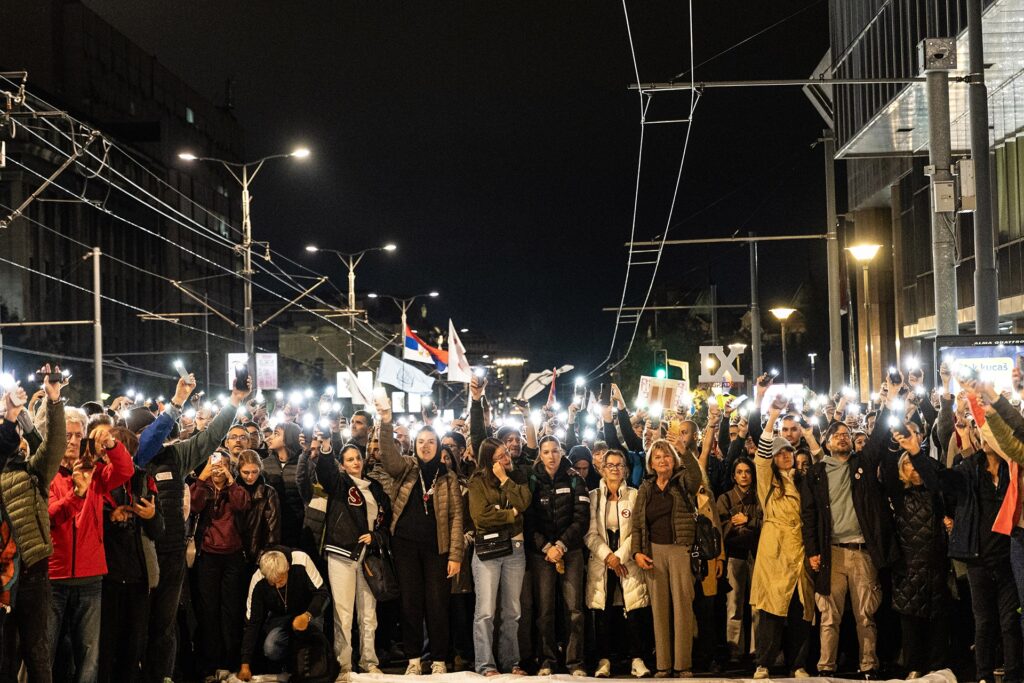
Dismissed two years ago as schoolkids skipping class, Serbia’s student-led opposition channeled public fury over state corruption into a historic election landslide, forcing President Aleksandar Vučić into an unprecedented concession.
When a handful of university students first spilled onto the streets two years ago to protest the deadly collapse of a railway station canopy, Serbia’s state-run media dismissed them as unruly kids merely looking for an excuse to cut class.
They were grieving the 16 people crushed to death and demanding accountability for what they condemned as lethal state corruption and crony contracting, bearing banners that read: “Corruption kills” and “Your hands are bloody.”
But those scattered demonstrations soon swelled into a generational revolt. Over two relentless years, the students slept in occupied lecture halls, barnstormed rural strongholds where state television branded them foreign mercenaries, and punctured a pervasive climate of fear with biting wit and viral banners.
On Sunday, the kids actually did it.
In a stunning ballot-box upset that shattered Aleksandar Vučić’s 14-year grip on power, Serbia’s student-led movement defeated the Balkan country’s formidable ruling machine, clinching a triumph so historic that even its young architects were left reeling in disbelief.
“Fantastic. I can’t believe it,” Ilija Ratković, 30, told OCCRP. “A regime that ruled for 14 years, was corrupt, and killed people in Serbia is out.” He admitted he never expected Vučić to yield quietly: “I expected him to fight to the end.”
The movement’s slogan, “Students are winning” (Studenti pobeđuju), mobilized Serbians at home and abroad to vote for the “Students’ List”—a slate of candidates chosen by activists to replace Vučić’s state apparatus. Though convinced the regime would try to manipulate the count, organizers aimed to counter fraud through overwhelming turnout, operating on a simple premise: elections can be stolen, but not in a landslide.
“The higher the turnout, the less chance he has to steal it,” one voter who identified himself as David told OCCRP ahead of the poll.
Then came Sunday. Even after Serbia’s Ministry of Foreign Affairs adjusted overseas polling hours to align with Belgrade’s time zone, thousands of diaspora Serbs lined up outside embassies and consulates in Australia and the United States in the dead of night. Some traveled thousands of kilometers from Brisbane to Sydney. In New York, voters showed up at 2:00 AM singing defiant songs, with several wearing pajamas, bathrobes, and sleep masks to mock a rule they viewed as blatant voter suppression.
Inside Serbia, queues at polling stations stretched around city blocks. Voters brought sandwiches and flasks of tea and coffee, waiting patiently for hours to cast their ballots.
A video circulating on social media on Monday perhaps best captured that determination: just one minute before polls were set to close, a man was filmed carrying a woman wearing house slippers toward a polling station entrance. “She delivered a baby two days ago!” he shouted to the people at the door, as another bystander rushed over to help carry her inside. She was the final voter admitted to the station.
“Change requires participation. Citizens who do not participate in the democratic process – not in the public square through protest and engaged debate, nor through the ballot box – will achieve nothing,” political analyst Jasmin Mujanovic wrote in a commentary.
With turnout approaching 70 percent—nearing a historic record—Vučić did the unthinkable roughly an hour and a half after polls closed at 8:00 PM. Preempting the official election commission tally, he conceded defeat from party headquarters, announcing that based on his party’s samples, the youth-led Students’ List had won decisively, projecting roughly 2.2 million votes for the “List” compared to 1.72 million for his party.
His admission unleashed an immediate explosion of jubilation across the country. Car horns blared, red flares illuminated squares, and crowds of weeping, laughing students spilled into the autumn night, dancing well past dawn.

Credit: Serbian youth celebrating election victory in Belgrade.
Jeanne Frank
Asked how she felt as the news broke, Ana Novak, 54, said she was “relieved, very happy, ecstatic.” She, too, had doubted Vučić would concede.
“I’m really hoping for a change—for a normal state, for a normal life in Serbia,” said Novak, who lives in Belgium with her family and is now considering moving back.
As morning arrived, the magnitude of the shift began to sink in across the capital. During a live news broadcast from Belgrade downtown, a passerby interrupted a reporter who in her report mentioned the movement’s signature battle cry: “Students are winning!”
“No,” the man interjected with a smile before walking away. “Students have won.”