A vast leak of internal banking records reveals how Deutsche Bank pursued Russian business despite warnings over sanctions, corruption and financial crime. The story exposes a larger European failure to recognise when profitable economic relationships were becoming geopolitical liabilities.
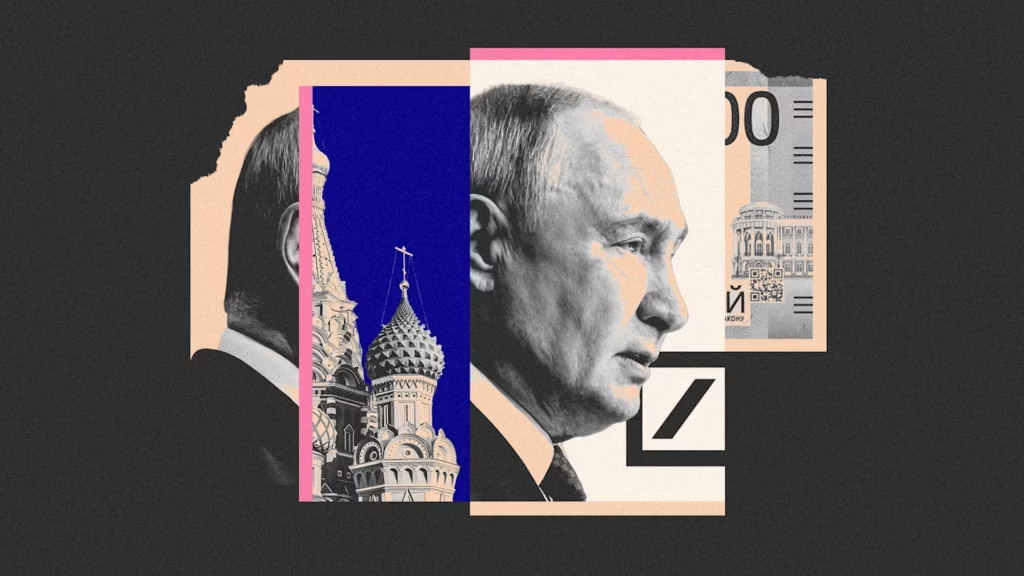
InDepthReports | Investigative Analysis
For years, Russia represented an uncomfortable but commercially attractive opportunity for Deutsche Bank. The country offered access to wealthy individuals, major state-owned companies, investment transactions and a financial market deeply connected to the political establishment surrounding President Vladimir Putin. The risks were hardly invisible. Russia’s annexation of Crimea in 2014 had already triggered Western sanctions, allegations of money laundering had damaged the German bank’s reputation, and internal compliance officials repeatedly questioned whether its Russian operations could be adequately controlled. Yet the institution continued looking for ways to preserve and expand parts of the business. When Russian forces launched their full-scale invasion of Ukraine in February 2022, Deutsche Bank confronted the consequences of a strategy that had treated political instability and regulatory warnings as risks to be managed rather than reasons to reconsider the relationship itself.
A major international investigation published on November 17, 2026, now provides a detailed account of how that strategy developed. Drawing on more than 15 million leaked internal documents, the Inside Deutsche Bank project examined the bank’s dealings with Russian companies, politically connected clients and other sensitive customers. Reporting by the Financial Times and Le Monde describes an institution whose commercial ambitions repeatedly collided with concerns raised by compliance teams, senior risk officials and monitors appointed following earlier regulatory failures. The documents suggest that Deutsche Bank’s Russian business remained strategically attractive to some executives even as its legal, reputational and geopolitical costs became increasingly difficult to justify. The disclosures do not establish that every Russian relationship was unlawful, but they reveal the tensions inside a bank attempting to profit from a market whose political environment was moving steadily toward confrontation with the West.
The significance of the story extends well beyond Deutsche Bank. For much of the period following the Cold War, European governments and businesses assumed that economic integration could moderate geopolitical conflict. Russian energy, investment and financial relationships were often defended as commercially rational arrangements that also created incentives for cooperation. Germany became one of the clearest expressions of this philosophy, maintaining extensive economic links with Moscow even as political disagreements intensified. Deutsche Bank’s experience illustrates the limits of that assumption. Commercial relationships can generate profits and mutual dependence without changing the political calculations of an authoritarian government. They can also become difficult to unwind when sanctions, war or diplomatic confrontation suddenly transform ordinary business exposure into a strategic vulnerability.
The November disclosures therefore raise two interconnected questions. The first concerns corporate governance: why did a bank with extensive knowledge of Russia-related compliance risks continue pursuing business that some of its own officials considered dangerous? The second concerns European political economy: why did so many institutions underestimate the possibility that the Russian market would cease to operate under the assumptions on which their investments depended? Answering those questions requires examining not only the decisions made after the invasion but the years during which warnings accumulated and commercial incentives continued to shape the bank’s behaviour.
A Profitable Market with a Troubled History
Deutsche Bank’s relationship with Russia did not begin with Putin’s presidency. The German lender had historical connections to the country stretching back to the nineteenth century, and Russia’s integration into international finance after the collapse of the Soviet Union created substantial opportunities for Western banks. Large Russian corporations needed access to international capital markets, foreign-currency financing, bond issuance and sophisticated financial services. Wealthy Russian individuals sought private banking, investment products and international asset-management structures. For an institution seeking a global position in investment and corporate banking, Russia represented a market where relationships with a relatively small number of powerful clients could generate significant business.
That opportunity came with structural risks. The Russian economy combined major state-controlled corporations, concentrated private wealth and a political system in which commercial success could be closely connected to government relationships. Western financial institutions therefore faced difficult questions about the origins of wealth, the independence of corporate decision-making and the political exposure of their clients. These concerns became more serious after 2014, when Russia’s annexation of Crimea led the European Union and the United States to impose sanctions on individuals, companies and sectors of the Russian economy. A client relationship that had previously appeared commercially attractive could become legally restricted or reputationally damaging as sanctions evolved.
Deutsche Bank had already encountered serious problems involving its Russian operations. In 2017, US and British regulators imposed penalties connected to a mirror-trading scheme in which clients used transactions involving Russian and London markets to move large sums of money. The bank agreed to pay approximately $630 million to US and UK authorities over anti-money-laundering failures associated with the scheme. The episode exposed weaknesses in its ability to understand customers and monitor complex transactions. It also demonstrated that the risks of Russian business were not theoretical. They had already produced substantial financial penalties and intense regulatory scrutiny.
The new reporting indicates that these earlier failures did not end the internal debate over Russia. According to Le Monde, Deutsche Bank established formal procedures for classifying sensitive Russian clients and escalating decisions to higher levels of management, including compliance, sanctions and reputational-risk specialists. On paper, this created multiple opportunities to identify problematic relationships before the bank accepted or expanded them. Yet internal communications examined by journalists suggest that commercial teams sometimes resisted or worked around restrictions. The existence of sophisticated procedures did not guarantee that the institution would consistently prioritise their warnings.
The tension became explicit in May 2019, when a senior figure on the bank’s supervisory-board risk committee questioned the value of continuing certain Russian activities. According to Le Monde, the discussion included concerns about weak control mechanisms and the limited profitability of some sensitive relationships. The question was not simply whether Russian business was risky. It was whether the bank was receiving enough commercial benefit to justify those risks. That distinction is important because it challenges the assumption that institutions knowingly accept extraordinary exposure only when the potential profits are extraordinary. Sometimes the momentum of an established business, the desire to preserve relationships and the expectation of future opportunities can sustain activities whose immediate economic value is comparatively modest.
The Internal Warnings That Failed to Change the Strategy
The leaked records, as described by the Financial Times, indicate that Deutsche Bank’s senior leadership remained interested in expanding Russian business during the years preceding the invasion. Chief executive Christian Sewing, who took over in 2018 with a mandate to restore the bank’s profitability and reputation, faced the challenge of balancing commercial recovery against the need to strengthen compliance. The investigation reports that the bank continued seeking opportunities involving prominent Russian companies, including Gazprom, despite concerns raised by some managers and monitors. Those warnings addressed weaknesses in controls, limited transparency within the Russian operation and the possibility that expansion would expose the bank to additional legal and reputational damage.
This is a revealing aspect of the case because the risks were being debated inside the institution rather than discovered only after the war. Corporate failures are often explained retrospectively as unforeseeable events. The Russian invasion of Ukraine was a major geopolitical shock, and the exact timing and scale of the attack were not certain years in advance. Nevertheless, the deterioration of relations between Russia and the West had been visible since 2014. Sanctions were already in place, political tensions were persistent and Deutsche Bank had direct experience of regulatory problems involving Russian financial activity. The internal warnings described in the leaked records therefore concerned an identifiable pattern of exposure rather than an entirely unexpected category of risk.
The difficulty lay in translating those warnings into strategic decisions. Compliance departments are typically responsible for determining whether activities satisfy legal and regulatory requirements, while commercial divisions seek customers and revenue. Senior management must reconcile these objectives, particularly when a relationship is legally permissible but carries significant reputational or geopolitical risk. A company may comply with existing sanctions while remaining vulnerable to future restrictions. It may conduct lawful transactions with politically exposed clients while still facing questions about transparency and the broader environment in which those clients operate. The Deutsche Bank case illustrates how institutions can become trapped between a narrow understanding of legal compliance and a wider strategic assessment of whether a market remains suitable for long-term investment.
The distinction is especially important in relation to Russian oligarchs and companies with politically connected ownership structures. The November investigation describes relationships involving businesses associated with prominent Russian figures, including individuals who later became subject to Western sanctions. Such relationships should not automatically be treated as evidence of wrongdoing. Sanctions differ by jurisdiction, change over time and apply to particular individuals or entities under defined legal conditions. A company may also have complex ownership arrangements that do not necessarily make every transaction prohibited. But these complexities increase the burden on financial institutions to understand beneficial ownership, control and the potential effects of future sanctions. When commercial teams seek to preserve relationships despite uncertainty over these issues, the bank can accumulate risks that become much harder to manage during a crisis.
The leaked material also points to governance concerns extending beyond sanctions screening. Le Monde reported an internal case involving public contracts and the recruitment of a banker whose father held a senior position in a Russian government ministry connected to the awarding of those contracts. The bank reportedly disclosed the matter to authorities, while its internal investigation concluded that it had not identified violations of its anti-bribery, conflicts or hiring frameworks. That conclusion must be distinguished from an external finding of misconduct, which the reporting does not establish. Nevertheless, the episode illustrates why politically connected business relationships require rigorous scrutiny. In markets where public contracts and private financial interests overlap, the appearance of a conflict can create reputational risk even when a formal internal investigation finds no breach of applicable rules.
The Invasion That Turned Commercial Exposure into a Strategic Crisis
The full-scale invasion of Ukraine in February 2022 transformed the environment in which Deutsche Bank’s Russian strategy operated. Western governments introduced extensive sanctions affecting Russian banks, companies, individuals and financial transactions. Businesses that had previously managed their exposure through compliance reviews suddenly faced a much broader challenge: determining whether they could continue operating in Russia at all. For international banks, the problem involved more than suspending new transactions. They had to assess existing loans, customer relationships, collateral, payment obligations, ownership structures and the legal consequences of withdrawing from the market.
The bank’s initial response exposed the tension between commercial obligations and geopolitical pressure. As reported by the Financial Times, Deutsche Bank initially resisted a rapid departure, with Sewing arguing that an immediate withdrawal would conflict with the institution’s responsibilities to clients and its stated values. The bank reversed its position the following day and announced that it would wind down its Russian operations. The sequence matters because it illustrates how rapidly the definition of responsible corporate conduct can change during a major international crisis. Before the invasion, maintaining customer relationships could be defended as fulfilling commercial commitments. After the invasion, continuing to operate in Russia increasingly attracted criticism because of the wider political and economic consequences of maintaining business links with the country.
A rapid exit was also difficult to execute. Banking relationships involve contracts, assets, liabilities, local employees and regulatory obligations that cannot always be terminated immediately. Russian laws and restrictions complicated the withdrawal of foreign businesses, while Western sanctions created additional constraints. Banks needed to distinguish between prohibited transactions, permitted activities required to wind down existing positions and obligations that could not legally or practically be abandoned. The resulting complexity demonstrates why the strategic cost of entering a politically sensitive market cannot be measured solely by the initial investment or annual revenue. The cost of leaving may become much greater when the political environment changes.
Deutsche Bank’s reported exposure figures illustrate the scale of the adjustment. According to information provided by the bank to Le Monde, its Russian credit exposure stood at approximately €3 billion at the end of 2021. It declined to €987 million by the end of 2022 and to approximately €13 million by the end of 2025. These figures demonstrate a substantial reduction in credit exposure, although they do not by themselves describe every remaining operational, legal or historical connection to the Russian market. The decline also should not be interpreted as proof that the bank recovered every euro without cost. Credit exposure measures a particular category of financial risk, not the total economic consequences of an international withdrawal.
The invasion also created complications involving the ownership of companies and assets connected to sanctioned individuals. According to the investigation, some Russian clients changed ownership arrangements as sanctions expanded, including transfers of stakes to family members. Such changes can be lawful or unlawful depending on the circumstances, but they create difficult questions for banks attempting to establish who ultimately controls an entity and whether restrictions apply. A company that appears to have a new shareholder may remain under the influence of a sanctioned person, while a legitimate ownership transfer may be wrongly treated as suspicious without sufficient evidence. Financial institutions must therefore examine substance rather than relying exclusively on formal documentation. The effectiveness of sanctions depends partly on whether banks can identify control and beneficial ownership in environments where information may be incomplete or deliberately obscured.
Germany’s Wider Russia Miscalculation
The Deutsche Bank revelations fit into a broader European history in which economic integration with Russia was frequently treated as both a commercial opportunity and a potential stabilising influence. Germany’s relationship with Moscow was particularly significant because it combined industrial exports, financial services and extensive energy cooperation. The underlying assumption was that deep economic interdependence would create incentives for predictability and reduce the likelihood of major confrontation. That assumption was not irrational in purely economic terms. Cross-border trade and investment can create mutual benefits and raise the costs of conflict. The problem was the expectation that those economic costs would necessarily determine the political decisions of the Russian leadership.
The events of 2022 demonstrated the limits of that approach. Russia launched a full-scale invasion despite the severe economic consequences it would face, while European companies discovered that commercial contracts could not insulate them from geopolitical disruption. Germany’s energy dependence became the most visible example, but banking relationships exposed a parallel vulnerability. Both sectors had developed around the assumption that Russia would remain sufficiently integrated into European economic structures to make long-term business planning possible. Both confronted a situation in which political decisions abruptly altered the value and viability of existing relationships.
The comparison between energy and banking is instructive because the risks operated differently. Energy dependence created a direct vulnerability through the supply of essential physical commodities. Financial exposure involved loans, transactions, investments, customer relationships and legal obligations. A disruption to gas supplies could affect households and industrial production immediately, whereas banking exposure could produce losses, sanctions violations, frozen assets and reputational damage. Yet both depended on a common strategic assumption: that economic relationships with Russia could remain manageable despite worsening political relations. The failure of that assumption suggests that European institutions need to incorporate geopolitical scenarios more systematically into commercial decision-making.
This does not mean every European company operating in Russia before 2022 acted irresponsibly or that all trade with politically difficult countries is inherently unacceptable. International business frequently involves uncertainty, and governments themselves maintained extensive economic relationships with Russia for years. The more precise lesson concerns the accumulation of risk after warning signs become persistent. Once sanctions, regulatory failures and geopolitical tensions repeatedly challenge the assumptions supporting a business strategy, institutions must reassess not merely individual transactions but the strategic rationale for remaining in the market. The Deutsche Bank documents suggest that this reassessment was contested internally and that commercial ambitions continued to exert influence even as the warning signs multiplied.
Sanctions, Financial Secrecy and the Limits of Western Oversight
The investigation also raises questions about the effectiveness of international sanctions and financial supervision. Western sanctions operate through legal prohibitions and restrictions imposed by individual jurisdictions or coordinated groups of countries. Their effectiveness depends on the ability of banks and other intermediaries to identify affected customers, understand ownership structures and prevent prohibited transactions. Yet global finance operates across corporate networks, legal systems and jurisdictions that do not always provide the same level of transparency. This creates opportunities for uncertainty, delay and potentially deliberate evasion.
The Financial Times reported that internal records revealed difficulties in reviewing sensitive Russian clients after the invasion, including complications involving ownership changes and limits on information available to investigators. Russian banking secrecy rules and other legal restrictions could obstruct access to material needed for compliance reviews. These obstacles are important because they demonstrate the limits of treating sanctions enforcement as a purely technical process. Software can screen names against sanctions lists, but it cannot always determine whether a company is effectively controlled by an individual whose ownership is concealed through complex structures. That assessment requires reliable information, legal expertise and cooperation among institutions and authorities.
For European policymakers, the problem is increasingly strategic. Sanctions have become a central instrument of economic statecraft, particularly in response to Russia’s war against Ukraine. Yet the credibility of sanctions depends on the institutions responsible for implementing them. If banks lack sufficient information or face conflicting legal obligations, enforcement becomes uneven. If commercial incentives encourage institutions to interpret uncertain cases narrowly, the intended restrictions may lose effectiveness. Conversely, excessively broad or poorly coordinated sanctions can create unnecessary legal uncertainty and disrupt legitimate activity. Effective policy therefore requires clear rules, reliable beneficial-ownership information and mechanisms for cooperation across jurisdictions.
The Deutsche Bank case illustrates why international financial regulation cannot be separated from foreign policy. A bank’s decision to maintain relationships with politically connected companies may be lawful at one moment and severely restricted later. The financial institution must therefore evaluate not only current legal obligations but the possibility of rapid changes in the geopolitical environment. This is especially relevant for businesses operating in countries where political authority, state-owned enterprises and private wealth are closely interconnected. The challenge is to develop risk management capable of anticipating structural vulnerabilities without treating every political disagreement as a reason to terminate commercial relationships.
A Banking Scandal with Consequences Beyond Russia
The November 17 disclosures arrived at a moment when Deutsche Bank has been attempting to demonstrate that its years of restructuring and compliance reform have produced a stronger institution. Under Sewing’s leadership, the bank has returned to profitability and sought to distance itself from the scandals that damaged its reputation during earlier decades. In response to the international investigation, Deutsche Bank said the reported matters dated back many years and that it had substantially strengthened its controls. It also argued that any potential financial consequences from the historical issues were unlikely to be material. Those statements are relevant to assessing the bank’s present position and should not be dismissed simply because the leaked documents describe serious historical concerns.
Nevertheless, the disclosures produced an immediate market reaction. Reuters reported that Deutsche Bank shares fell approximately 5% in early trading on November 17 after the publication of reports covering Russian clients, Jeffrey Epstein, Donald Trump and other matters. The decline cannot be attributed exclusively to the Russian findings because the international investigation examined several distinct areas of the bank’s historical conduct. It does, however, demonstrate that reputational risks can remain financially relevant long after the original decisions were made. Investors may assess not only potential penalties but also the possibility that newly disclosed information could trigger additional scrutiny, litigation or questions about the effectiveness of past reforms.
The broader leak is notable for its scale and international character. More than 15 million files were examined through a collaboration involving over 230 journalists and more than 50 media organisations. The material reportedly includes internal emails, client records, risk assessments and investigations spanning years of the bank’s operations. Such records can reveal discrepancies between public statements and internal discussions, but they must be interpreted carefully. Internal warnings do not automatically establish wrongdoing, and documents may reflect preliminary concerns, disputed interpretations or incomplete information. The significance of the investigation lies in its ability to reconstruct institutional decision-making across time rather than merely identify controversial customers.
The Russian findings are particularly important because they concern the relationship between commercial judgment and geopolitical change. Deutsche Bank did not cause Russia’s invasion of Ukraine, and the leaked records do not establish that the bank’s activities determined the Kremlin’s decisions. The more defensible conclusion is that the institution pursued business in a market where political risks were becoming increasingly visible and where its own control systems had already encountered serious difficulties. The failure was therefore one of risk assessment and strategic positioning rather than an ability to predict the precise outbreak of war.
What the Case Reveals About Europe’s Financial Future
European financial institutions now operate in an international environment where geopolitical risks are increasingly difficult to separate from ordinary commercial activity. Sanctions, export controls, investment screening, cyber threats and political restrictions can rapidly alter the conditions under which banks serve customers or finance projects. The growing use of economic instruments in international disputes means that banks are no longer simply intermediaries between savers and borrowers. They are also participants in the implementation of foreign policy, even when their primary objectives remain commercial.
This creates a difficult governance challenge. Banks cannot reasonably be expected to predict every geopolitical crisis, nor should they be required to terminate relationships whenever political tensions arise. But they can assess the concentration of their exposure, the transparency of customer ownership, the reliability of local legal systems and the consequences of a sudden market exit. They can also establish clear thresholds for escalating strategic concerns to senior management and supervisory boards. The essential requirement is that risk warnings should influence commercial strategy before a crisis makes the risks unavoidable.
The Deutsche Bank experience suggests that financial institutions need to move beyond a narrow approach to geopolitical risk based primarily on whether a transaction is currently prohibited. A business may comply with existing law while remaining vulnerable to a foreseeable expansion of sanctions. A profitable customer may expose the bank to reputational costs that exceed the revenue generated by the relationship. A local subsidiary may operate successfully under ordinary conditions while becoming difficult to supervise during political confrontation. These are strategic risks that require judgment at board level rather than routine transaction monitoring alone.
For European regulators, the case raises the question of whether existing supervisory frameworks sufficiently connect financial crime, governance and geopolitical exposure. Traditional banking supervision focuses heavily on capital adequacy, liquidity, credit risk and compliance. Those areas remain essential, but the Russian experience demonstrates how quickly geopolitical events can affect all of them simultaneously. Banks with complex international operations may need more rigorous scenario analysis addressing sanctions escalation, restrictions on cross-border payments, asset freezes and the practical consequences of exiting politically sensitive markets. Such analysis would not eliminate losses or uncertainty, but it could reduce the likelihood that institutions remain committed to vulnerable strategies simply because withdrawal appears commercially inconvenient.
The wider European lesson is that strategic dependence can accumulate through countless decisions that appear rational when assessed individually. A bank maintains a profitable client. An industrial company extends a supply contract. An energy company invests in infrastructure. A government encourages trade. Each decision may be defensible under the conditions prevailing at the time, yet together they can create exposure that becomes difficult to reverse. The Russian invasion revealed how those accumulated dependencies could constrain European institutions and impose substantial adjustment costs. Deutsche Bank’s internal records provide a detailed case study of how such risks can develop within a major financial institution.
Conclusion: The Price of Treating Geopolitics as a Business Variable
The story of Deutsche Bank’s Russian business is not simply about a bank that made an unsuccessful commercial bet. It is about the limitations of a model in which geopolitical instability was repeatedly incorporated into financial calculations without necessarily changing the underlying strategy. Russia offered important commercial opportunities, and the bank had legitimate reasons to evaluate them. But those opportunities existed alongside sanctions, regulatory failures, opaque ownership structures and persistent political tensions. The leaked documents suggest that these concerns were recognised inside the institution, even as parts of the business continued to pursue growth.
The invasion of Ukraine transformed the consequences of that approach. Relationships that had been managed through compliance procedures became subject to far-reaching restrictions. Assets and credit exposures required reassessment. Ownership structures became more difficult to interpret. Withdrawal created legal and operational challenges. Deutsche Bank ultimately reduced its Russian credit exposure dramatically, from approximately €3 billion at the end of 2021 to €13 million at the end of 2025, according to figures it provided to Le Monde. That reduction demonstrates the scale of the bank’s retreat, but it also highlights how extensive the earlier exposure had become.
The November 2026 investigation adds an important dimension to the public understanding of this history. The central issue is not whether executives should have known the exact date of the invasion. It is whether the bank adequately incorporated the known risks of operating in Putin’s Russia into its long-term decisions. Internal warnings, earlier penalties and geopolitical developments provided substantial reasons for caution. The documents described by journalists suggest that the relationship between those warnings and commercial strategy remained contested until events imposed a much more abrupt reckoning.
Deutsche Bank maintains that it has changed substantially and strengthened its controls. That claim deserves assessment on the basis of current evidence rather than an assumption that historical failures necessarily continue. Yet institutional reform should also be judged by whether lessons have been translated into decisions that might prevent comparable exposure elsewhere. The next geopolitical crisis may involve a different country, a different industry or a different form of economic restriction. The underlying governance problem will remain familiar: how to ensure that commercial incentives do not systematically outweigh risks whose consequences extend beyond ordinary financial losses.
For Europe, the larger lesson is equally significant. Economic integration can create opportunities for cooperation, but it cannot guarantee political moderation or prevent conflict. Trade and finance may increase the costs of confrontation without eliminating the willingness of governments to accept those costs. European institutions must therefore distinguish between commercial interdependence that strengthens resilience and dependence that leaves them vulnerable to decisions beyond their control.
Deutsche Bank’s Russia gamble ultimately reveals the cost of recognising geopolitical risk without allowing that recognition to change commercial behaviour. The bank’s withdrawal after the invasion reduced its exposure, but the internal debate preceding the war is what makes the story important. It shows how a major European institution could identify serious concerns, establish procedures to manage them and still struggle to change direction while profitable relationships remained available.
The question facing Europe’s banks and policymakers in November 2026 is no longer whether geopolitics can disrupt business. The war in Ukraine has settled that. The more difficult question is whether financial institutions have learned to act on geopolitical warnings before the next crisis transforms manageable risks into liabilities that cannot be easily reversed.
For Deutsche Bank, Russia became a costly test of that judgment. For European finance, it remains a warning about the limits of treating political power, sanctions and institutional opacity as secondary considerations in the pursuit of commercial growth.