A network led by Syrian-Russian banker Mudalal Khouri evolved into a parallel bank for the Assad regime, operating through offshore companies in Cyprus and the British Virgin Islands and Russian banks such as Tempbank. The network facilitated the movement of billions of dollars — from cash flights to Damascus to financing fuel and grain shipments, and even setting up front companies tied to Syria’s chemical and ballistic missile programs. Experts estimate that as much as $4 billion flowed through this system, with luxury real estate investments in Moscow and Londonexceeding $40 million. Later, the network expanded to include links with North Korea through Russian Financial Society (RFS) and the payment platform Sendy, exposing a transnational financial web designed to keep Assad’s regime afloat despite international sanctions.
By Ali Al-Ibrahim – InDepthReports
Key findings
- A Moscow-based network headed by Syrian-Russian banker Mudalal Khouri used a web of anonymous companies in the EU and UK Overseas Territories to move billions of dollars and deliver lifelines to the Assad regime — from hard-currency banknotes to fuel and front firms linked to Syria’s chemical and ballistic programs.
- Global Witness estimates the network’s visible property purchases at ~$40 million (Moscow offices, a mansion, London real estate, and a factory). If that represents a 1% cut, total flows could approach $4 billion for various clients including the Assad regime. (Estimate acknowledged as speculative.)
- Three firms tied to the Scientific Studies and Research Centre (SSRC) — Piruseti Enterprises, Frumineti Investments (Cyprus), and Tredwell Marketing (BVI) — sit inside the Khouri orbit. The first two were sanctioned by the U.S. for acting as illicit procurement agents for the SSRC and Syria’s central bank.
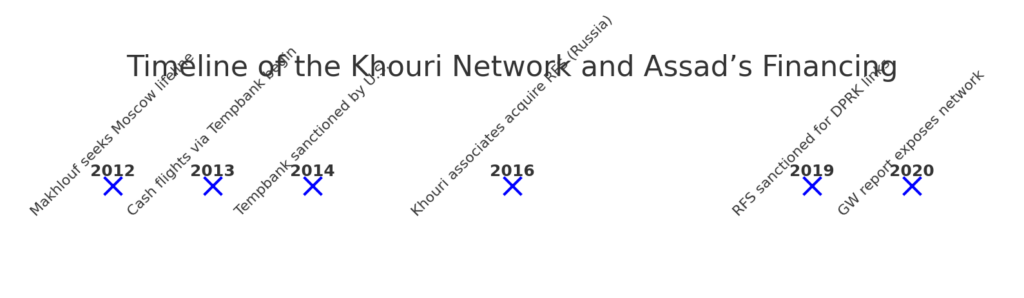
- Tempbank (where Khouri held shares) organized cash flights from Moscow’s Vnukovo to Syria’s central bank and helped arrange fuel and grain purchases; its chairman Mikhail Gagloev says this happened “five or six” times between 2012–2016. Tempbank and Gagloev were sanctioned by the U.S. in 2014.
- After 2016, network associates bought Russian Financial Society (RFS), later sanctioned by the U.S. (2019)for helping North Korea access the international financial system. A linked e-wallet, Sendy, became host for WeChat Pay and Alipay in Russia and eyed EU expansion.
- The network helped the Makhlouf family (Assad’s powerful relatives) acquire ~$40 million in Moscow skyscraper property, with a Khouri employee listed as “trusted individual” in company papers.
The night sky over Damascus in 2013 was alive with the buzz of warplanes. In the streets below, people queued for hours outside bakeries, clutching ration cards, waiting for bread that often never came. At gas stations, drivers slept in their cars, hoping to fill half a tank. Families huddled in cold apartments, the lights gone out yet again as the Syrian pound collapsed to record lows.
Thousands of kilometers away, in a gleaming Moscow office tower, the scene could not have been more different. Syrian-Russian banker Mudalal Khouri sat at the center of a quiet financial ballet. Shell companies in the British Virgin Islands, bank accounts in Cyprus, property firms in Moscow’s luxury towers — all moved in sync. Cash flights were organized, fuel deals signed, banknotes printed. The Assad regime’s survival, in many ways, was being scripted not in Damascus, but here in Moscow.
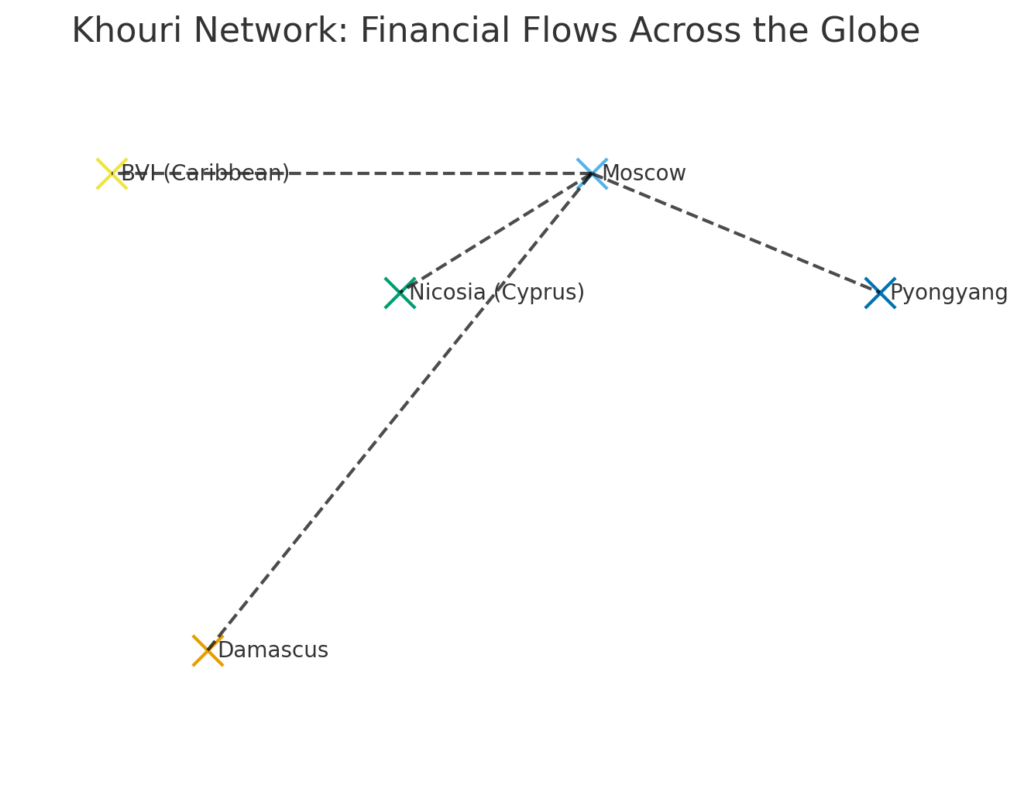
While ordinary Syrians counted their last coins to buy bread, Khouri’s network was moving billions through offshore havens and sanctioned banks — a parallel bank for a parallel war. From Damascus to Moscow, Pyongyang to Tortola, it was a system designed to keep one of the world’s most brutal regimes alive, hidden beneath layers of secrecy.
The Fixer in Moscow
By the summer of 2012, Syria’s war had entered a brutal new phase. International sanctions were biting hard: European and U.S. measures had cut off most of Damascus’s access to fuel markets, the regime’s dollar reserves were dwindling, and even the printing of Syrian banknotes — carried out in European factories — was suddenly out of reach. The Assad system, which for decades relied on patronage and oil rents, faced the specter of financial collapse.
At this critical moment, Mohammed Makhlouf — Bashar al-Assad’s uncle, de facto family banker, and patriarch of one of Syria’s most powerful clans — traveled to Moscow in search of lifelines. Moscow offered more than just diplomatic cover at the UN Security Council. It offered bankers, brokers, and fixers who could rewire Syria into the global financial system despite sanctions.
One of the first doors Makhlouf knocked on belonged to Mudalal Khouri, a Syrian-born financier who had settled in the Soviet Union in the 1970s. Over decades, Khouri cultivated connections across Russian banks, intelligence-linked circles, and offshore jurisdictions. By the time the war began, he had assembled a toolkit uniquely suited to a sanctioned state: pliable banks willing to take risky clients, shell companies incorporated in Cyprus and the British Virgin Islands, and trusted associates capable of moving money across borders with minimal scrutiny.
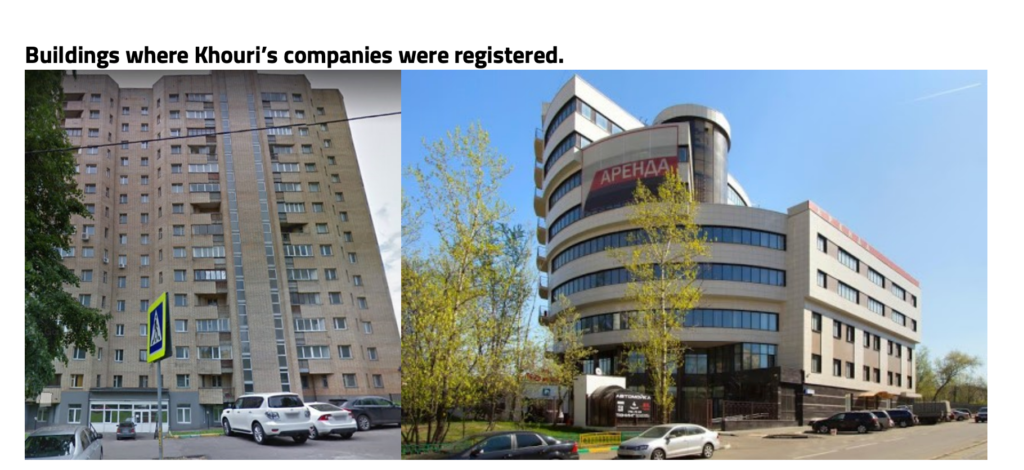
According to Global Witness, Khouri’s network not only facilitated the procurement of fuel and deliveries of banknotes to Damascus but also set up front companies linked to Syria’s Scientific Studies and Research Centre (SSRC) — the institution behind chemical weapons and ballistic missile programs. These were not marginal services; they were lifelines for a regime whose survival depended on hard currency and continued access to strategic materials.
Investigators suggest that such operations could not have functioned without at least the tacit consent of Russian intelligence. One of Khouri’s business partners even appears to have had direct ties to the SVR, Russia’s foreign intelligence service. This blurred the line between private profiteering and state-sanctioned geopolitical maneuvering.
Inside Syria, public anger was already boiling over. In 2011, demonstrators in Damascus famously shouted: “Go away, Makhlouf. We don’t want thieves.” The chant captured deep resentment at a system in which the Assad family and their cronies had amassed vast fortunes while ordinary Syrians struggled. What the protests could not foresee was how, from an office tower in Moscow, Khouri and his associates would step in to keep that patronage system alive — laundering billions, buying property, and reinventing the financial arteries of a besieged dictatorship.
As one Western diplomat who tracked Khouri’s activities later put it:
“This wasn’t just about moving money. It was about moving the war forward. Every fuel shipment and every cash flight helped Assad buy more time on the battlefield.”
Anonymous Companies as Getaway Cars
If the Khouri network was the engine of Assad’s financial survival, anonymous shell companies were the getaway cars. From Nicosia to Tortola, paperwork was the weapon of choice.
In the British Virgin Islands (BVI), one Khouri-linked company, Tredwell Marketing Ltd., maintained an account at FBME Bank in Cyprus between 2007 and 2013. Later, the U.S. Treasury’s FinCEN designated FBME a “primary money laundering concern,” citing its role in hosting front entities for Syria’s Scientific Studies and Research Centre (SSRC) — the very institution that manufactured barrel bombs, Scud missiles, and chemical weapons. In an internal request to FBME, Cyprus’s Central Bank scribbled a telling note next to Tredwell’s file: “SSRC?”
By 2012, the same playbook spread deeper into Cyprus. Two new Khouri vehicles — Piruseti Enterprises and Frumineti Investments — appeared, both controlled by Issa al-Zeydi, a Syrian-Russian financier close to Khouri. In 2014, the U.S. Treasury sanctioned al-Zeydi, accusing him of acting as an illicit procurement agent for both the SSRC and the Syrian Central Bank.
Defectors from the SSRC later described to investigators how such procurement worked: false delivery addresses, “cover stories” through Syrian universities, and middlemen in Europe or Asia who were paid commission to quietly source dual-use technologies. “It was a system built on deception, and the shells were the masks,” said one defector, now in exile in Germany, to Global Witness.
Al-Zeydi admitted in a rare interview that he helped channel funds to the Syrian Central Bank, including for banknote printing contracts in Moscow, but flatly denied involvement in weapons procurement. Yet leaked filings reviewed by investigators revealed another company under his control, Balec Ventures (BVI), which processed at least $500 million between 2006 and 2014.
International experts say these corporate shells weren’t just passive vehicles; they were essential tools of warfare.
“Anonymous companies are the oxygen of kleptocratic regimes,” said Dr. Tom Keatinge, director of the Centre for Financial Crime at RUSI in London. “Without the veil of secrecy provided by BVI or Cyprus, Khouri’s network could never have kept Assad afloat or funded procurement linked to weapons of mass destruction.”
A senior EU financial regulator, speaking on background, went further:
“Every time a Cypriot bank waved through one of these transfers, it wasn’t just money laundering. It was potentially underwriting chemical attacks in Homs or Aleppo.”
The picture that emerges is stark: while Syrian civilians faced bombardment and starvation, a hidden lattice of offshore companies quietly rerouted hundreds of millions of dollars — not in spite of the global financial system, but by exploiting its darkest corners.
Cash Flights, Fuel Deals — and a Sanctioned Bank
As Western sanctions tightened their grip on Syria after 2011, the regime’s banking arteries began to collapse. European institutions cut ties, regional banks grew wary, and Damascus found itself increasingly cut off from international markets. In this financial desert, one Russian bank stepped in: Tempbank.
Between 2012 and 2016, according to interviews conducted by Global Witness, Tempbank became a critical conduit for the Assad regime. Its role went far beyond routine banking: the institution physically flew shipments of cash by plane into Damascus — at least five or six flights, each carrying millions in hard currency.
“It was enough to strengthen and stabilize a currency,”
admitted Mikhail Gagloev, a senior Tempbank executive, in comments to investigators.
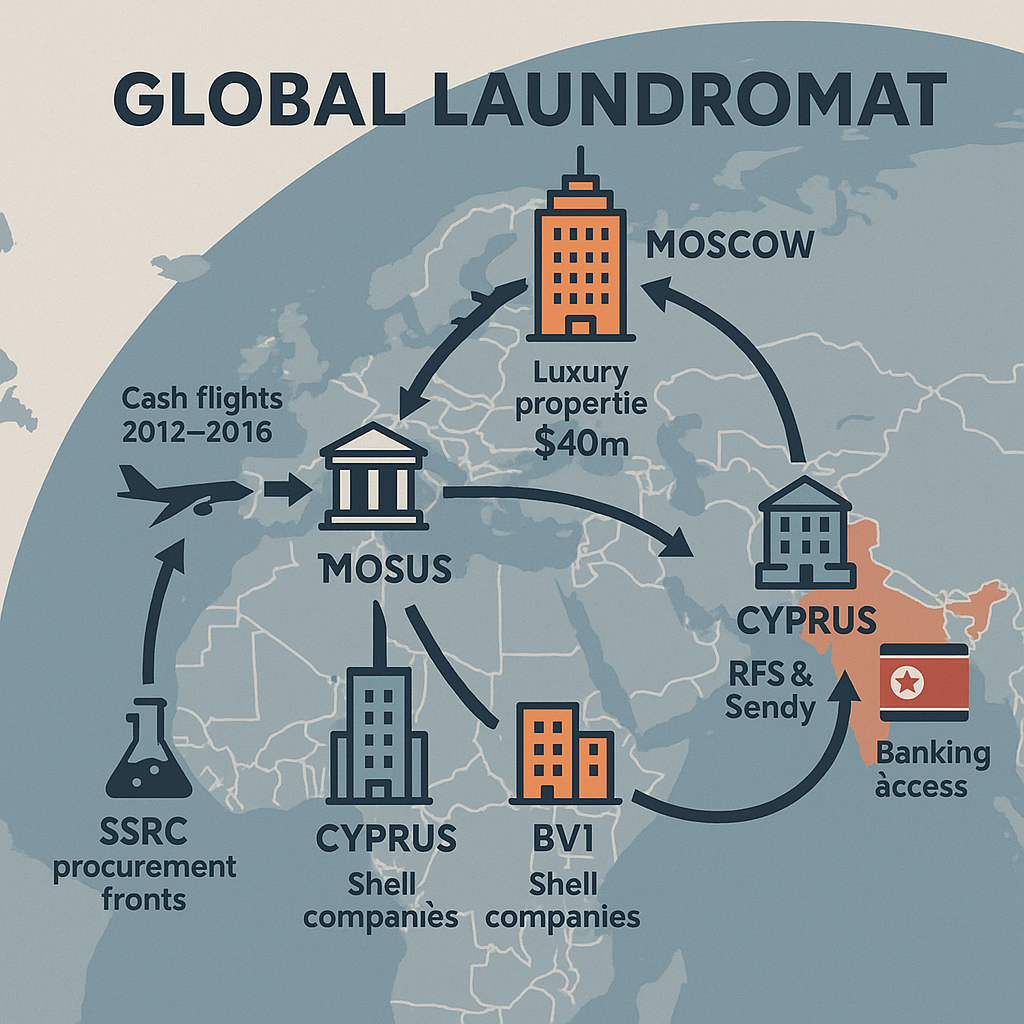
Those cash injections gave the Central Bank of Syria the lifeline it desperately needed to keep the Syrian pound from total collapse. Alongside the currency flights, Tempbank also processed trades for fuel and grain — commodities without which Assad’s war machine, and civilian survival, would have been impossible.
In May 2014, the U.S. Treasury sanctioned Tempbank and Gagloev personally, accusing them of conducting financial transactions on behalf of Syria’s sanctioned Central Bank and the state oil company (Sytrol). The sanctions cited Tempbank’s role in enabling the regime to purchase fuel, evade restrictions, and maintain liquidity for the war effort.
Confronted with these findings, Gagloev downplayed the bank’s role, insisting Tempbank had avoided prohibited transactions:
“We did exclusively banking business. No politics. We didn’t touch anything related to chemical weapons,”
he told Global Witness.
But financial crime experts are unconvinced.
“Flying suitcases of cash into a war zone under sanctions is not ‘normal banking,’”
argued Dr. Louise Shelley, director of the Terrorism, Transnational Crime and Corruption Center at George Mason University.
“These transfers were lifelines for a regime accused of war crimes. They extended Assad’s ability to wage war and suppress his population.”
Documents reviewed by investigators suggest that Tempbank’s relationship with Damascus may have been deeper than admitted. One former European sanctions official described the cash flights as “a shadow central bank in the skies.”
For ordinary Syrians, the consequences were clear: while international donors struggled to channel humanitarian aid through legitimate channels, clandestine networks ensured Assad never ran out of cash to pay soldiers, buy fuel, and print propaganda.
From Assad to Pyongyang: The North Korea Link
By the mid-2010s, the Khouri network’s reach extended far beyond Damascus or Moscow. It was now brushing up against another pariah state under heavy sanctions: North Korea.
In 2016, five Khouri employees and two close associates quietly acquired 70% of the Russian Financial Society (RFS), a small Moscow-based bank. The official explanation was that RFS would support a booming e-wallet platform called Sendy. But behind the fintech façade, investigators soon uncovered a darker purpose.
By 2019, the U.S. Treasury sanctioned RFS for opening accounts for North Korean institutions already under U.N. and U.S. sanctions, accusing the bank of helping Pyongyang maintain access to the global financial system despite its isolation. While Sendy itself escaped sanctions, its rapid integration into mainstream financial infrastructure raised alarms.
Sendy was not just another payment app. It hosted WeChat Pay and Alipay in Russia, won a “systemically important” designation from the Russian Central Bank, and was actively exploring expansion into the EU. In the words of one European anti-money-laundering official, it was:
“A potential money-moving machine hiding in plain sight.”
The Khouri network’s North Korean connection didn’t end there. A Russian media investigation revealed that Tempbank, the very institution that had flown cash into Damascus, once held accounts for Korea United Development Bank, a bank under U.N. sanctions for its role in financing Pyongyang’s weapons programs.
The ties grew even clearer when Igor Klyuchnikov, a former adviser at Tempbank, resurfaced as a major shareholder in RFS and Sendy’s parent company. The overlap of personnel and assets strongly suggested that the same shadow network enabling Assad’s financial survival was also helping North Korea sidestep sanctions.
Experts say this convergence of sanctioned regimes through Moscow’s financial backchannels is no coincidence.
“When you see Syrian and North Korean money moving through the same Russian nodes, you’re looking at a transnational laundering architecture,” said Dr. Andreas Krieg, a Middle East security expert at King’s College London. “It’s not about isolated cases — it’s about systemic complicity.”
For Washington and Brussels, the implications were chilling: technologies meant to modernize Russia’s payments landscape could simultaneously serve as covert pipelines for two of the world’s most heavily sanctioned regimes.
As one former U.S. sanctions official put it:
“If Sendy had gone fully operational in Europe, you could have had Syrian, Russian, and North Korean dirty money moving undetected through the same rails your coffee purchase runs on.”
The Moscow Property Trail: $40 Million with a “Trusted Individual”
If Syria’s children were denied classrooms, Moscow’s skyline told a very different story. While half-finished schools rusted under the Iraqi sun and hospitals in Aleppo struggled without electricity, Assad’s inner circle was quietly buying luxury property in Russia’s capital.
Global Witness had already traced about $40 million in assets to the Makhlouf family, the notorious financiers of Assad’s war machine. New filings now reveal that Elizaveta Sosedova, a long-time employee of Mudalal Khouri, was listed as the companies’ official “trusted individual” — the fixer responsible for filings and compliance paperwork.
Sosedova’s name doesn’t just appear on the Moscow property trail. She and other Khouri-network operatives later surfaced as stakeholders in the parent company of Russian Financial Society (RFS), the same institution sanctioned by the U.S. for helping North Korea.
Two of the Moscow property firms were directly owned by Hafez Makhlouf, Assad’s cousin and former intelligence chief, sanctioned for human rights abuses. Records show he alone purchased nearly $20 million worth of prime office space. The purchases sent a clear message: while Syrians endured hunger and bombardment, the regime’s enforcers were parking millions in safe havens abroad.
How Big Was the Laundromat?
Trying to calculate the scale of Khouri’s laundering operation is like mapping smoke. But piecing together asset records, leaked filings, and bank documents gives a glimpse.
Measured assets since 2012 tied to the Khouri network include:
- Moscow Progress Plaza offices – cadastral value of $19 million
- A luxury mansion in Moscow’s outskirts – $15–20 million
- A Mayfair flat in London – $2.4 million
- An industrial factory site – $3–4 million
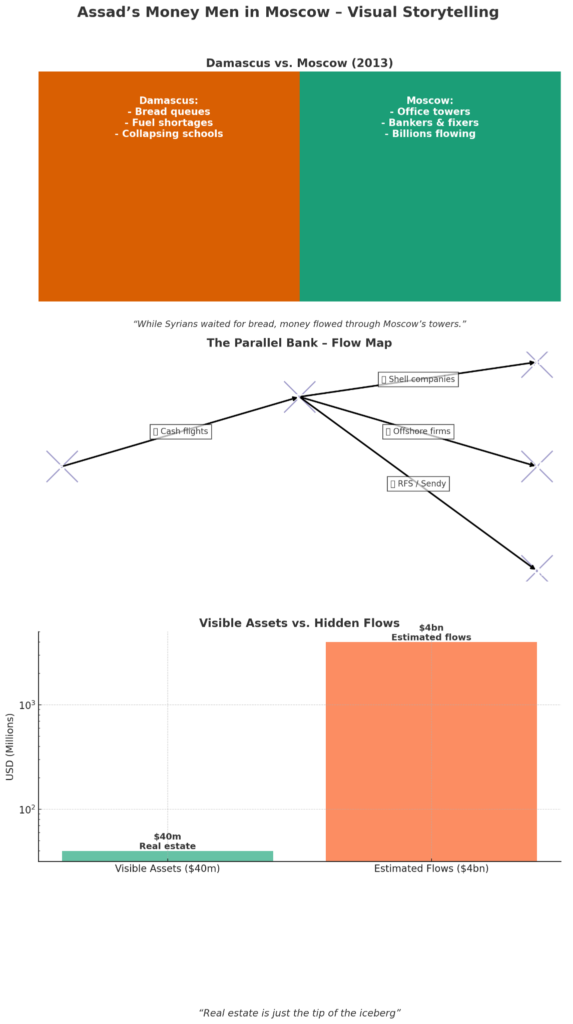
That’s roughly $40 million in visible assets. But investigators suggest this may only represent the skimmed share — a kind of commission. If the real cut was about 1% of total flows, then the Khouri laundromat may have cycled through an astonishing $4 billion.
One shell company alone, Balec Ventures (BVI), is reported to have moved $500 million through the disgraced FBME Bank in Cyprus between 2006–2014.
“These are just the tip of the iceberg numbers,” said Dr. Louise Shelley, director of the Terrorism, Transnational Crime and Corruption Center at George Mason University. “When you see tens of millions crystallized in real estate, it usually sits on billions that have already been washed through opaque channels.”
Global Witness stresses that the $4 billion figure is illustrative, not definitive. But the sheer scale of the assets and transactions revealed paints a sobering picture: Moscow’s gleaming towers and London’s Mayfair streets were not just playgrounds for oligarchs — they became vaults for Assad’s blood money.
A Parallel Bank for a Parallel War
From the steel-and-glass towers of Moscow, to the shell companies of Nicosia and the British Virgin Islands, the Khouri network stitched together a global financial system in miniature — one built not for citizens, but for dictators.
When Damascus was cut off from global banking, Khouri’s firms and allies became the financial lungs of the Assad regime: moving cash by plane through Tempbank, wiring millions through offshore fronts, and even printing Syria’s banknotes in Moscow.
When Assad’s circle sought to secure its wealth, the network offered $40 million in Moscow real estate, hidden behind “trusted individuals” and nominee directors.
When the regime’s chemical and ballistic procurement was threatened by sanctions, Khouri-linked shells in Cyprus and the BVI surfaced as possible fronts for the Syrian Scientific Studies and Research Centre — the same entity accused of building barrel bombs and sarin warheads.
And when Pyongyang needed banking access, the same web reached east: Russian Financial Society and Sendy, operated by Khouri associates, opened accounts for sanctioned North Korean banks, allowing two pariah states to tap into the arteries of global finance.
What emerges is not simply corruption, but a parallel bank for a parallel war. A system that linked Damascus, Moscow, Pyongyang, and the Caribbean — all hidden under layers of shell firms, secrecy jurisdictions, and regulatory blind spots.
As one European sanctions expert told InDepthReports:
“This was not a side hustle. It was a state within a state — a financial shadow system designed to outlive the war itself.”
The Khouri network shows how 21st-century warfare is not only fought with jets and missiles, but with bank accounts, offshore companies, and cash flights in the night. And unless those channels are shut down, with transparency registers, sanctions on enablers, and global oversight regimes like Assad’s will always find a banker in the shadows.