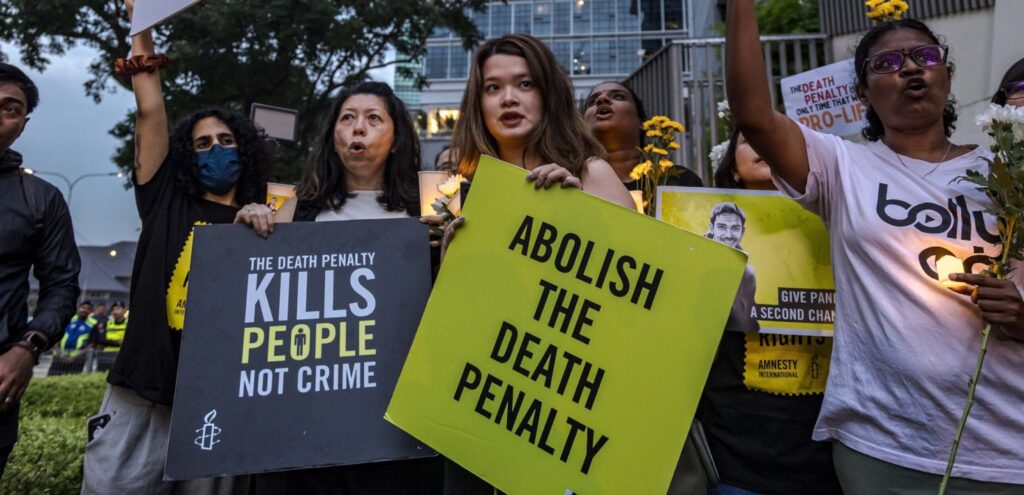
Abstract: This investigation explores the rising use of the death penalty in the Islamic Republic of Iran, particularly against political protesters, ethnic minorities, and individuals accused of drug-related offenses. Drawing on case studies, interviews, human rights reports, and data analysis, the report reveals how the Iranian judiciary system functions not merely as an instrument of justice but as a tool of state repression. It also highlights the international legal violations inherent in Iran’s application of capital punishment.
Investigation Team
The Politics of Death in Iran The death penalty has long been a feature of the Islamic Republic’s penal system, but in recent years, its use has escalated into a targeted weapon against dissent. Since the outbreak of mass protests in 2019 and especially following the death of Mahsa Amini in 2022, executions have surged in frequency and symbolism. Public hangings and televised confessions have returned as tools of fear. Behind the stage-managed confessions and swift trials lies a systematic policy: to deter, silence, and eliminate opposition.
The Legal Machinery: Lack of Due Process Iran’s Revolutionary Courts are at the heart of its capital punishment system. Defendants are often denied access to independent legal counsel. Trials are conducted swiftly, with some lasting just minutes. Forced confessions, extracted under torture or psychological coercion, are routinely accepted as evidence. Hearings take place behind closed doors, with family members and lawyers excluded. Appeals, when allowed, are often superficial and rubber-stamped.
Ethnic Targeting: Kurds, Baluchis, and Ahwazi Arabs Ethnic minorities in Iran are overrepresented on death row. Kurdish activists, particularly those accused of separatism or cultural advocacy, are sentenced under vague charges like “moharebeh” (waging war against God). Baluchi youth are frequently accused of drug trafficking under questionable evidence. Ahwazi Arab community leaders face execution for promoting Arabic language rights or documenting environmental destruction. In all cases, the underlying thread is suppression of identity and autonomy.
Protesters on Death Row Recent statistics from human rights organizations illustrate the scale of executions tied to protest activity. According to Iran Human Rights (IHRNGO), at least 834 people were executed in Iran in 2023 — the highest number in eight years. Of these, more than 80 were tied to protest-related charges. In the first quarter of 2024 alone, over 180 executions were reported, with a concerning number involving ethnic minorities and individuals arrested during demonstrations. These numbers reflect both an escalation in repression and the urgency of international monitoring.
The 2022 protests marked a new chapter in state repression. Dozens of protesters were arrested and charged with capital crimes within weeks. The most high-profile cases involved teenagers or young adults sentenced to death for allegedly killing security officers — often with no forensic evidence or witnesses. Executions were carried out swiftly, sometimes within a month of arrest. Families were notified only after the fact.
Drug-Related Executions: A Legal Grey Zone Although Iran amended its drug laws in 2017 to reduce the number of executions, the trend has reversed. Executions for non-violent drug offenses have skyrocketed since 2021. In many cases, individuals were arrested without warrants, denied access to lawyers, and sentenced based on confessions obtained under duress. According to Iran Human Rights (IHRNGO), more than 500 drug-related executions occurred in 2023 alone — a direct violation of international human rights treaties that prohibit capital punishment for non-violent crimes.
International Reactions and Legal Violations The UN Special Rapporteur on human rights in Iran has repeatedly condemned these executions as violations of the International Covenant on Civil and Political Rights (ICCPR), to which Iran is a signatory. Human rights organizations like Amnesty International and Human Rights Watch have documented dozens of such cases, urging international accountability. Yet, Iran continues to frame its executions as part of a sovereign legal process, rejecting all foreign criticism as interference.
The Role of Civil Society and Resistance Despite the risks, Iranian human rights defenders continue to document and resist state executions. Lawyers like Nasrin Sotoudeh, journalists, and civil society groups both inside Iran and in the diaspora have been key to exposing violations. Social media campaigns have pressured international bodies to intervene, even leading to the occasional suspension of an execution. But those who speak out — including families of the condemned — face surveillance, arrest, or exile.
Death as Deterrence, Death as Control In the Islamic Republic of Iran, capital punishment has become a blunt instrument of political and social control. Whether directed at ethnic minorities, political protesters, or drug offenders, the death penalty is wielded not for justice, but for domination. The international community must go beyond statements of condemnation and push for concrete accountability measures, including sanctions targeting those responsible for judicial abuses.
Ending the use of the death penalty in Iran will require a combination of legal reform, international pressure, and domestic resistance. Until then, the gallows will continue to loom large over Iranian civil society — a symbol not of justice, but of fear.