The development of uninhabited maritime systems in Australia has been accelerated by simplified access to defence programmes and closer collaboration between the military and industry, but this new approach is not without drawbacks.
This blog post was first published on Military Balance+ on 16 April 2026
In February 2026, the members of the AUKUS trilateral defence partnership – Australia, the United Kingdom and the United States – tested the interoperability and payload configurations of the Speartooth large uninhabited underwater vehicle (UUV) with the Royal Navy’s Astute-class nuclear-powered attack submarine, HMS Anson.
Conducted at HMAS Stirling in Western Australia, the tests highlighted the progress that Australia has made in developing indigenous maritime technologies, with the Speartooth system produced by Melbourne-based C2 Robotics, a company established less than seven years ago.
The Australian government is placing an emphasis on the development and procurement of persistent, long-range undersea warfare capabilities to complement its current and future fleet, as underscored in its 2026 National Defence Strategy and the 2026 Integrated Investment Program released in April 2026, which outlines a total investment of AUD94-130bn (USD66.18-91.53bn) over the next ten years. This effort includes maritime autonomous systems with an investment of AUD4.8-5.8bn (USD3.38bn-4.08bn) until 2036, and the Royal Australian Navy (RAN) is exploring several platforms that feature modular designs that allow for operational flexibility, with the vehicles’ sensors, payload modules and batteries reconfigurable depending on the mission.
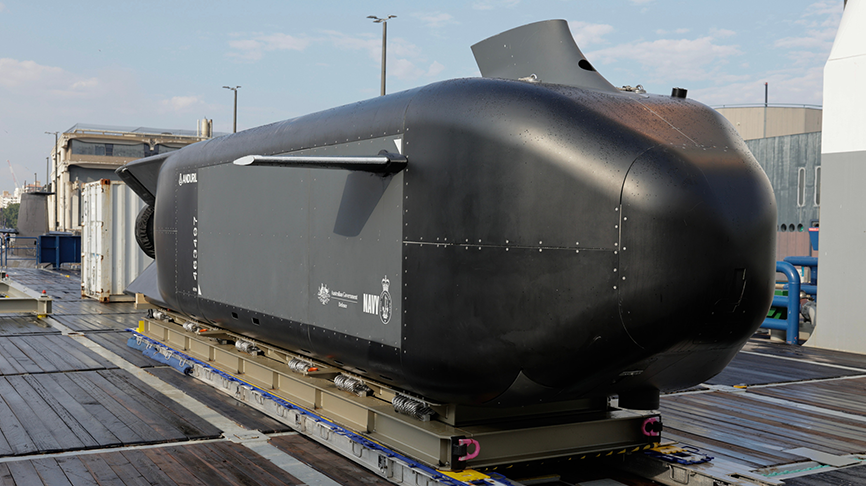
The fielding of uncrewed maritime systems is being accelerated through engagement with international and domestic companies. US ‘neo prime’ Anduril Industries established its Sydney office in March 2022 and two months later secured a three-year AUD140m (USD97.3m) contract with the RAN to develop three prototypes of the extra-large autonomous undersea vehicle (XLAUV), later renamed the Ghost Shark. Investment was split 50–50 between the company and the Australian government. Production began in September 2025 under a AUD1.87bn (USD1.2bn) contract for ‘dozens’ of systems, with initial deliveries scheduled for early 2026.
C2 Robotics was awarded a AUD2.41m (USD1.81m) contract in 2021 for its Speartooth UUV prototype, followed by a AUD5.94m (USD3.92m) contract in 2024 for a second-generation system featuring improved endurance and range, and modular payload bays. Speartooth systems have been exported to an undisclosed customer.
Meanwhile, in March 2020, OCIUS Technology received AUD5.54m (USD3.82m) under Australia’s Defence Innovation Hub initiative to develop its Bluebottle uninhabited surface vessel (USV). The company has subsequently received production contracts from the RAN for a total of 55 vessels, including a AUD126.04m (USD81.87m) order for 40 systems announced in March 2026. The Bluebottle USV has also achieved export success, with the delivery of two platforms to the Royal New Zealand Navy completed in April 2025.

The approach to developing these platforms is intended to combine low-cost and high-volume manufacturing with close alignment with the RAN in order to better meet the service’s requirements. It also highlights Australia’s efforts to lower barriers of entry to defence programmes and accelerate innovation by engaging with startup companies. Investing in multiple platforms that deliver similar capabilities may be a duplication of efforts, but Australia is apparently focusing on working with a broad range of suppliers that are capable of delivering systems with reduced development timelines and commercial approaches to production, with a further aim of reducing procurement costs.
Military Balance+
While this new approach to contracting and procurement may accommodate fast-moving software-upgrade cycles and emerging technologies, as well as spreading costs across successive rounds of system development, it can create challenges around transparency and programme planning and lead to hidden costs, as well as to compliance risks when the commercialisation of processes is prioritised.
Cost-assessment and strategic-planning issues are apparent with the RAN’s Speartooth UUV and Bluebottle USV programmes, as costs have increased due to frequent contract amendments to accommodate additions as the platforms have matured and testing completed. The RAN’s initial 2021 contract award to C2 Robotics for Speartooth ‘system development and demonstration’ was AUD2.41m (USD1.81m), but this increased to AUD11.21m (USD7.73m) in 2023 following two contract amendments. The development and testing contract for the second-generation platform also increased by a similar factor, jumping from AUD5.94m (USD3.92m) to AUD25.69m (USD16.76m) in 2024–25 after five contract amendments. Meanwhile, the initial development funding for the Bluebottle programme increased from AUD5.54m (USD3.82m) in 2020 to AUD10.15m (USD7.03m) following three contract amendments. Similarly, the procurement contracts underwent significant increases. For instance, the first production contract for five USVs agreed in 2022 for AUD5.39m (USD3.75m) rose to AUD27.3m (USD18.12m), and the second contract for eight additional Bluebottles inked in 2024 for AUD5.5m (USD3.64m) increased to AUD38.16m (USD24.7m).
Other considerations have been addressed during Australia’s procurement of uninhabited maritime systems. For the Ghost Shark, the government paid to acquire the core intellectual property for the platform in order to remove any constraints that may have been placed on development owing to Anduril being a US company. Obtaining an export licence will likely entail further costs.
Despite the involvement of new entrants to the defence sector, Australia continues to rely on established contractors for various aspects of its UUV and USV programmes, such as sonar arrays and other sensors. It remains to be seen to what extent the newcomers will significantly disrupt traditional ways of delivering defence programmes, challenge established defence firms in the long run, or reshape how the military engages with the sector.