By In Depth Reports
As Moscow prepared to commemorate the Soviet Union’s victory over Nazi Germany with its annual Victory Day military parade on Red Square, the war in Ukraine once again overshadowed the Kremlin’s attempt to project strength and stability.
What Russia presented as a temporary humanitarian truce quickly appeared to collapse under renewed missile and drone attacks from both sides, exposing the fragility of any pause in a war that has now entered its fifth year.
A Ceasefire Kyiv Never Accepted
Earlier this week, Russian President Vladimir Putin announced a unilateral two-day ceasefire timed around Russia’s World War II commemorations. The Kremlin framed the move as a humanitarian gesture intended to reduce hostilities during one of the country’s most symbolically important national holidays.
But Ukraine never agreed to the truce.
Kyiv instead accused Moscow of attempting to secure a brief pause solely to protect the Victory Day celebrations and prevent possible Ukrainian strikes against Russian territory during the parade.
Ukrainian President Volodymyr Zelensky dismissed the ceasefire as politically motivated, arguing that Russia had shown no genuine intention to halt fighting on the battlefield.
“On the Russian side, there was not even a token attempt to cease fire on the front,” Zelensky said, adding that Ukraine would continue responding “symmetrically” to Russian attacks.
The Ukrainian leader also accused Moscow of wanting “a permit from Ukraine” to hold the parade safely for a few hours before resuming military operations afterward.
Escalation Despite the Truce
Despite the announced ceasefire, both countries launched significant overnight attacks.
Ukraine’s air force said Russia launched 67 drones overnight — a lower number compared to recent weeks but still part of continued aerial operations targeting Ukrainian territory. Zelensky reported hundreds of additional Russian frontline attacks using short-range drones and assault operations across eastern battle zones.
Meanwhile, Russia’s Ministry of Defence announced that its air defence systems had intercepted 264 Ukrainian drones overnight, describing the attacks as evidence that Kyiv had no intention of respecting the temporary truce.
Ukraine also claimed responsibility for striking an oil depot in Russia’s Yaroslavl region, approximately 200 kilometres northeast of Moscow, highlighting Kyiv’s continued strategy of targeting Russian energy infrastructure deep inside Russian territory.
The growing threat of Ukrainian long-range drone attacks prompted Russian authorities to temporarily close 13 airports across southern Russia, while mobile internet restrictions were intermittently imposed in Moscow ahead of the Victory Day celebrations.
Moscow Fears an Attack on Red Square
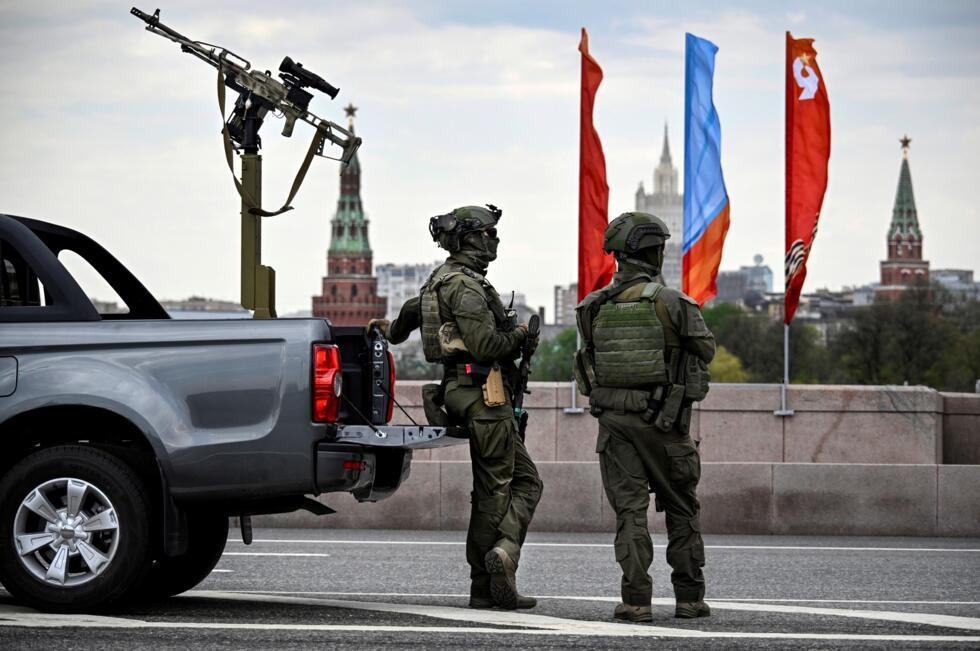
Behind the Kremlin’s public confidence, security concerns surrounding the Victory Day parade appear significant.
Over the past several days, Russian officials repeatedly warned Ukraine against targeting the parade or Moscow itself, threatening what they described as a “massive strike” against Kyiv in response.
In an unusually direct statement, Russia’s defence ministry urged civilians in Kyiv and foreign diplomatic personnel to leave the Ukrainian capital “in good time,” a move widely interpreted as psychological pressure ahead of the celebrations.
The warnings reflected growing Russian anxiety over Ukraine’s expanding ability to strike military and infrastructure targets inside Russia, particularly after several recent attacks on oil depots, energy facilities, and transport infrastructure.
Despite the threats, a senior Ukrainian official confirmed that President Zelensky would remain in Kyiv throughout the weekend.
Several European governments, including Germany and the United Kingdom, publicly condemned Moscow’s threats against the Ukrainian capital.
Victory Day Under the Shadow of War
Victory Day has become one of the central pillars of Putin’s political narrative, increasingly used to connect Russia’s invasion of Ukraine with the Soviet struggle against Nazi Germany.
But this year’s celebrations are taking place under visibly different circumstances.
Reports indicate that heavy military hardware will be significantly reduced during the parade for the first time in nearly two decades, while the number of high-profile foreign guests attending the event remains limited.
Analysts believe the Kremlin hopes to use the parade to reinforce the image of Russia as a resilient global power despite sanctions, military losses, and international isolation. Yet Ukraine’s growing ability to strike targets inside Russia has complicated that narrative.
Stalled Diplomacy and an Endless War
Efforts to negotiate an end to the conflict remain largely frozen.
Moscow continues demanding that Ukraine withdraw from four occupied regions claimed by Russia, conditions Kyiv and its Western allies consider unacceptable.
Meanwhile, Ukraine insists that any meaningful ceasefire must involve genuine security guarantees and an end to Russian military aggression rather than temporary symbolic pauses.
More than four years into the conflict, the war increasingly resembles a prolonged war of attrition — militarily, economically, and politically.
And as Russian tanks prepare to roll through Red Square, the reality remains that neither side appears ready to compromise, while any ceasefire unaccompanied by a broader political agreement risks becoming little more than a brief pause beneath the sound of drones, missiles, and artillery fire