By InDepthReports
The fragile diplomatic opening between Washington and Tehran is already facing its first major contradiction.
Only hours after the United States and Iran completed their first round of talks in Switzerland, American officials presented the negotiations as a breakthrough that could reopen the Strait of Hormuz, ease sanctions, stabilize Lebanon, and bring international nuclear inspectors back into Iran. But Tehran quickly rejected one of Washington’s central claims: that Iran had agreed to allow inspectors from the International Atomic Energy Agency back into the country under new terms.
The disagreement may appear technical, but it goes to the heart of the emerging deal. If the Strait of Hormuz is the economic test of the agreement, nuclear inspections are its political and strategic test. Without clarity on monitoring, verification, and access to nuclear sites, the broader process risks becoming another temporary pause in a decades-long cycle of confrontation.
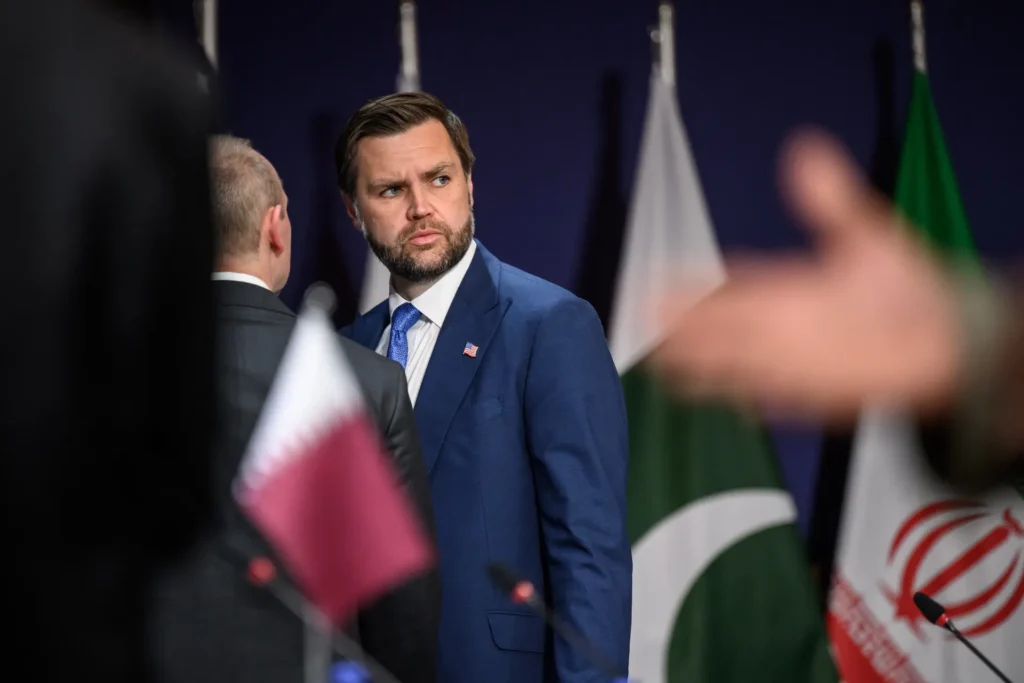
The dispute began after US Vice-President JD Vance said that discussions with the IAEA could begin “as soon as today,” adding that he expected the process of restoring inspections to start at least within the week. US Treasury Secretary Scott Bessent also linked Washington’s temporary sanctions waiver to Iranian commitments on keeping Hormuz open and allowing inspectors back into the country.
But Iran’s foreign ministry rejected that interpretation. Speaking to Iranian state media, spokesman Esmail Baqai said Tehran had made “no new commitments” on nuclear inspections. Any engagement with UN inspectors, he said, would take place only under existing procedures set by Iran’s parliament and Supreme National Security Council.
This public contradiction exposes the central weakness of the current diplomatic framework: the United States and Iran may have agreed on a roadmap, but they have not yet agreed on what the roadmap actually means.
A Deal Built on Ambiguity
The first round of negotiations was presented by mediators Qatar and Pakistan as an encouraging step toward a final agreement within sixty days. Their joint statement described the creation of a communication line to avoid incidents in the Strait of Hormuz and a de-confliction cell involving the United States, Iran and Lebanon to help end military operations there.
These are significant developments. After months of military escalation, maritime disruption and regional instability, even limited mechanisms for communication can reduce the risk of miscalculation. The Strait of Hormuz remains one of the world’s most important energy corridors, and any sustained disruption threatens global oil and gas markets. Lebanon, meanwhile, has become the most immediate battlefield where the US-Iran understanding could either hold or collapse.
Yet the nuclear issue is different. It cannot be managed through ambiguity for long.
Iran suspended IAEA access to sites bombed by Israel and the United States during the twelve-day war last summer. The following month, the UN nuclear watchdog withdrew its remaining inspectors from the country. Since then, the world has had reduced visibility over parts of Iran’s nuclear infrastructure at precisely the moment when mistrust between Tehran and Washington has deepened.
For Washington, bringing inspectors back is essential to proving that diplomacy is not merely giving Iran economic breathing space. For Tehran, however, inspections remain deeply political. After strikes on Iranian nuclear sites, allowing international inspectors to return under pressure could be portrayed domestically as a concession made under threat.
That is why both sides are now speaking in different languages.
The United States wants to frame inspection access as part of a new bargain. Iran wants to frame it as part of existing sovereign procedures.
The Sanctions Waiver: A Major US Concession
The nuclear dispute unfolded alongside one of the most consequential elements of the emerging agreement: a temporary US sanctions waiver allowing Iran to sell oil in US dollars for the first time in decades.
The sixty-day waiver, issued by the US Treasury, authorizes the production, sale and delivery of Iranian crude and petrochemicals until 21 August. It also allows banking transactions, insurance and transport services linked to Iranian oil exports. In practical terms, it dismantles several central pillars of Washington’s long-running embargo, at least temporarily.
This is not a symbolic gesture. For years, Iran has relied on complex networks of intermediaries, shadow shipping arrangements and alternative payment structures to sell crude under sanctions. The new waiver could allow Tehran to sell oil more openly, access financial channels more easily and reduce the costs associated with sanctions evasion.
For Iran, this is a major economic gain. For the United States, it is a calculated risk.
Washington is effectively offering Iran short-term economic relief in exchange for regional de-escalation, maritime security and progress toward nuclear talks. But if Tehran receives the economic benefits while delaying or narrowing inspection access, critics in Washington will argue that the administration conceded too much too early.
That is why the dispute over IAEA inspectors matters so much. It will shape whether the sanctions waiver is seen as diplomatic leverage or premature reward.
Tehran’s Calculation
Iran’s response reflects a familiar negotiating strategy: accept economic relief, support regional de-escalation where useful, but avoid new commitments that could be interpreted as surrender.
Tehran has strong reasons to engage. Years of sanctions have weakened its economy, limited investment, increased inflationary pressure and complicated access to global markets. The reopening of oil channels and the partial release of frozen assets could provide immediate relief. A reduction in military pressure could also help stabilize domestic politics after months of confrontation.
But Iran also has reasons to move carefully. The leadership cannot appear to accept nuclear inspections on American terms after US and Israeli strikes on its facilities. Nor does it want to create a precedent in which military pressure produces new inspection obligations.
This explains the wording used by Iran’s foreign ministry. By saying there are “no new commitments,” Tehran is not necessarily rejecting all engagement with the IAEA. Rather, it is insisting that any return of inspectors must be framed within Iranian legal and institutional procedures, not as a new concession extracted by Washington.
The distinction may seem narrow, but politically it is crucial.
Washington’s Pressure Strategy
The United States is also negotiating on two tracks: offering relief while threatening force.
Vice-President Vance described the talks as having laid a “very good foundation,” but President Donald Trump simultaneously warned that if Iran does not live up to the agreement, he would “do what I have to do.” Earlier, Trump had posted that the US could “hit Iran very hard again,” a statement that reportedly prompted Iranian negotiators to threaten walking out.
This mixture of diplomacy and coercion has long defined US policy toward Iran. The difference now is that the stakes are higher. The war has already shown that confrontation can rapidly disrupt energy markets, ignite Lebanon and draw in regional actors.
The American message is clear: sanctions relief is available, but only if Iran reduces regional instability and accepts nuclear constraints.
The Iranian message is equally clear: economic normalization is welcome, but not at the price of appearing to submit to American threats.
The talks are therefore not only about policy. They are also about narrative, dignity and domestic legitimacy.
Lebanon as the Immediate Battlefield
While the nuclear file remains the strategic core of the negotiations, Lebanon may become the first real operational test.
The mediators announced the creation of a de-confliction cell involving the US, Iran and Lebanon, facilitated by Qatar and Pakistan. Iranian Foreign Minister Abbas Araghchi said Lebanon would be the first “real test” of the process.
That assessment is accurate.
The fighting between Israel and Hezbollah has eased since Saturday night, but the ceasefire remains fragile. Israel continues to frame Hezbollah’s military infrastructure in southern Lebanon as a direct threat to northern Israel. Hezbollah, meanwhile, has said it remains committed to the ceasefire but will confront Israeli attempts to seize territory or expand occupation.
If clashes resume, the US-Iran process could quickly come under pressure. Iran will be expected to restrain Hezbollah. The United States will be expected to restrain Israel. Neither task will be easy.
Lebanon is therefore more than a side issue. It is the battlefield on which the credibility of the broader agreement may first be tested.
The Sixty-Day Clock
The roadmap announced by Qatar and Pakistan gives the parties sixty days to move toward a final deal. That timeline is ambitious.
Within that period, negotiators must establish working groups on nuclear issues, sanctions, maritime security and regional de-escalation. They must clarify what Iran is expected to do, what the United States is prepared to waive or lift, and what role international monitors will play.
The problem is that each issue is connected to the others.
Iran may resist nuclear concessions without broader sanctions relief. The United States may resist deeper sanctions relief without verifiable nuclear access. Lebanon may destabilize the process. Israel may reject any deal it believes leaves Iran’s strategic capabilities intact. Hardliners in Tehran may accuse the government of compromising under pressure. American critics may accuse Washington of rewarding Iran too early.
The agreement has created momentum, but it has also created a deadline.
Deadlines can focus negotiations. They can also expose contradictions.
A Fragile Opening, Not a Settlement
The first round of US-Iran talks has produced real progress, but not yet a durable settlement.
The reopening of communication channels, the temporary sanctions waiver, the maritime safety mechanism and the Lebanon de-confliction cell all represent meaningful steps away from open confrontation. But the immediate dispute over nuclear inspections shows how fragile the process remains.
At its core, the emerging agreement rests on a difficult bargain: Iran receives economic relief and reduced military pressure; the United States receives regional de-escalation, maritime security and progress toward nuclear limits. The difficulty is that both sides want the benefits immediately while postponing the most politically costly concessions.
That is why the inspection issue is so important. It is the first sign that the deal’s language may be broad enough to allow progress, but vague enough to create conflicting interpretations.
For now, the talks have created a diplomatic opening where escalation seemed more likely only weeks ago. But whether that opening becomes a path toward stability will depend on what happens next: whether inspectors return, whether Hormuz remains open, whether Lebanon holds, and whether Washington and Tehran can turn ambiguity into enforceable commitments.
The first round ended with encouraging progress. The second will reveal whether that progress was real.