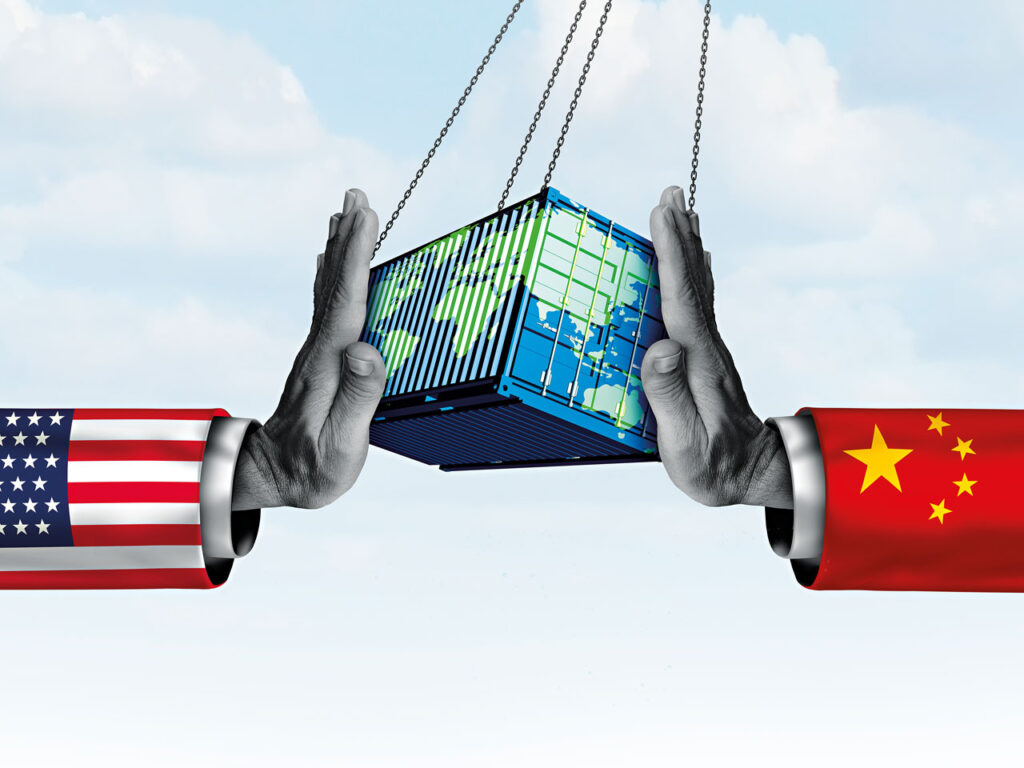
At first glance, the events that unfolded across July 2026 appeared unrelated. A new wave of tariffs announced in Washington. Shipping companies quietly rerouting vessels away from the Red Sea. European manufacturers warning about delayed components. Insurance premiums climbing for commercial cargo. Energy traders monitoring every missile launched in the Middle East. Stock markets reacting not to battles themselves but to the possibility that another maritime corridor could close.
Individually, each event looked manageable. Together, they reveal something far more consequential: the global economy is no longer operating under the assumptions that defined the past three decades.
An InDepthReports investigation examined trade data, maritime disruptions, policy announcements, shipping behaviour and economic indicators throughout July 2026. The evidence suggests that the world is entering a new era in which economic pressure has become the preferred instrument of geopolitical competition.
July 2026 may eventually be remembered not for a single military confrontation or diplomatic crisis, but for something far more consequential: the quiet transformation of the global economy into a battlefield. Throughout the month, a series of developments unfolded across different regions that initially appeared disconnected. Missile attacks targeted strategic infrastructure in the Middle East, commercial shipping companies quietly altered their routes through some of the world’s busiest maritime corridors, governments announced new tariffs and trade restrictions, while insurance markets rapidly reassessed geopolitical risk. None of these events individually suggested a systemic shift in the international order. Yet when examined together, they reveal a profound change in how states increasingly pursue geopolitical objectives. Military power remains important, but economic instruments—trade restrictions, maritime disruption, sanctions, supply chains, and strategic infrastructure—have become equally decisive tools of international competition. The global economy is no longer merely affected by geopolitical conflict; it has become one of its principal battlegrounds.
The first indication of this transformation appeared not in government statements but in the behaviour of commercial shipping. Maritime transport has long served as one of the most reliable indicators of global economic confidence because shipping companies respond to operational realities rather than political rhetoric. During July, however, vessel movements through the Red Sea and the Bab el-Mandeb Strait changed noticeably as security conditions deteriorated following renewed Houthi attacks connected to the broader confrontation involving Iran. Shipping operators increasingly redirected vessels away from the region despite the substantial financial costs associated with longer routes around the Cape of Good Hope. The decision reflected a calculation that uncertainty itself had become commercially unacceptable. Even where shipping lanes technically remained open, the growing possibility of missile attacks, drone strikes, or sudden escalation altered commercial behaviour in ways that extended far beyond the immediate conflict zone.
The economic implications of these routing decisions extend well beyond maritime logistics. Every additional day spent at sea increases fuel consumption, insurance costs, crew expenses, and delivery times while simultaneously reducing the availability of vessels for future operations. Modern supply chains, built over decades around principles of efficiency and predictability, are particularly vulnerable to such disruptions because they rely on tightly synchronised production schedules with minimal inventory buffers. As shipping becomes slower and more expensive, manufacturers face delays in receiving components, distributors struggle to maintain delivery schedules, and businesses increasingly absorb costs that eventually reach consumers. The disruption therefore travels silently through the global economy, affecting industrial production, inflation, and investment decisions long before the average consumer becomes aware that geopolitical instability has influenced the price of everyday goods.
One of the clearest indicators that July represented more than a temporary security crisis emerged from the insurance industry. Marine insurers are among the first institutions to translate geopolitical developments into measurable financial consequences because their business depends upon accurately assessing operational risk. As attacks intensified in the Red Sea, insurers revised war-risk premiums for commercial vessels operating in the region, reflecting growing concern that merchant shipping itself had become a deliberate target rather than an unintended casualty of regional conflict. These adjustments may appear highly technical, yet they serve as one of the most reliable early warning systems within the global economy. Rising insurance premiums influence freight rates, shipping decisions, and ultimately the cost of international trade. In this sense, financial markets often recognise strategic transformation before political leaders publicly acknowledge it.
Perhaps the most significant lesson emerging from July 2026 is that modern conflicts increasingly seek to influence infrastructure rather than territory. Traditional warfare aimed to seize cities, occupy land, or destroy opposing military forces. Contemporary geopolitical competition increasingly focuses instead on the systems that sustain global economic activity. Maritime chokepoints, ports, pipelines, undersea communication cables, energy terminals, semiconductor production facilities, and digital networks have all become strategic assets whose disruption can generate consequences comparable to those once associated with conventional military victories. The Bab el-Mandeb Strait illustrates this evolution particularly clearly. Closing the waterway completely is unnecessary. Generating sufficient uncertainty for commercial operators to alter their behaviour may produce many of the same economic effects while avoiding the political and military costs associated with a formal blockade. Strategic success is therefore measured not by territorial occupation but by the ability to reshape commercial calculations across international markets.