Germany’s latest environmental emergency is not confined to burning forests or shrinking rivers. Taken together, the wildfires, persistent drought conditions, unusually low river levels and transport disruptions of the summer of 2026 point toward a deeper question for Europe’s largest economy: what happens when the physical infrastructure on which an industrial model was built becomes less reliable because the climate itself is changing?
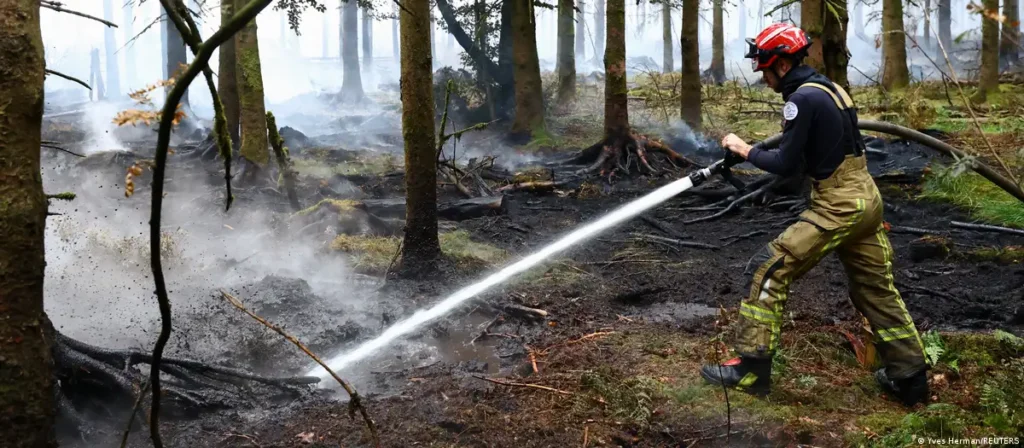
The warning signs are increasingly difficult to treat as isolated events. In August 2026, a major wildfire in Belgium’s High Fens nature reserve advanced to within roughly 300 meters of the German border. Around 30 residents of 17 homes in Monschau were evacuated as a precaution. The Belgian fire burned approximately 3,000 hectares, while firefighters faced difficult terrain, smoke and fires burning deep in peat soil. Belgium activated the EU Civil Protection Mechanism and received assistance from other European countries.
At almost the same time, persistent dry conditions were creating another, less dramatic but potentially more economically consequential problem. Falling water levels on German rivers were reducing the amount of cargo that vessels could carry. Construction-sector representatives warned that supplies of sand, gravel, bitumen, aggregates, natural stone and fuels could become more expensive or difficult to obtain. The Rhine, one of the central arteries connecting German industry to European ports and international markets, was again demonstrating that a climate event can quickly become a logistics event, an industrial event and eventually a macroeconomic one.
The significance of the situation lies precisely in this interaction. Germany is not confronting one climate problem. It is confronting several physical stresses that can reinforce one another: heat increases evaporation and dries vegetation; drought raises wildfire risk and reduces river flows; low rivers constrain freight transport; transport constraints increase the cost of fuel and industrial inputs; and higher input costs can weaken investment and industrial competitiveness.
The central issue, therefore, is no longer whether extreme weather can disrupt the German economy. That has already happened. The more consequential question is whether these disruptions are becoming frequent enough to alter the economics of Germany’s infrastructure-dependent industrial model.
A Climate Shock That Is Becoming a Structural Risk
Germany has experienced droughts, heatwaves and low river levels before. What is changing is the economic relevance of their recurrence.
The 2018 drought remains an important benchmark. According to the OECD, Rhine transportation fell by 27% year-on-year during that episode, while German industrial production declined by 1.5% and chemicals and pharmaceutical production fell by about 10% for three months. The OECD also notes that droughts and heatwaves are closely connected and that extended, intensive drought periods have been increasing as temperatures rise and precipitation patterns change.
Germany’s own environmental monitoring provides another indication that the problem cannot simply be treated as an exceptional episode. The German Environment Agency reports that low-water restrictions affecting shipping on the Lower Rhine have shown a significantly increasing trend since 1997. In 2018, freight transported by German inland vessels fell by roughly 25 million tonnes from the previous year, an 11.1% decline.
That does not mean every drought, fire or low-water episode can be attributed directly to climate change. Individual events are influenced by weather variability, land management, river conditions, vegetation, ignition sources and numerous other factors. The more defensible conclusion is that the underlying risk environment is changing. Higher temperatures and increasingly severe periods of drought can increase the probability that existing vulnerabilities—whether a conifer forest or a shallow section of the Rhine—turn into economic disruptions.
Germany is particularly exposed because of the physical geography of its economy. Large industrial facilities were built close to rivers for good historical reasons: water transport moves enormous volumes of heavy materials at relatively low cost. Chemical plants, steelmakers, refineries, construction-material suppliers and logistics facilities have developed around this system over decades.
Climate change does not have to make the Rhine unnavigable to challenge that model. It only has to make reliable navigation sufficiently less predictable.
The Rhine Is Infrastructure, Not Just Geography
The Rhine’s economic importance is difficult to overstate. Germany’s transport ministry describes it as the country’s most important transport route for inland navigation, while the German Environment Agency says more than three quarters of goods transported by inland shipping move via the Rhine.
Germany transported 171.6 million tonnes of goods on its inland waterways in 2025. That was already the lowest annual volume recorded since German reunification in 1990 and 1.3% below 2024. Dry bulk commodities accounted for 92.5 million tonnes, or 53.9% of inland-waterway freight, while liquid bulk goods represented another 49 million tonnes, or 28.5%.
The composition matters. Inland shipping is especially valuable for commodities that are heavy, bulky and relatively inexpensive per tonne. In 2025, German inland waterways carried 27.8 million tonnes of liquid petroleum products, 20 million tonnes of stone and earth, 17.7 million tonnes of iron ore and 16.1 million tonnes of coal. Those four categories alone accounted for 47.5% of inland shipping volume.
Germany’s waterways are also deeply integrated into international supply chains. Of 171.6 million tonnes transported by inland waterway in 2025, roughly 118.1 million tonnes involved international transport. Rotterdam alone accounted for 57.2 million tonnes of inland-waterway trade with Germany, followed by Antwerp with 17.7 million and Amsterdam with 9 million. Together, those three ports accounted for more than 71% of Germany’s internationally transported inland-waterway freight.
This creates an important vulnerability. The Rhine is not simply another transportation option operating alongside road and rail. For some industries it is the economically optimal way of moving extraordinarily large quantities of material between North Sea ports and industrial centers in western and southern Germany.
When the river becomes shallow, the vessels do not necessarily stop moving. Instead, they load less.
That distinction is essential to understanding the economics of low water.
How a Drought Becomes an Industrial Shock
A cargo vessel must maintain sufficient clearance between its hull and the riverbed. When water levels fall, the amount of cargo it can safely carry declines. The vessel may still travel, but the economics of the journey change.
Imagine that a barge normally carries a large shipment of industrial raw material. If low water forces the operator to carry only half of its normal load, approximately twice as many vessel movements may be necessary to transport the same quantity. If usable capacity falls further, the number of required journeys increases correspondingly.
The physical transport capacity has effectively become scarcer.
Freight rates can then rise. Additional vessels may need to be chartered. Delivery schedules become less predictable. Companies may draw down inventories or attempt to move freight onto trains and trucks. Manufacturers dependent on continuous supplies may eventually reduce production.
This is precisely why the construction industry’s warnings in August 2026 matter. Industry representatives said water transport was becoming increasingly difficult, particularly for sand and gravel delivered in large quantities to concrete plants. Suppliers warned that continued low water could affect bitumen, aggregates, natural stone, fuels and mineral construction waste as well.
The economic transmission mechanism therefore runs approximately as follows:
drought → lower river discharge → lower vessel capacity → higher transport cost → tighter availability of raw materials → higher input prices and delays → lower or more expensive production.
The crucial point is that the economic damage can become much larger than the direct cost incurred by shipping companies. A relatively small transportation bottleneck can interrupt production worth far more than the freight itself.
Germany learned that lesson in 2018.
2018 Was the Warning
The prolonged Rhine low-water episode of 2018 provides perhaps the clearest historical illustration of the economic risk now re-emerging.
Germany’s inland-waterway freight volume fell from 222.7 million tonnes in 2017 to 197.9 million tonnes in 2018, an 11.1% decline. The German Environment Agency notes that the low-water period lasted unusually long, with restrictions continuing through parts of the autumn and affecting industrial supply chains and fuel distribution.
Estimates of the macroeconomic effect vary depending on methodology and the period examined. The Kiel Institute estimated that low water reduced German GDP growth by approximately 0.1 percentage point in both the third and fourth quarters of 2018. Other research has estimated roughly €2.4 billion in economic damage for Germany from the 2018 Rhine low-water episode.
The precise number matters less than the mechanism it exposed. A meteorological event had become a measurable national economic event.
This also explains why comparisons with 2018 should be made carefully. Germany has adapted since then. Companies have changed logistics strategies, governments have developed low-water plans and some firms have invested in vessels capable of carrying greater loads at shallower depths.
But adaptation has not eliminated the underlying dependence.
The Limits of Trucks and Trains
A common response to Rhine disruption is that freight can simply be transferred to road or rail. In practice, substitution is much harder.
Germany’s rail network already carries large freight volumes. In 2025, rail transported approximately 328 million tonnes of goods, compared with 171.6 million tonnes carried by inland waterways. But those headline figures do not imply that hundreds of millions of tonnes of additional river cargo could immediately move onto rail.
Rail capacity depends on available locomotives, wagons, drivers, terminals and train paths. Freight trains compete for network capacity with passenger services, and industrial plants designed around river deliveries may not have sufficient rail unloading infrastructure to substitute seamlessly.
Road transport faces similar constraints. Moving bulk commodities by truck can require large numbers of vehicles, increasing labor requirements, congestion, fuel consumption and emissions. For low-value materials such as gravel or aggregates, the additional transport cost can represent a significant proportion of the product’s value.
This makes redundancy expensive.
Yet the alternative—maintaining supply chains that depend overwhelmingly on one transport mode exposed to increasingly volatile hydrological conditions—also carries a cost.
Germany’s challenge is therefore not to replace the Rhine. It is to build enough redundancy around it that a low-water episode does not become an industrial crisis.
Fuel Prices Reveal How Quickly Consumers Can Feel the Impact
The relationship between low river levels and energy prices illustrates how a transport disruption can move from industrial logistics into household budgets.
In August 2026, Germany’s E10 gasoline averaged €2.161 per liter nationally, while diesel averaged €2.243. Both had risen substantially over the preceding week. The immediate causes were multiple: international oil-market tensions, the expiration of Germany’s temporary fuel-tax reduction and transportation problems associated with low river levels all played roles.
Low water should therefore not be treated as the sole explanation for higher fuel prices.
But the mechanism is historically established. During the 2018 low-water crisis, tank barges could no longer travel fully loaded on parts of the Rhine. Combined with disruption at a Bavarian refinery, this contributed to fuel scarcity and higher filling-station prices in southern Germany.
The significance is broader than gasoline.
If inland shipping constraints simultaneously affect petroleum products, chemicals, minerals and construction materials, climate-induced logistics disruption can generate several inflationary pressures at once. Transportation becomes more expensive; industrial inputs become more expensive; construction projects become more expensive; and some of those increases ultimately reach consumers.
One drought does not necessarily produce sustained national inflation. Repeated droughts, however, could change how businesses price logistical risk.
That is a different problem.
Construction Could Become a Climate-Adaptation Paradox
Germany needs extensive construction and infrastructure investment partly because it must adapt to climate change. But climate disruption itself can increase the cost of delivering that infrastructure.
This creates a potential adaptation paradox.
Concrete production requires enormous quantities of aggregates such as sand and gravel. Road construction requires bitumen and mineral materials. These commodities are heavy relative to their value, making transportation economics unusually important.
If low river levels make these materials more expensive to deliver, public infrastructure projects may face higher costs or longer timelines precisely when governments are attempting to accelerate infrastructure modernization and climate adaptation.
The same applies to housing.
Germany already faces pressure to expand housing supply. If construction-material prices become more volatile because of transportation constraints, developers may encounter another layer of uncertainty on top of financing costs, labor shortages, regulation and land prices.
No single episode is likely to stop Germany’s construction industry nationally; indeed, the German Construction Industry Federation said in August that a widespread halt remained unlikely. But the federation warned that the risks of shortages, higher logistics costs and delays were increasing as low water persisted.
The long-term concern is therefore less dramatic but more persistent: climate volatility could become embedded in the cost structure of building Germany’s future infrastructure.
Germany’s Forests Are Another Form of Infrastructure
The wildfire problem reveals a parallel vulnerability.
Roughly one-third of Germany’s land area—about 11.5 million hectares—is forested. The country’s most common tree species include spruce, pine, beech and oak. According to the latest federal forest inventory, approximately 79% of German forest area qualifies as mixed forest, but substantial areas remain vulnerable.
German authorities estimate that approximately 21% of forest area, equivalent to about 2.5 million hectares, is not yet mixed forest. The Thünen Institute estimates that roughly 95,000 hectares require adaptation each year, while active conversion is currently occurring on only about 30,000 hectares annually—roughly one-third of the estimated requirement.
That gap is economically significant.
Germany’s federal agriculture ministry has spent decades promoting the conversion of large pure conifer stands into more diverse, site-appropriate forests. Between 2020 and 2023, federal and state governments jointly invested an average of around €40 million through one major support framework for near-natural forest conversion.
The logic extends beyond wildfire prevention. Diverse forests can be more resilient to drought, pests and disease. Germany’s forests have still not fully recovered from the extremely hot and dry summers of 2018–2020, even after comparatively favorable conditions in 2023 and 2024.
Germany therefore faces a slow-moving infrastructure challenge in its forests similar to the challenge on the Rhine: the physical system was shaped under historical climatic conditions, while the conditions governing its future performance are changing faster than the system itself can be redesigned.
Adaptation Has Already Started—but Speed Is the Question
Germany is not beginning from zero.
After the 2018 crisis, the federal government developed an eight-point Rhine Low Water Action Plan. Its measures include better operational water-level forecasting, longer-term hydrological projections, improved real-time depth information for vessels, greater storage capacity, alternative transport arrangements, digitalization and the development of ships optimized for low-water conditions.
The plan also acknowledges the central problem directly: climate change could increase the frequency of extreme and prolonged low-water episodes, requiring investigation of longer-term engineering and water-management solutions.
Corporate adaptation is occurring as well. Companies exposed to Rhine disruptions have invested in specialized vessels and alternative logistics. BASF, for example, developed a tanker designed to transport significant loads even under exceptionally low-water conditions. Other industrial companies have strengthened rail alternatives following the disruption of 2018.
These investments demonstrate that adaptation is possible.
But they also reveal something important about the economics of climate change. Resilience is not free.
A specialized low-water vessel represents capital that might not have been necessary under historical conditions. Additional storage capacity ties up land and money. Maintaining alternative rail contracts costs more than relying exclusively on the cheapest transport route. Redundant suppliers reduce efficiency in exchange for reliability.
For decades, industrial supply chains were optimized around efficiency. Climate adaptation requires them to assign greater value to redundancy.
That shift could prove fundamental.
The Wildfire at the Border Shows Why National Adaptation Is Not Enough
The High Fens fire provides another lesson: climate risk does not respect political borders.
Belgium’s largest wildfire in a century threatened German communities and required international firefighting assistance. Belgium activated the EU Civil Protection Mechanism while emergency authorities in Germany prepared for the possibility that the fire could cross into German territory.
The same logic applies to the Rhine.
Germany does not control the river’s hydrology by itself. The Rhine connects Switzerland, France, Germany and the Netherlands and links German industrial centers to ports such as Rotterdam and Antwerp. Climate adaptation therefore requires coordination across borders, transport systems, environmental authorities and emergency-response organizations.
This creates an institutional challenge. Climate change increases the probability that several European countries will experience major emergencies simultaneously. A continent-wide heatwave can generate wildfires in multiple states while reducing river flows and straining electricity systems at the same time.
European solidarity mechanisms work most easily when one country needs assistance and others have spare capacity. They become more difficult when many countries need the same firefighting aircraft, emergency personnel, water resources or logistics capacity simultaneously.
The High Fens fire is therefore not merely a Belgian fire that nearly reached Germany. It is an illustration of how European climate security is becoming interconnected.
The Social Cost Will Not Be Distributed Equally
Environmental disruption eventually becomes a distributional question.
Higher transportation costs, fuel prices, housing costs and energy bills do not affect every household equally. Lower-income households generally have less capacity to absorb sudden increases in essential expenses. Rural households may depend more heavily on cars. Renters can be exposed indirectly through construction and heating costs. Workers in vulnerable industrial regions can face employment risks if factories reduce production or investment.
These pressures arrive at a time when Germany is already confronting wider social and demographic challenges. In 2025, 10% of Germans aged 20–24 were neither employed nor participating in education or training, compared with 8.8% in 2022. Germany remained below the EU average of 12.9%, but the direction of the trend deserves attention.
There is no evidence in the supplied material establishing that climate disruption caused this increase, and such a causal claim would be inappropriate. The relevance is instead fiscal and social: climate adaptation will occur in a society already facing competing demands for housing, education, pensions, industrial support, defense and infrastructure.
Every additional adaptation requirement therefore enters an increasingly crowded political economy.
The Real Competition Is for Investment Capacity
Germany is simultaneously attempting to modernize its transport infrastructure, transform its energy system, increase military capacity, adapt to climate change and maintain industrial competitiveness.
The scale of these competing priorities is substantial. Germany’s Bundeswehr employed roughly 186,700 soldiers as of July 31, 2026, while the longer-term goal is a full-time force of around 260,000 plus approximately 200,000 reservists.
Climate adaptation does not necessarily compete euro-for-euro with defense or social spending. Successful adaptation can prevent future economic losses and may therefore produce positive fiscal returns.
But governments face finite administrative capacity, engineering capacity, construction labor and political attention even when financing is available.
This makes delayed adaptation potentially expensive.
Infrastructure that takes ten or fifteen years to plan becomes problematic if climate risks are changing more rapidly than the planning process. Forest conversion is similarly constrained by biological time: a resilient mixed forest cannot be created instantly after a severe fire. Trees take decades to mature.
Adaptation therefore contains an asymmetry. Governments can postpone spending, but they cannot necessarily recover the lost preparation time later.
Three German Futures for 2030
Germany’s trajectory over the remainder of the decade can be understood through three broad scenarios.
Scenario One: Adaptation and Containment
In the most favorable scenario, the 2026 drought and wildfire season accelerates investments that were already underway.
Germany expands low-water forecasting, speeds improvements at critical Rhine bottlenecks, incentivizes low-draft vessels and develops stronger rail and storage alternatives for strategic industrial commodities. Forest conversion accelerates substantially from today’s pace, while Germany and neighboring countries expand joint wildfire-response capacity.
Businesses incorporate hydrological risk into procurement and inventory planning. Critical industrial facilities maintain larger buffers of essential materials. Improved forecasts allow companies to react weeks rather than days before severe navigation restrictions emerge.
Climate extremes continue. Some summers remain highly disruptive. But the relationship between extreme weather and economic damage weakens because the economy becomes less fragile.
The defining characteristic of this scenario is not that Germany defeats climate change. It is that individual climate shocks stop automatically becoming supply-chain crises.
Scenario Two: Slow Adaptation
The second scenario is arguably more difficult because it lacks a single dramatic failure.
Infrastructure improvements proceed, but slowly. Forest conversion continues below estimated requirements. Rail capacity remains constrained. Companies invest selectively in resilience, while smaller firms struggle to justify expensive redundancy.
Low-water episodes consequently become recurring seasonal economic events.
Freight rates spike during dry summers. Construction projects experience delays. Fuel-price differences between regions periodically widen. Industrial companies carry more inventory and pay more for transportation insurance and backup logistics.
None of these costs alone causes a national economic crisis.
Together, however, they become a persistent resilience premium embedded in German production.
The danger is cumulative. An economy can remain functional while gradually becoming more expensive.
Scenario Three: Structural Stress
The third scenario emerges if severe drought and low-water conditions become sufficiently frequent that adaptation cannot keep pace.
In this world, businesses stop treating Rhine disruptions as temporary exceptions and begin incorporating them into long-term investment decisions. A new factory’s location is evaluated not only according to labor costs, energy availability, taxes and market access, but also according to water security and transportation resilience.
Companies with extremely high bulk-transport requirements may favor locations with more diversified logistics. Warehouses move closer to production facilities. Inventories rise structurally. More capital is tied up in redundancy.
The implications would extend beyond the Rhine.
Insurance costs would increase in areas facing wildfire, flood or drought risk. Governments would confront simultaneous demands for emergency response and infrastructure adaptation. Construction costs could rise while the amount of construction required for adaptation increases.
Germany would still possess enormous advantages: skilled labor, sophisticated infrastructure, advanced engineering, strong institutions and access to the European single market.
But climate volatility would become another structural cost affecting its competitiveness.
At that point, climate change would no longer be primarily an environmental externality imposed on the German economy.
It would be part of the operating cost of the German economy.
What to Watch
The transition between these scenarios will not be revealed by a single dramatic event. It will become visible through a collection of indicators.
Rhine water levels—particularly at economically critical gauges—should be monitored alongside the number of days vessels face meaningful loading restrictions. Freight rates and average vessel load factors can show whether physical scarcity is translating into higher transportation costs.
Industrial inventories can reveal whether companies are increasing buffers. Construction-material prices can indicate whether river disruption is feeding into infrastructure costs. Regional fuel-price differences can help identify distribution bottlenecks.
Forest indicators are equally important: hectares converted annually to climate-resilient forest, wildfire area, soil-moisture anomalies and the health of major tree species.
Corporate behavior may ultimately provide the clearest signal. Investments in low-water vessels, expanded storage, rail connections and alternative logistics indicate adaptation. Factory relocation, cancelled industrial projects or explicit corporate warnings about water-related logistics would indicate something more serious.
Germany should also watch whether inland-waterway freight continues its long-term decline. Inland shipping volume fell from 222.7 million tonnes in 2017 to 171.6 million tonnes in 2025—a decline of roughly 23% across eight years, although that trend reflects many factors beyond climate and cannot be attributed to low water alone.
That distinction is essential. Climate risk operates alongside industrial restructuring, energy transition, trade changes and broader economic weakness. Separating these forces will be necessary to understand whether Germany is adapting successfully or simply becoming less dependent on river transport because industrial activity itself is changing.
Conclusion: From Efficiency to Resilience
For much of modern Germany’s industrial history, geography was an advantage.
The Rhine connected factories with ports, suppliers and international markets. Forests supplied timber, protected ecosystems and shaped regional economies. Rivers provided transport, water and energy-related functions. Industrial infrastructure developed around assumptions about how these natural systems normally behaved.
Those assumptions are becoming less reliable.
The events of 2026 do not prove that Germany’s industrial model is becoming untenable. Nor does every wildfire, drought or low river level represent evidence of economic decline. Germany has considerable technological, financial and institutional capacity to adapt.
But the evidence does indicate that adaptation can no longer be treated as a distant environmental policy objective.
The Rhine low-water crisis of 2018 demonstrated that hydrological conditions could measurably reduce industrial output. The drought of 2022 repeated the warning. In 2026, river transport constraints are again affecting construction materials and fuel distribution while severe wildfire conditions are testing emergency systems on Germany’s borders. Meanwhile, official German policy already explicitly recognizes the possibility of more frequent and prolonged extreme low-water events under climate change.
The economic question is consequently shifting.
For decades, companies optimized supply chains around cost, speed and efficiency. The emerging climate environment places a premium on something different: redundancy.
A second transport route. A vessel capable of operating in shallower water. A larger inventory. A more diverse forest. A better forecast. More firefighting capacity. A supply contract that does not depend on a single corridor.
Every one of these measures costs money.
But the relevant comparison is no longer between adaptation and zero cost. It is between the cost of adaptation and the increasingly visible cost of disruption.
Germany’s experience in 2018 demonstrated what happens when the Rhine becomes a bottleneck. The summer of 2026 is demonstrating that the same vulnerability exists within a wider system of climate stresses—from forests and waterways to construction, energy and cross-border emergency response.
The decisive indicator over the next several years will therefore not simply be how low the Rhine falls or how many hectares burn.
It will be whether each new climate shock produces smaller economic consequences because Germany has adapted—or larger ones because the physical environment is changing faster than its infrastructure.
That distinction will determine whether the current period is remembered as a sequence of difficult summers or as the point when climate volatility began to reshape the economics of Europe’s largest industrial economy.