An In Depth Reports
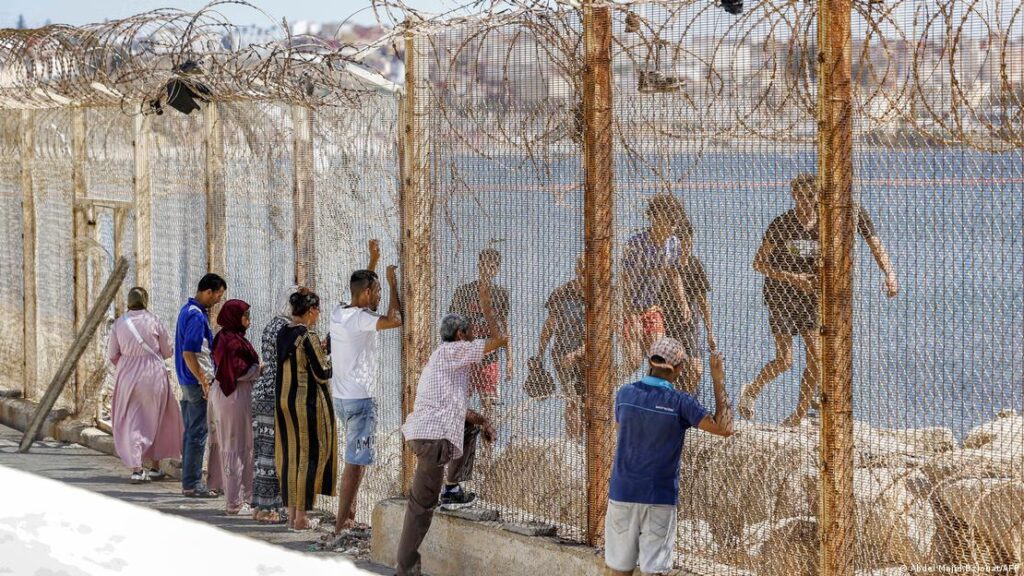
The migration pressure around Ceuta is no longer simply a border-management issue. What is unfolding in and around Fnideq, the Moroccan city facing the Spanish enclave, is a convergence of economic frustration, digital mobilisation, irregular migration, humanitarian vulnerability and European border politics. The events of late July and mid-August 2026 reveal how quickly a local crisis can escalate when thousands of people believe that a narrow geographic opening may provide access to a radically different future. The July 30 mass crossing attempt was extraordinary in scale. According to the material provided, an estimated 72,000 people crossed from Morocco into Ceuta, while around 100 people died. Most of those who entered the Spanish enclave later returned to Morocco, though several thousand are believed to remain in Ceuta under difficult conditions. The sheer size of the movement transformed Fnideq from a border city into a temporary staging ground for people arriving from other parts of Morocco in the hope of following the same route.
The significance of the episode lies not only in the number of people involved, but in what drew them there. Many were not responding to organised smuggling networks in the traditional sense. Instead, they were reacting to information, videos and rumours circulating online. Social media effectively created a new kind of migration infrastructure, one based on collective perception rather than central organisation. A widely circulated video showing people successfully crossing a border can create the impression that an opportunity exists and may disappear quickly. The result is a self-reinforcing movement in which people travel because they believe many others are travelling too. Moroccan media analyst Ahmed al-Dafri described this phenomenon as a form of digital mobilisation without a single leader or central authority. That distinction matters because it makes such movements significantly more difficult for governments to anticipate and disrupt.
Traditional border-control strategies often focus on organised smuggling groups, known routes and identifiable networks. Digital mobilisation behaves differently. A message can reach tens of thousands of people almost instantly, a rumour can become operational information, and a successful crossing can become proof that the border is temporarily penetrable. Individuals who might never have considered travelling may suddenly experience a sense that they are being left behind. This psychological dimension helps explain why people continued arriving in Fnideq even after evidence emerged that the July crossing had produced tragedy rather than easy access to Europe. Most of those who crossed returned to Morocco, many of those who remained were reportedly sleeping on beaches while waiting for Spanish authorities to determine their future, and yet rumours of another crossing in August still drew people from across the country.
That apparent contradiction is central to understanding irregular migration. People do not necessarily calculate risk in the same way when they perceive their current situation as intolerable. For Malika, the mother of two interviewed in Fnideq, migration was not described primarily as an economic calculation. It was presented as an escape from what she regarded as total social collapse: homelessness, unemployment, family instability and inability to provide food for her children. Her belief that reaching Ceuta would produce support and educational opportunities for her children illustrates how European territory can acquire symbolic meaning far beyond the actual conditions migrants encounter after arrival. Ceuta becomes not merely a place but an imagined solution. That gap between expectation and reality is one of the engines of irregular migration.
The image of Europe circulating online often emphasises social services, employment and personal freedom. The difficulties of asylum procedures, homelessness, legal uncertainty, possible detention and eventual return receive considerably less attention. When thousands of people begin moving at once, individual expectations can become collective momentum. This is why simply publicising the dangers of migration often has limited impact. Those warnings compete with visible examples of people who appear to have crossed successfully, however temporary that success may prove.
The August mobilisation demonstrates how authorities have responded to this challenge. After rumours circulated about another coordinated attempt on August 15, Moroccan authorities deployed a heavy security presence around Ceuta and Melilla. Checkpoints, patrol boats and water cannons were positioned near the border, while police arrested more than 100 people attempting to enter Ceuta. The expected mass crossing did not materialise. From a border-security perspective, that response was effective. From a migration-policy perspective, however, it addressed the symptom rather than the source. The people who travelled to Fnideq did not disappear because the border became harder to cross. They remained in Morocco with the same economic and social conditions that encouraged them to leave.
That distinction is critical. Europe and Morocco can strengthen fences, expand patrols and increase surveillance. These measures can reduce crossings at specific locations, but they cannot eliminate migration pressure if the underlying motivation remains unchanged. The case of 22-year-old Ahmed Amhid illustrates this structural dimension. He travelled from central Morocco because he believed his hometown offered no meaningful employment or future. His complaint was not framed around persecution or political conflict but around economic hopelessness. This reflects a broader pattern in which young people may confront unemployment, underemployment and limited opportunities for upward mobility even when the national economy continues to grow.
This produces a particularly difficult type of migration pressure. Economic migrants may not meet asylum criteria, yet their decision to move can still be driven by genuine desperation. Europe’s migration system therefore encounters people whose circumstances may be serious without fitting neatly into conventional categories of refugee protection. Morocco confronts the other side of the same problem. The country functions simultaneously as a state of origin, a transit country and increasingly a destination for migrants from elsewhere in Africa. Fnideq demonstrates how those roles can overlap geographically.
The city itself is being transformed. It was historically associated with proximity to Ceuta and cross-border economic activity, but local civil-society representatives now describe migration as becoming part of its identity. This transformation carries local consequences. People arriving temporarily require food, shelter and services. Public spaces become informal accommodation. Security increases. Tourism can decline. Local residents begin associating the city with migration pressure rather than commercial activity. The result is that a border crisis produces economic and social effects on the communities expected to manage it.
This helps explain why some Fnideq residents emphasised economic revival rather than migration control alone. Local traders described declining tourism and stalled development projects. Their argument implicitly challenges the assumption that the migration crisis can be resolved solely through policing. If border communities possess stronger economies, the incentive to leave can weaken while the capacity to absorb temporary migration pressure improves. This does not mean economic development automatically ends irregular migration, but long-term employment opportunities can alter the calculation for individuals who otherwise see migration as the only available route toward economic advancement.
The Ceuta episode therefore exposes the importance of local economic policy. Fnideq needs more than border infrastructure. It needs employment, investment and economic alternatives capable of generating predictable incomes outside seasonal commerce. Without those alternatives, the city risks remaining permanently caught between European border policy and Moroccan economic frustration.
There is also a deeper European dimension. Ceuta is Spanish territory located on the North African coast. This unusual geography turns the enclave into one of the clearest physical expressions of inequality between Europe and its southern neighbourhood. For someone standing in Fnideq, the European Union is not located across a continent. It is visible only a few kilometres away. That proximity changes migration psychology. People can see the border, see Spain and sometimes watch others cross. The distance therefore appears manageable even when the legal, social and political distance remains enormous. This is one reason Ceuta and Melilla repeatedly become focal points for mass crossing attempts.
For Spain, this creates a difficult security dilemma. Allowing uncontrolled mass entry is politically and administratively unsustainable. Yet aggressive border enforcement carries humanitarian and reputational risks, especially when large numbers of people attempt dangerous crossings simultaneously. Spain therefore depends heavily on Moroccan cooperation. This gives Rabat considerable strategic importance in European migration policy. Morocco is not merely a neighbouring country; it functions as one of Europe’s most important external border-security partners.
That relationship creates mutual dependence. European governments need Moroccan enforcement to limit irregular crossings. Morocco benefits from European economic cooperation, diplomatic engagement and development funding. Migration consequently becomes part of a broader political relationship involving trade, security and foreign policy. This creates leverage on both sides. Whenever migration pressure increases sharply, the border becomes more than a humanitarian issue. It becomes a diplomatic instrument.
The Ceuta crisis also reveals why European migration policy increasingly depends on countries outside the European Union. Physical borders can stop individual crossings but cannot manage migration routes extending hundreds or thousands of kilometres. European policy therefore increasingly seeks cooperation with origin and transit countries to disrupt smuggling, manage returns and reduce incentives for irregular migration before migrants reach EU territory. But this externalisation strategy carries political risk. If Europe’s migration control becomes excessively dependent on third countries, those governments can acquire significant bargaining power. A dispute involving trade, visas or diplomacy can potentially influence cooperation on migration.
There is also a humanitarian risk. Pressure to prevent departures can encourage harsh enforcement in transit countries, while individuals stranded before reaching Europe may lack adequate shelter or legal protection. The situation described in Fnideq demonstrates precisely this vulnerability. Some would-be migrants arrived expecting an opportunity to cross and instead became homeless in a city where they possessed few resources or support networks. They had not entered Europe, but they had also left the social structures of their home communities. They were effectively trapped between migration ambition and border enforcement.
Social media intensifies this problem because rumours can move considerably faster than humanitarian systems. Thousands of people can respond to a perceived opportunity within days. Authorities can deploy security forces rapidly, but social services cannot necessarily expand at the same speed. This creates temporary populations with almost no formal support. Future migration management will therefore need digital monitoring not simply for security purposes but for humanitarian preparedness. When authorities detect viral calls for mass movement, local municipalities and aid organisations may need to prepare for people who could arrive even if the border crossing itself never occurs.
The events in Fnideq also challenge a common political narrative surrounding irregular migration: not everyone wants to leave. Several local residents interviewed in the source material rejected the idea of migration despite acknowledging difficult economic conditions. They possessed businesses, families and social ties that made staying preferable to risking an uncertain journey. This is important because migration pressure should not be interpreted as evidence that entire societies have lost faith in their future. Migration decisions are highly individual. Two people experiencing similar economic conditions can make completely different choices depending on family responsibilities, risk tolerance, expectations and access to opportunities.
Policy therefore needs to avoid portraying migration either as irrational behaviour or as an inevitable consequence of poverty. It is a calculation shaped by perceived alternatives. The most effective long-term strategy is to expand those alternatives. For Morocco, this means employment, education, social protection and regional development. For Europe, it also means considering more credible legal migration channels alongside more efficient asylum and return systems. If the only visible route to Europe appears to be climbing a fence, swimming around a border or joining a mass crossing, irregular migration will continue to attract people willing to accept extraordinary risks.
The Ceuta episode is ultimately a story about inequality of expectations. On one side of the border, Europe represents security, education and opportunity. On the other, many people experience unemployment and uncertainty. A fence can separate those realities geographically, but it cannot prevent people from comparing them. Social media makes that comparison constant. A young Moroccan with a smartphone does not experience Europe only through television or stories from relatives abroad. European lifestyles, wages and opportunities can appear daily on the same screen used to organise migration attempts.
This produces a form of digital proximity that traditional border systems were never designed to manage. The July and August events therefore should not be dismissed as isolated surges. They represent a migration environment in which economic frustration, social media and geographical proximity can generate mass movement with remarkable speed. Europe and Morocco can prevent individual crossings, but the harder task is preventing desperation from repeatedly turning the border itself into a destination.
The deepest lesson from Fnideq is therefore not about the height of Ceuta’s fences or the number of police deployed along them. It is about the growing distance between people’s expectations for their lives and the opportunities they believe are available where they live. As long as that distance remains greater than the few kilometres separating Fnideq from Ceuta, the border will continue to attract people willing to risk almost everything to cross it.