More than 15 million internal files detail the powerhouse German bank’s actions and attitudes toward oligarchs, authoritarians and influential people
Frederik Obermaier, Bastian Obermayer, Khadija Sharife, Brian Fitzpatrick and Josy Joseph
When Christian Sewing became the chief executive of Deutsche Bank in 2018, after a string of scandals had tainted the international bank’s reputation, he promised that the institution would be different: more stable and “a bit more boring.”
The bank has since spent years trying to convince the world that its era of scandals is over.
But a leak of more than 15 million internal files to investigative journalists severely tests that narrative, laying bare a bank that built an enormous compliance machinery to ensure it was following its regulatory and standards obligations but repeatedly struggled to make it work.
Emails from senior executives. Secret risk assessments. Suspicious-transaction reports. Private information about billionaires, oligarchs, politicians and royalty. Records involving Jeffrey Epstein, businessmen sanctioned over ties to Russia, and even Donald Trump. Previously undisclosed companies linked to authoritarian regimes.
Together, they add up to the largest cache of internal documents ever leaked to journalists from within a bank.
The files show Deutsche Bank repeatedly missed warning signs of possible money laundering and sanctions violations. It bent its own rules for powerful clients. It allowed business considerations to override its own compliance regime. Sometimes, the bank only discovered serious failures years after suspicious money had passed through its systems.

For months, more than 200 reporters from around the world examined the huge cache as part of an investigation called Inside Deutsche Bank. The records span some of the bank’s most sensitive functions and activities: anti-financial crime, sanctions monitoring, internal auditing and the units responsible for deciding whether risky clients stay or go.
The bank operates across roughly 55 countries directly, including Canada, and more than 140 countries are reached by its correspondent banking network.
The leak of the documents, provided via two whistleblowers, was shared with Indian journalist Josy Joseph and South African journalist Khadija Sharife. Barracuda Media, a non-profit vehicle, was established to analyze the data and share it with reporters from more than 50 global media outlets spanning 46 countries, including the Investigative Journalism Bureau in Canada.
The whistleblowers, whose identities are being protected, say they copied the files and removed them from the institution. Besides giving them to Joseph and Sharife, they also provided material to the U.S. Department of Justice, the U.S. Financial Crimes Enforcement Network, and the U.K.’s HM Revenue and Customs, their lawyer said. It is not known what action those agencies have taken.
It is evident that the whistleblowers wanted to expose Deutsche Bank’s relationships with both Russian oligarchs and Russian money.
“We are deeply committed to serving the public interest,” they said in a statement. They said the public has a right to know about the bank’s misconduct and its extensive banking of oligarchs. According to one of the whistleblowers, they believed the files contained potential criminal misconduct regarding business relationships with corrupt regimes.
The files also expose the intimate financial information of well-known or extremely powerful people.
Bank ‘regrets’ Epstein connection
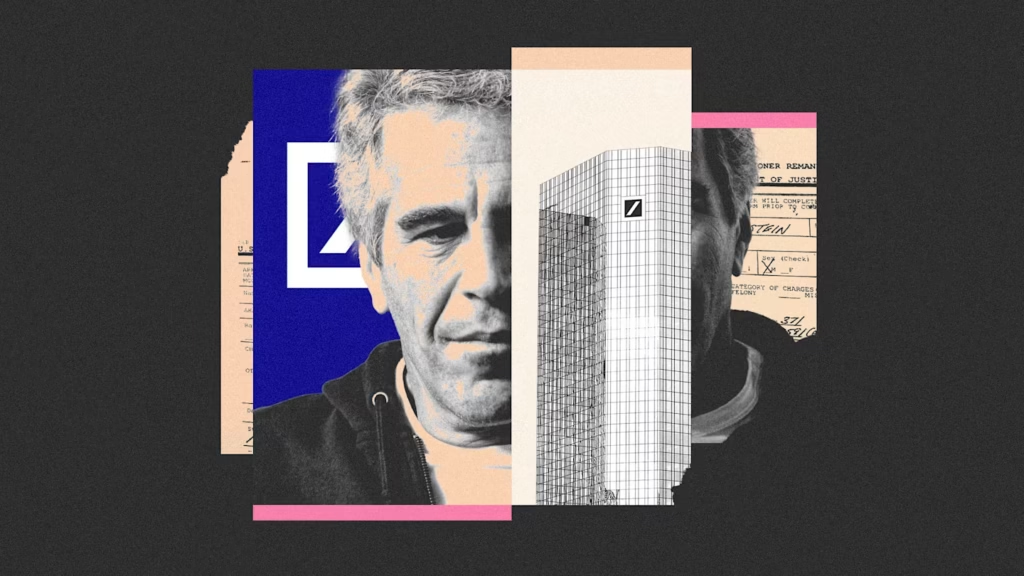
Deutsche Bank accepted Epstein as a client in 2013, years after his conviction for soliciting prostitution from a minor. The leak shows the bank later identified more than US$600 million in suspicious transactions involving him and his network — more than twice the amount previously publicly known.
The leak also holds extensive details on alleged Vladimir Putin-allied oligarchs such as Oleg Deripaska and Roman Abramovich.
Deutsche Bank’s clients included a company whose ultimate beneficial owner was a Saudi businessman named on the famous “Golden Chain” list of purported sponsors of al-Qaida, discovered in 2002 during an anti-terrorism raid in Bosnia and Herzegovina. And as a third-party correspondent bank, Deutsche Bank helped process payments linked to the late Rifaat al-Assad, Syria’s former vice-president known as the Butcher of Hama for his role in a bloody 1982 crackdown in the Syrian city.
In 2015, despite mounting adverse media reports and its own suspicious activity reports, or SARs, surrounding Jho Low, Deutsche Bank continued to process millions in transfers linked to the Malaysian financier.

Low is a central figure in the 1MDB scandal in which more than US$4.5 billion was allegedly stolen from Malaysia’s state investment fund and laundered through global banks. Deutsche Bank’s Malaysian entity Deutsche Bank (Malaysia) Berhad is now being sued in a civil claim by 1MDB over its alleged role in moving part of these funds.
In a statement on 1MDB, Deutsche Bank said: “Deutsche Bank has not been subject to any regulatory penalty or sanction arising from 1MDB.” It said 1MDB had made “material misrepresentations and omissions to Deutsche Bank officials” in connection with 1MDB’s transactions with the Bank, and said the bank “has cooperated fully with regulatory and law enforcement authorities in relation to inquiries concerning 1MDB.”
It added: “Allegations made by 1MDB in Malaysian civil proceedings concern a different Deutsche Bank entity. We reject any attempt to conflate separate matters.”
On the al-Assad payments, Deutsche Bank said:
“This matter has been resolved in 2022, as publicly disclosed. In the investigation proceedings of the public prosecutor’s office in Frankfurt in connection with two suspicious activity reports (SAR) filed by Deutsche Bank in the correspondent banking business, the bank accepted a fine of € 7.01 million. The administrative penalty notice contains the allegations that the SARs were submitted too late because they should have been made in 2017 already. The bank cooperated in the proceedings.”
Deutsche Bank did not respond to questions about the individual on the Golden Chain list. The individual, who is identified in bank files only by his initials, was identified by reporters but did not respond to a request for comment.
Deripaska, who has previously rejected accusations of wrongdoing and rejected the oligarch label, did not respond to requests for comment.
A law firm representing Abramovich told reporters it is “not for our client to comment on Deutsche Bank’s internal processes and decisions.”
“To the extent those internal processes documented unfounded speculation concerning our client, he rejects that speculation,” they added. “He denies any allegation or suggestion of wrongdoing, including any allegation of criminal conduct, corruption or impropriety.”
Abramovich has also previously rejected being characterized as an oligarch.
Low could not be reached for comment, but has previously denied wrongdoing. The bank said: “We do not comment on potential, former or existing client relationships.”

On Epstein, the bank said it “acknowledges its error of onboarding Epstein in 2013 and regrets our historical connection with him. We have cooperated with regulatory and law enforcement agencies and the U.S. Congress regarding their investigations and have been transparent in addressing these matters in parallel.”
Deutsche Bank said that numerous findings relayed to it by the project’s reporters are “based on a misleadingly incomplete selection of data or on a misinterpretation of information taken out of context …”
In response to the wide range of topics raised in the leak, Deutsche Bank said matters raised by reporters “date back many years, in some cases decades.” Where relevant, the bank said, these matters were reviewed at the time and were discussed with regulators and competent authorities as necessary.
“We are a different bank today,” the bank added. “Under Christian Sewing’s leadership, Deutsche Bank has gone through a fundamental transformation.”
The bank said it had invested seven billion euros in its financial and regulatory control environment between 2019 and 2025, supported by significant technology investments.
“These investments have been accompanied by a reinforced approach to identify and manage risks and a fundamental shift in culture. This work has supported the remediation of legacy issues and the completion of significant regulatory milestones.”
“Our progress has been recognized by the market, key regulators and supervisory authorities, as well as clients and other stakeholders. We remain committed to ensuring continuous enhancements of our control environment and a culture of integrity.”
Internal probe flagged firms for money laundering, organized crime
The files hold the secrets a major global bank is meant to keep confidential. Now, those secrets are out.
Deutsche Bank has paid more than 20 billion euros in fines and settlements since the year 2000 over identified failures related to mortgage securities, interest-rate manipulation, Russian mirror trades, anti-money-laundering failures, and other misconduct.
Though the bank told reporters it is a “different bank today,” the leaked files show it has not become “boring” as Sewing promised when he took the helm.
In one case never before made public, the leak shows that in 2019 employees found what they believed to be a sprawling money laundering network that had moved hundreds of millions of euros, using the bank’s systems, through companies in Cyprus, Britain, Hong Kong and Ukraine.
The bank’s monitoring systems had detected pieces of the puzzle, but missed the big picture. It took roughly three years before one employee spotted the pattern, leading a manager to joke that the bank had found another “employee of the month.” The manager soon made a more important observation: “Our systems explicitly failed to detect it.”
In a response, the bank said it “takes its anti-financial crime and sanction-related obligations extremely seriously.” It said it “reviews potentially unusual activity, reports matters to the relevant authorities where required, and cooperates with lawful requests for information.”
In Colombia the bank’s own internal investigation, dubbed Project Cali, showed that in 2019 it had processed thousands of transactions for companies linked to the adult entertainment business. The money had been sent to women in Colombia through suspicious paths without the bank reporting most of the transactions to authorities.
The internal investigation flagged at least eight companies for “money laundering,” and another as “organised crime.” When the bank finally spotted the red flags it had missed across 2019, it filed 230 SARs and prohibited all payments from those companies. By that point, millions had already been transacted.

In a response on Project Cali, Deutsche Bank said it was “a historical review that led to specific remediation measures and a broader reassessment of financial-crime risks across Deutsche Bank’s correspondent- banking portfolio.”
“Decisions on suspicious-activity reporting are governed by jurisdiction-specific legal and confidentiality requirements, and we therefore cannot comment on individual reports, transactions, entities or counterparties.”
Reporters also found that beginning in 2015 Deutsche Bank facilitated transactions worth hundreds of millions of dollars involving the Singapore-based commodities trader Xangbo group without spotting, or acting on, warning signs of suspicious activity.
These included transactions, made via Deutsche Bank’s Singapore branch, between Deutsche Bank’s Xangbo group clients and three companies accused of laundering alleged kickbacks for the Gupta brothers, Indian-born businessmen who have been accused in massive corruption and state capture in South Africa.
The Gupta-linked companies were allowed to move about US$675 million between December 2012 and January 2017 through the Xangbo network, continuing even as South Africa erupted in public protests over the scandal that implicated the brothers. Of these movements, 30 pairs of transactions totalling US$167 million were carried out across multiple accounts, often being done within a day.
It took an external whistleblower’s December 2019 allegations about unrelated, allegedly fraudulent activity in Singapore and elsewhere to finally nudge Deutsche Bank to further examine Xangbo’s transactions in more depth. Even then, records show the bank did not begin the process of exiting its relationship with Xangbo until 2021. Records further show the bank decided there were “no reasonable grounds” to file a report about a suite of convoluted transactions involving Xangbo.

In a response, Xangbo told reporters its accounts at the bank were not closed because of any dealings the group had with the Gupta-linked companies. “That is absolutely false,” a spokesperson said, adding that Deutsche Bank “continued to be our prime broker till 2022.”
The Guptas did not respond to a request for comment. They have previously said allegations against them are politically motivated.
In a response, Deutsche Bank said reporters’ findings on its dealings with Xangbo contained “several inaccuracies.” It said that, “consistent with its legal obligations,” it could not elaborate but “takes its financial crime risk obligations seriously.”
Meanwhile, reporters found that transactions involving suspected North Korean front companies went undetected even though some payment information contained the words “North Korea.”
“As a matter of policy, Deutsche Bank restricted dealing with North Korea and engaged with law enforcement and our regulators, as required,” the bank told reporters.
Client policies ‘breaking the back of our revenue’
Sometimes, reporters found, the problem wasn’t incompetence — it appeared to be the bank’s appetite for business.
In one leaked email, Sewing, who was then a member of the management board, complained that know-your-customer or KYC rules — the basic requirement that banks understand who their clients are, and where their money comes from — were affecting the bottom line. “KYC bricht uns das revenue Genick,” he wrote. In English, “KYC is breaking the back of our revenue.”
In a response, the bank said it strongly rejects what it called “false insinuations” about Sewing’s “alleged attitude.”
It added: “Christian Sewing always emphasized that controls and risk management must be taken seriously and set as boundaries for the business. His focus on strong controls and risk management builds on a career during which he worked across all three lines of defense, spending the majority of the time in control functions.”

A recurring tension runs through the leak: People charged with controlling risk were repeatedly met with people paid to generate revenue. Amid this clash, powerful customers often had room to manoeuvre.
Take Timur Kulibayev, the billionaire son-in-law of Kazakhstan’s former president. Files show the bank acknowledging “historical concern as to the legitimacy of (Kulibayev’s) original source of wealth.”
In internal documents which identify Kulibayev as a bank “client” since as far back as 2006, it is also pointed out that in 2013, a risk analysis commissioned by the bank on Kulibayev had “highlighted a number of corruption allegations” stretching back to the early 2000s.
The bank’s anti-financial-crime department noted that he had not been convicted of corruption, and that one of his companies had provided evidence to show that criminal investigations into him in Europe had been dropped.
Yet after Kulibayev provided insufficient explanation for a January 2020 “inflow” of US$15 million into his account from a United Arab Emirates account, files show Deutsche Bank blocked the incoming funds.
Records indicate that weeks later, employees began the process of opening a Deutsche Bank account in Luxembourg under his wife’s name. Only months after that point did the bank discuss the possibility of ending the long relationship.
Kulibayev, via his law firm, denied any wrongdoing. The law firm said the bank had been made aware of his sources of income, which derived primarily from a joint ownership, with his wife, of the investment firm Almex and its shareholding in Halyk Bank of Kazakhstan.
A statement added: “Any suggestion therefore that Mr Kulibayev (or individuals working for him) concealed his source of wealth from Deutsche Bank, or knowingly provided false or misleading information about it, is categorically false.”

The law firm said their client was unable to identify the US$15 million transaction in question from their own records, based on the information provided by reporters. It added that any suggestion Kulibayev had personally banked with Deutsche Bank in the mid-2000s was false, and he “did not open a personal account until many years later.” It said reporters were appearing to “conflate the distinct personal and corporate banking relationships maintained by Mr Kulibayev and his businesses.”
Deutsche Bank said it does “not comment on actual, potential or former client relationships.”
Elsewhere, the bank can be seen choosing not to conduct a formal sanctions-risk review for subsidiaries of Bombardier, the Canadian aerospace and defence company, despite internal references to Bombardier’s doing business in “special risk” countries. The justification given for the decision to instead perform an “informal” review included Deutsche Bank’s long relationship with the company. Bombardier revenues from these high-risk countries, it was pointed out, were low.
Bombardier did not respond to a request for comment.
The leak also exposes the flexibility of the bank’s hiring processes.
It recruited the children of influential politicians, executives and government officials, including applicants who failed aptitude tests or lacked qualifications. Alexey Storchak, the son of Russia’s deputy finance minister, was hired in 2010 and subsequently supplied colleagues with non-public information surrounding a bond issuance. As a result, files show Deutsche Bank itself subsequently investigated whether the bank itself should have ever possessed such information.
In 2019, the bank paid US$16.1 million in a settlement after the U.S. Securities and Exchange Commission investigated its hiring program. An internal calculation contained in the leak found that the bank generated roughly US$190 million in revenues from transactions linked to the hiring of relatives of foreign government officials.
Storchak did not respond to a request for comment.
‘Good and bad oligarchs’
Russia, and the bank’s dealings with it, were among the whistleblowers’ primary concerns when contacting reporters with their information.
After Putin annexed Crimea in 2014, Western sanctions forced banks to decide which Russian clients were still palatable. “We started making lists,” a former Deutsche Bank insider told reporters. “Good and bad oligarchs.”
The leaked documents show the bank repeatedly facilitating sanctioned or politically exposed Russians, and remaining reluctant to fully abandon its long Russian entanglement. Documents show that by May 2020, with expansion of certain Russian business being planned by bank leaders, the move was described by one anti-financial-crime specialist as akin to throwing her team in front of a train.
Russia has continued to haunt the bank.
Early this year, German investigators searched Deutsche Bank’s Frankfurt headquarters. Police and Deutsche Bank have not confirmed who was being investigated but a source close to the case told IJB partner paper trail media the raid was conducted over concerns about money the bank had allegedly transferred for Abramovich just days before the Ukraine invasion. The figure involved was several billion euros, the source said.
In their response, the law firm for Abramovich said that it had been instructed to say German authorities had “confirmed to our client that he is not under investigation in connection with the search of Deutsche Bank’s premises by the German Federal Criminal Police Office in January 2026.”
“Neither the German authorities nor Deutsche Bank has referred to our client (whether directly or indirectly) in any public statement about the searches, or indicated that any allegation is being made against him.”
Through correspondent banking, the invisible plumbing of global finance, Deutsche Bank moves money for other banks, giving them access to euros, dollars and international markets. It is lucrative and exceptionally difficult to police, and the underlying customers may be several steps removed from Deutsche Bank itself. Criminals, sanctioned entities and shell companies can disappear inside millions of ostensibly legitimate transactions.

Can a bank reliably identify money laundering, drug trafficking and human smuggling within such a system?
“No,” said Ulrich Göres, former head of Deutsche Bank’s anti-financial crime department. Why do banks do it? “For banking for high risk countries, and for high risk industries generally, higher fees can be charged.”
In one of its biggest scandals to date, Deutsche Bank was a major correspondent bank for Danske Bank’s Estonian branch. Roughly 200 billion euros flowed through Danske Bank’s Estonian branch between 2007 and 2015, much of it involving customers from Russia and other former Soviet states. Deutsche Bank helped process international payments for the branch as a correspondent bank.
While German authorities concluded there was no evidence of criminal misconduct on the part of the bank, they levied an administrative fine of 13.5 million euros against Deutsche Bank, in connection with the affair. Such penalties are a weak deterrent, Göres said, unless the penalty payments exceed the income generated previously.
In a response, Danske Bank said:
“The money laundering case was clearly very serious, and what happened during those years should never have happened. We expressed our regret at the time and have consistently done so since. The case was subject to extensive investigations by the bank and the relevant authorities, and in 2022, the matter was concluded through coordinated resolutions with the Danish and U.S. authorities. Since then, Danske Bank has implemented fundamental changes across the bank and invested significantly in systems, capabilities and controls aimed at preventing and detecting financial crime.
On correspondent banking, Deutsche Bank said:
“Over the past decade, Deutsche Bank has substantially reduced its risk profile in this business, including exiting high-risk clients and countries. At the same time the bank has materially strengthened its financial crime controls and expertise … to manage the inherently elevated financial-crime risk in correspondent banking through significant investments.”
Trump bank data allegedly leaked
When Trump won his first presidential term on Nov. 8, 2016, Deutsche Bank faced an almost unprecedented situation: the president-elect was also one of its most controversial borrowers. The bank created a special project around him, codenamed “Novus Ordo.” New Order.
Trump-related documents were secured. Access was restricted. Communications were encrypted. Personal contacts minimized. But there was a larger problem: Trump and his businesses still wanted things from Deutsche Bank, like changes to existing loans.
The relationship had already gone spectacularly wrong once. After Trump failed to repay a loan for his Chicago tower during the financial crisis, claiming he was not required to because the financial crisis was an unforeseen event, he sued Deutsche Bank for US$3 billion, essentially blaming it for a crisis that had damaged his business (the case was settled before trial). Deutsche Bank continued doing business with him.
Trump did not respond to requests for comment.
Reporters found that by 2017, with Trump well into his first term, a Deutsche Bank employee accidentally sent an outside party a link containing financial information for 1,586 customers. Three accounts allegedly belonged to the newly-inaugurated president; these were called “DT” and “DJT” internally.
Managers debated whether Trump had to be informed of the leak, but concluded he did not. One manager called it a “brilliant outcome.” Sewing approved the case’s handling with a simple, “Ok.”

Trump did not respond to a request for comment.
The Inside Deutsche Bank leak comes at a particularly sensitive time for an institution already under heightened scrutiny. This year alone, its offices have been raided at least four times by authorities, and the bank has reportedly filed several self-disclosures with authorities.
Amid this mounting pressure, the leak offers an unprecedented glimpse into what has been going on behind closed doors. Trump. Epstein. Deripaska. Abramovich. Jho Low. The list of major names, and global corporations, in the leak is enormous.
The bank itself had anticipated the danger.
After a much smaller incident involving misdirected customer information in 2021, an employee warned that specialized law firms might see a potential business model in suing the bank over data breaches. Soon, the employee predicted, customers would be able to find standard legal claims online and copy them “1:1”.
The Inside Deutsche Bank leak is of an entirely different magnitude.
Again and again, the files show the same sequence: a warning appears, compliance teams raise concerns, executives debate risk, and the bank finds a reason to continue. Sometimes the client was an oligarch. Sometimes the business involved a sanctioned market or a lucrative energy project. Sometimes, the bank’s systems simply failed to notice what was happening at all.
With files from: Sophia Baumann (PTM), Maria Christoph (PTM), Eva Jung (Berlinske), Michael Lund (Berlinske), Maria Fernanda Cruz (Barracuda Media), Aidila Razak (Barracuda Media), Nikita Saxena (Confluence), Craig Bentley-McKune (Financial Mail), Vernon Wessels (Financial Mail), Cynthia O’Murchu (Financial Times), iStories, Hakan Tanriverdi (PTM), Lukas Kotkamp (Follow the Money), Naish Gawen (Data Desk), Maria Teresa Ronderos (CLIP), Francisca Skoknic (CLIP), Karina Shedrofsky (DARC), Vivian Yap (Malaysiakini), Nigel Aw (Malaysiakini), Aung Naing (Myanmar Now), Amy Doffegnies (Myanmar Now), Hala Nasreddine (DARAJ). The Inside Deutsche Bank investigation was coordinated by Barracuda Media in South Africa, with technical support from the Data and Research Center (DARC) in Germany.
The Investigative Journalism Bureau (IJB) at the University of Toronto’s Dalla Lana School of Public Health is a collaborative investigative newsroom supported by Postmedia that partners with academics, researchers and journalists while training the next generation of investigative reporters. Sign up for the IJB’s weekly newsletter here.